


Rechargeable Countdown Release Lock Module
August 14, 2026
Four-Bridge Floating-Cradle Wand with Offset Oval Head
August 14, 2026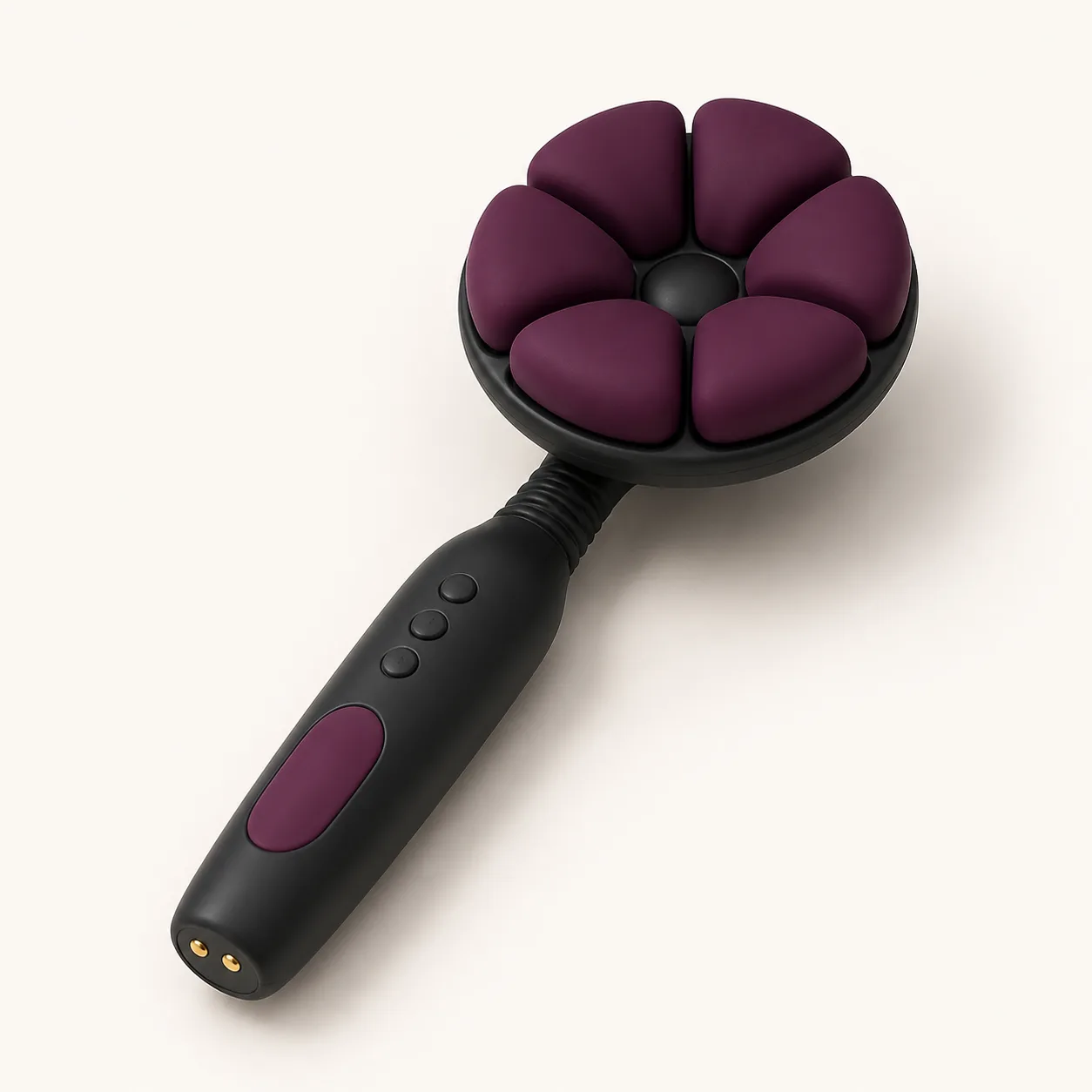
Six-Petal Radial-Flex Crown Wand with Recessed Center Dome
A rechargeable wand concept with six rounded flexible contact petals around a recessed center dome, guarded channels, a support ring and a flexible neck.
44,99 $
200 in stock
Six flexible petals surround a recessed center dome
This six petal crown wand concept replaces a conventional single dome with six thick rounded contact petals arranged around a smaller recessed center. A rigid outer support ring is intended to limit petal fold-under while the flexible neck separates head movement from the grip.

The image does not establish material, petal force, vibration output, waterproofing, runtime or safe load.
Inventory the crown as seven contact zones
Request drawings and a bill of materials for each of the six petals, center dome, petal roots, support ring, channel guards, head shell, motor, coupling, neck reinforcement, controller, battery, buttons, contacts, pigments, lubricants and adhesives.
Confirm whether all petals share one molded layer or have separate carriers, because root fatigue and cleaning access differ.
Measure petal geometry one position at a time
Record crown diameter, petal length, width, height, edge radius, root thickness, channel width and depth, center-dome height, support-ring clearance and head mass. Number test petals without marking customer samples.
Compare opposite petals and document molding variation rather than averaging six measurements.
Map individual petal deflection
Apply low controlled forces at the center, inner edge and outer edge of each petal on an instrumented fixture. Record travel, stiffness, lateral twist, recovery time and permanent set after unloading.
Reject a petal that folds beneath the ring, exposes a hard root or recovers differently from the rest of the crown.
Check the recessed dome under petal compression
Measure when the center dome first contacts a compliant surface as one, two and several petals deflect. Record dome pressure, head-shell movement and whether compressed petals rub the dome.
A recessed center should not become a hard concentrated point under ordinary approved contact load.
Inspect guarded channels for pinch and debris
Probe every channel from the petal tips to the roots with standardized soft film, hair and textile fixtures while flexing adjacent petals separately and together. Examine the support-ring junction and dome perimeter.
Reject closing gaps, sharp rims, exposed carriers or recesses that cannot be seen, wiped and dried.
Measure vibration across the complete crown
Use calibrated sensing at every petal tip, root, center dome, support ring, neck and grip for each supported setting. Record amplitude, frequency, phase, startup, transitions and battery-level changes.
Do not assume equal sensation from symmetrical-looking petals; coupling and root stiffness can create measurable variation.
Compare unloaded and compliant-contact operation
Run the head in free air and against a compliant fixture at several low verified loads. Record vibration loss, petal spread, dome engagement, motor current, sound and temperatures at the head, neck, handle and battery.
Define a safe contact envelope before publishing intensity or pressure claims.
Challenge the support ring without side levering
Apply capped axial and off-center loads to one petal and then opposite pairs while the device is off. Observe ring flex, head tilt, root exposure, neck bending and permanent change.
The ring is a fold limiter, not a pry point, handle, suspension feature or rated load-bearing frame.
Separate neck movement from petal movement
Measure neck bending force and recovery with the motor off, then repeat head vibration tests at several neck angles. Inspect the neck root for whitening, delamination, internal knocking and position-dependent heat.
Neck flex must not push the head shell into petal roots or narrow the guarded channels.
Audit controls, charging and fault behavior
Document button functions, press duration, lockout, setting memory, low-battery indication, contact polarity, cable specification, charger input, charge time, runtime and operation during charging.
Test startup under light compliant load, local overcurrent shutdown, restart behavior and temperature limits without obstructing the head by hand.
Cycle petals and the neck together
Run alternating petal-deflection, neck-bending and powered fixture cycles within documented limits. At intervals inspect petal roots, channels, dome, ring, head seam, neck, buttons and contacts.
Track stiffness, vibration balance, noise, temperature and setting stability as well as visible wear.
Verify every external and internal material
Obtain exact formulations for petals, dome, guards, ring, shell, buttons, neck layers, internal supports, coatings, pigments, lubricants and adhesives. Request restricted-substance, skin-contact, electrical and battery evidence for the ordered revision.
Silicone, body-safe, medical-grade, hypoallergenic, waterproof and submersible claims remain unconfirmed until exact-model evidence and sample tests support them.
Clean between all petals without forcing roots
Power the device off and wipe the petal faces, rounded edges, channels, roots, center dome, support ring, head seam, neck folds, controls and charging contacts by the confirmed method. Flex only within the documented care range.
Immersion, boiling, dishwasher use, alcohol, bleach, abrasive brushes and oil inside channels require explicit compatibility evidence. Dry channels and contacts fully before charging.
Price the segmented crown above a standard wand
An Alibaba rechargeable wand listing currently shows USD 15.00-15.90 with an MOQ of 100 pieces. It is a category benchmark only and does not confirm this six-petal crown, recessed dome or approved supplier.
The procurement reference supports an EUR 44.99 planning price after allowing for China-origin freight, seven-zone geometry, individual petal force mapping, channel pinch inspection, vibration balance, loaded operation, ring and neck tests, electrical and thermal review, material documentation, cleaning validation, protective packing and discreet fulfillment. Exact quotation, packed dimensions, weight, freight, duty, tax, insurance, payment fees and delivery terms remain pending.
Frequently asked questions
Do all six petals vibrate independently?
No independent motors are assumed; exact coupling and phase must be measured on the production sample.
Can a petal be folded beneath the ring?
No. Fold-under, hard-root exposure or persistent deformation indicates a fault.
When does the center dome make contact?
That depends on verified petal deflection and load; its engagement point must be mapped on a compliant fixture.
Is the support ring a handle?
No. Hold the designed grip and avoid levering or pulling the head ring.
Can the channels be scrubbed with a brush?
Only if the confirmed care instructions approve a specific soft tool and method.
Which faults require retirement?
A torn root, folded petal, enlarged channel, exposed hard part, loose ring, cracked dome, neck delamination, unusual heat, battery swelling, corrosion or residue beyond cleaning access.
Reviews
There are no reviews yet.