


Three-Length Center-Marked Bondage Rope Set
August 14, 2026
Four-Cuff Quick-Pull Bondage Restraint Set with Indexed Fit Tabs
August 14, 2026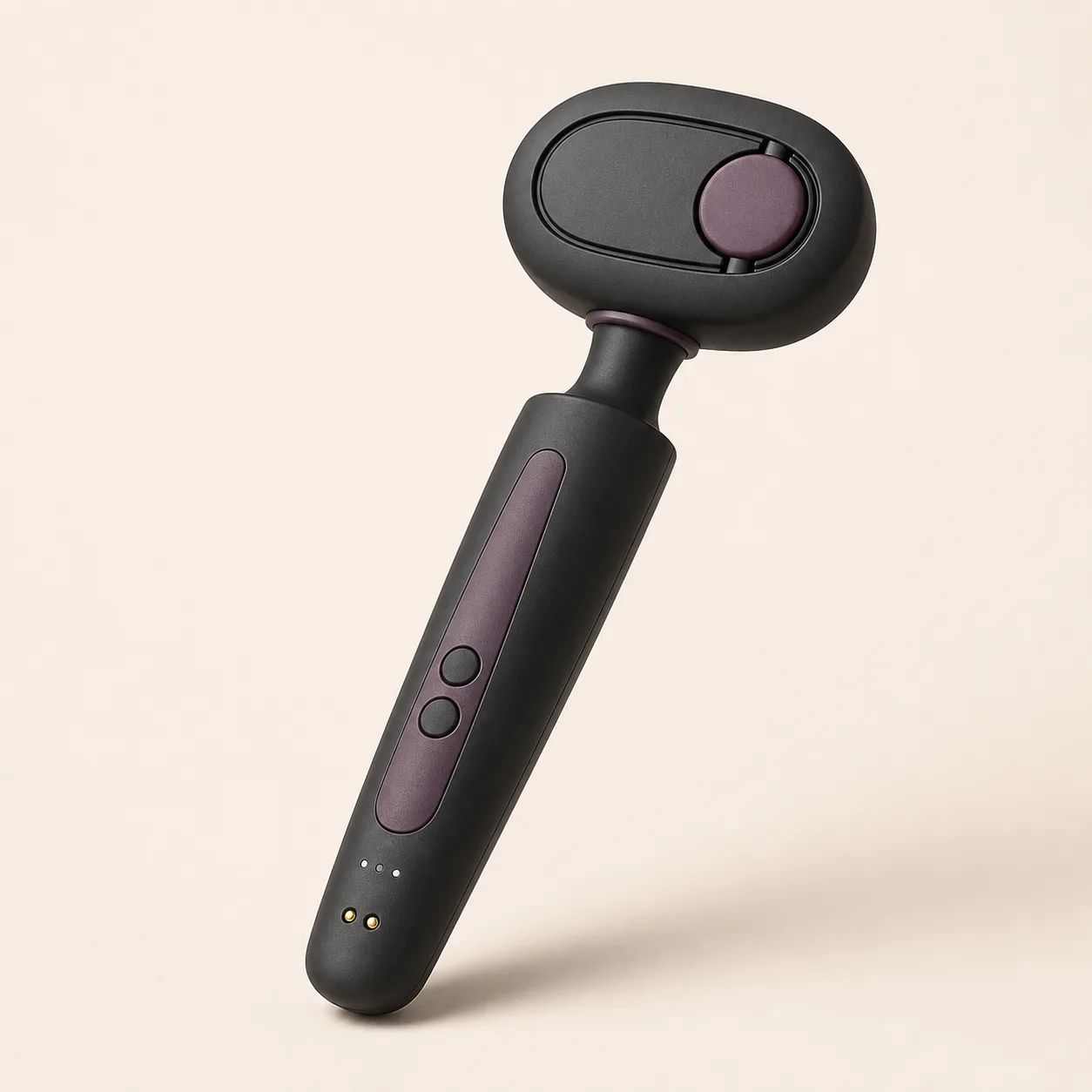
Offset Orbit-Track Wand Massager with Captive Floating Pod
A rechargeable wand concept with one broad oval head and an off-center captive contact pod for separately testable track travel, localized output and loaded carrier behavior.
44,99 $
200 in stock
Observe one pod within one closed head track
This orbit track wand massager concept places one plum contact pod inside a recessed oval path on a broad head. Two small guide bridges visually retain the pod, and an isolation collar separates the head from the rechargeable handle.

The image does not prove that the pod moves, the distance or speed of travel, motor count, output, waterproofing, runtime, material or approved contact location.
Inventory the track, bridges and carrier
Request an exploded drawing and bill of materials for the contact cap, pod shell, carrier, guide rollers or sliders, closed track, two guide bridges, end clearances, fasteners, head frame, isolation collar, neck core, handle shell, actuator, controller, battery, buttons, indicators, charging contacts, pigments, seals, lubricants and adhesives.
Trace power and signal paths through the neck and into any moving carrier. A hidden flexible conductor can experience a different cycle load from the visible track.
Measure track geometry and pod envelope
Record head length, width and depth, track major and minor axes, channel width and depth, bridge span, pod diameter and height, cap curvature, edge radius, carrier clearance, neck offset and total mass.
Use sectional gauges or scanning to identify any narrow point where the pod or carrier can rub. Compare production samples against one common track datum.
Establish the neutral pod position
Mark the pod location before power, after each program and after a compliant load is removed. Measure angular position, lateral offset, head-face height and any drift during a fixed observation period.
If the pod is intended to park at one location, define a tolerance and verify that the carrier settles there without impact, chatter or manual assistance.
Map travel resistance around the loop
On a guarded fixture, move the carrier only through supplier-approved travel. Measure breakaway force, running force, speed, acceleration, direction change, dwell, play and sound at many points around the oval path.
Plot the readings by track position to expose bridge friction, tight curves, contamination sensitivity and a local stall that an average value could hide.
Test guide bridges and pod retention
Inspect both guide bridges for fastener security, flex, edge finish and clearance to the pod cap. Apply low calibrated upward, lateral and twisting inputs at several track positions while monitoring carrier lift and bridge strain.
Reject a sample if the pod can disengage, a bridge cracks, the cap contacts a sharp edge or the retention gap changes beyond the documented limit.
Characterize local output at the pod
Measure amplitude, frequency, startup, decay and surface temperature at the pod center and perimeter for every confirmed program and charge level. Repeat at multiple track positions.
Document whether output changes when the carrier passes beneath either guide bridge. Do not infer uniform performance from a single stationary reading.
Separate head resonance from pod output
Place synchronized sensors on the pod, track frame, outer head edge, neck and handle. Compare phase, amplitude and sound in free air so direct pod output can be distinguished from housing resonance.
A broad head may vibrate noticeably even when the moving contact element has lower output, which affects both performance claims and hand comfort.
Apply compliant load across orbit positions
Use a compliant instrumented surface and several verified low loads. Record contact area, pressure, pod height, carrier speed, path accuracy, vibration loss, current, sound and temperature at straight and curved sections.
Stop for pod stall, sudden release, carrier lift, hard collision, unexpected path change, rising current, unusual heat or an unstable head.
Measure neck strain and isolation
Instrument the collar and neck while the pod operates at different track positions and loads. Log bending, torsion, vibration transfer, shell movement and conductor strain.
Verify that the isolation collar does not loosen, cover a seam or allow the head to rotate relative to the controls. Its color does not prove a damping specification.
Study balance and grip control
Measure center of mass, handle pressure, slip, control reach and accidental button activation with the pod parked near both ends and both sides of the track. Include dry and lightly damp test gloves.
Confirm the moving mass cannot pull the wand out of a controlled grip at any approved orientation or program.
Audit programs, indicators and charging
Document every button sequence, program order, lockout, memory state, low-battery response and indicator meaning. Verify whether track motion and vibration can be selected separately or only together.
Confirm charger input, contact polarity, charge time, runtime, standby drain and operation during charging. Keep the device off and dry while charging unless exact-model instructions explicitly permit another condition.
Log current, sound and heat
Run the highest verified setting in free air and under compliant load. Record current and temperature at the pod, carrier, guide bridges, track curves, head frame, collar, neck, grip, controller, battery and charging contacts.
Check automatic shutdown and restart behavior after a guarded low-force obstruction test below confirmed limits.
Cycle the orbit system and clean it
Run repeated startup, full-path, direction-change, compliant-load, button, charge and cleaning cycles. At planned checkpoints inspect pod bond, carrier play, bridge clearance, track wear, lubricant migration, neck movement, output, current, sound and heat.
Obtain the exact cleaning method and ingress rating before wet care. Clean the pod edge, full track, bridge undersides, collar seam, buttons and contacts with approved tools, then dry all recesses fully.
Build price from track tolerances
An Alibaba rechargeable dual-sided wand listing currently shows USD 6.09-7.29 with an MOQ of one. It is a category benchmark only and does not confirm this orbit-track head, captive pod, guide bridges or an approved supplier.
The procurement reference supports an EUR 44.99 planning price after allowing for China-origin freight, complete part inventory, track metrology, neutral-position and travel maps, bridge retention, per-position output, resonance separation, compliant-load testing, neck strain, balance, electrical and thermal review, cycle life, material and battery evidence, cleaning validation, protective packing and discreet fulfillment. Exact quotation, packed dimensions, weight, freight, duty, tax, insurance, payment fees and delivery terms remain pending.
Frequently asked questions
Does the pod complete a full orbit?
That remains unconfirmed until a production sample is mapped through every approved program.
Can the pod be removed?
The concept shows a captive carrier; any service procedure and retention limit require exact-model documentation.
Do vibration and track motion work separately?
Control mapping is pending, so each available combination must be documented and tested.
Is the broad head waterproof?
No ingress rating is assumed; keep track recesses and charging contacts away from water until verified.
How should the track be cleaned?
Use only the supplier-approved method and tools after material compatibility and drying access are confirmed.
Which faults require immediate retirement?
A loose bridge, lifted pod, rough track, carrier stall, cracked neck, exposed conductor, unstable control, unusual sound, heat, swelling or corrosion.
Reviews
There are no reviews yet.