


Twin-Hinge Figure-Eight Padded Wrist Restraint with Guarded Releases
August 14, 2026
White Lace-Bust Satin Spaghetti-Strap Nightdress with Blue Bows
August 14, 2026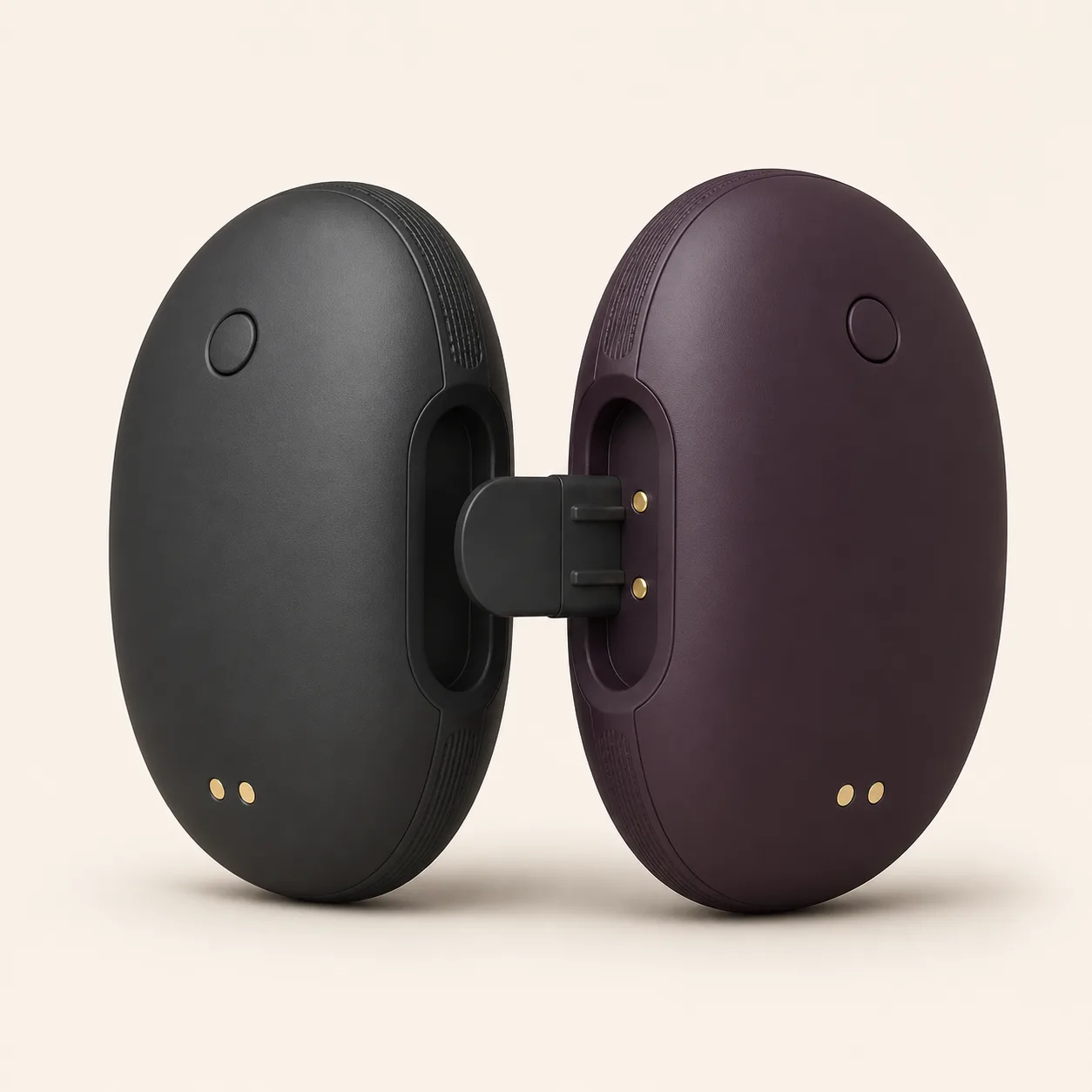
Polarity-Keyed Docking Pair Vibrators with Shared Sync Bridge
A coordinated two-pebble couples vibrator concept with separate local controls and a polarity-keyed bridge designed to synchronize the pair when docked.
46,99 $
200 in stock
Two compact vibrators join through one keyed bridge
This docking pair vibrator concept includes charcoal and deep-plum pebble units that work separately or face one another around a short shared sync bridge. Offset rails prevent the connector from seating in the wrong orientation, while recessed bays protect the joined profile.

The bridge is proposed to coordinate patterns when docked; it is not a remote control, charger or structural handle.
Identify both units and every bridge interface
Confirm pebble A, pebble B, the shared bridge, local buttons, charging contacts, docking contacts, guide rails, bay liners and perimeter grip ridges. Request details of hidden magnets, latches, seals, springs, fasteners, antennas and adhesives.
Each component needs a durable identifier that does not rely only on color.
Measure the separate and joined configurations
Record each pebble’s length, width, thickness, mass, edge radius, contact area and button position. Measure bay depth, rail spacing, bridge projection, joined thickness, alignment offset and the gap between the two housings.
The joined assembly must not create an untested clamp or narrow pinch slot.
Prove the polarity key prevents forced misassembly
Attempt insertion at every plausible orientation using a written low-force limit. Document where the offset guides reject an incorrect approach and whether a user can still damage contacts by twisting or pushing diagonally.
Never force the bridge, widen a bay or file a guide rail to make mismatched parts fit.
Test bridge capture without treating it as a handle
Join the unpowered pebbles on a padded fixture and apply controlled axial pull, shear, twist and light shake tests below supplier limits. Recheck latch or magnetic retention, contact alignment and surface flushness.
Separation, rattle, bridge creep, cracked rails or exposed hard edges fails qualification.
Map contact pressure and pinch gaps while docking
Use pressure film and feeler gauges around the bays as the pair closes. Measure the smallest opening at the bridge ends and confirm that fingers, hair and fabric can stay clear during connection and separation.
Dock only on a stable surface with both motors switched off.
Verify synchronization as a defined state machine
Test power-up with the units apart, connection while off, coordinated start, pattern change, local override, bridge removal and full shutdown. Record which device leads, whether settings match and what each motor does after contact loss.
Unexpected restarting, uncontrolled escalation or a unit that cannot stop locally is unacceptable.
Challenge contact bounce and partial seating
Use a fixture to hold the bridge at full seat, shallow seat and a controlled micro-gap while monitoring commands. Repeat after clean-and-dry cycles and low-amplitude vibration exposure.
A partial connection must fail safely instead of sending erratic commands or heating the contacts.
Compare both motors before the pair is shared
Map amplitude, frequency, sound and surface temperature for every verified setting on each pebble separately. Then dock the pair and compare phase behavior, output matching, battery draw and vibration transfer through the bridge.
Matching labels do not prove matched output; both serial-numbered units require measurements.
Keep independent local shutdown available
Confirm that either pebble can be stopped at its own button in separate and docked modes. Measure press force, long-press timing, lockout behavior and restart state after an interrupted connection.
Both partners should know which button controls each unit before use begins.
Use the pebbles externally and communicate changes
The proposed contact faces are for external use only. Begin with separate units at the lowest verified setting, communicate before docking or changing patterns, and keep control of both local buttons.
Stop for pain, numbness, irritation, excessive heat, unexpected output, loss of control, bridge movement or discomfort with the joined gap.
Charge the two batteries as independent systems
Request cell chemistry, capacity, charge input, cable specification, charge time, runtime and protection circuitry for each serial-numbered pebble. Log whether one unit reaches low battery or thermal shutdown earlier than the other.
The sync bridge is not assumed to transfer charging power, and neither unit should be operated while charging unless exact instructions permit it.
Review materials, contacts and magnetic claims
Obtain composition for both outer surfaces, pigments, bay liners, bridge body, rails, contacts, seals, magnets and adhesives. Review corrosion, restricted-substance, skin-contact and electromagnetic evidence for the exact revision.
People with implanted or body-worn medical devices should follow professional device guidance and avoid unverified magnetic products.
Clean the bays before the pair is rejoined
Power off and separate the pebbles on a dry surface. Follow confirmed mild-cleaning instructions for contact faces, then use a soft swab around bay corners, guide rails and bridge edges without flooding unverified contacts.
Dry every recess and contact completely before docking, storage or charging; soaking, boiling, bleach, alcohol and abrasive tools are not approved without exact evidence.
Price the pair above a single compact reference
An Alibaba couples-vibrator showroom lists a compact rechargeable finger vibrator at USD 5.49-5.70 with a three-piece minimum. It is a category benchmark only and does not establish this two-pebble keyed docking set, a legal supplier or a production quotation.
The procurement reference supports an EUR 46.99 planning price after allowing for China-origin freight, exact paired-set quotation, identity marking, geometry, misassembly protection, bridge retention, pinch-gap testing, synchronization logic, partial-contact behavior, dual-motor output, battery and thermal validation, material and magnetic review, cleaning tests, protective packing and discreet fulfillment. Packed size, weight, freight, duty, tax, insurance, payment fees and destination terms require confirmation.
Frequently asked questions
Can each pebble operate by itself?
That is the proposed design, but separate controls, outputs and shutdown behavior need production-sample confirmation.
Does the bridge charge the pair?
No charging function is assumed; the visible bridge is proposed only for keyed docking and synchronization.
Can the connector be inserted either way?
No. Offset guide rails are intended to allow only the verified orientation without force.
What happens if the pair separates while running?
Both units should enter a documented safe state and remain locally stoppable, which must be verified before sale.
Are the two colors enough to identify users?
No. Add durable unit identifiers and keep cleaning responsibility clear for each serial-numbered pebble.
Which faults require retirement?
A loose bridge, cracked bay, bent rail, corroded contact, erratic synchronization, failed local stop, swelling, abnormal heat, split surface or trapped residue.

Reviews
There are no reviews yet.