



Split-Crescent Alternating-Rocker Wand Massager
August 14, 2026
Mirrored Twin-Pod Couples Vibrator Set with Dual-Well Charging Dock
August 14, 2026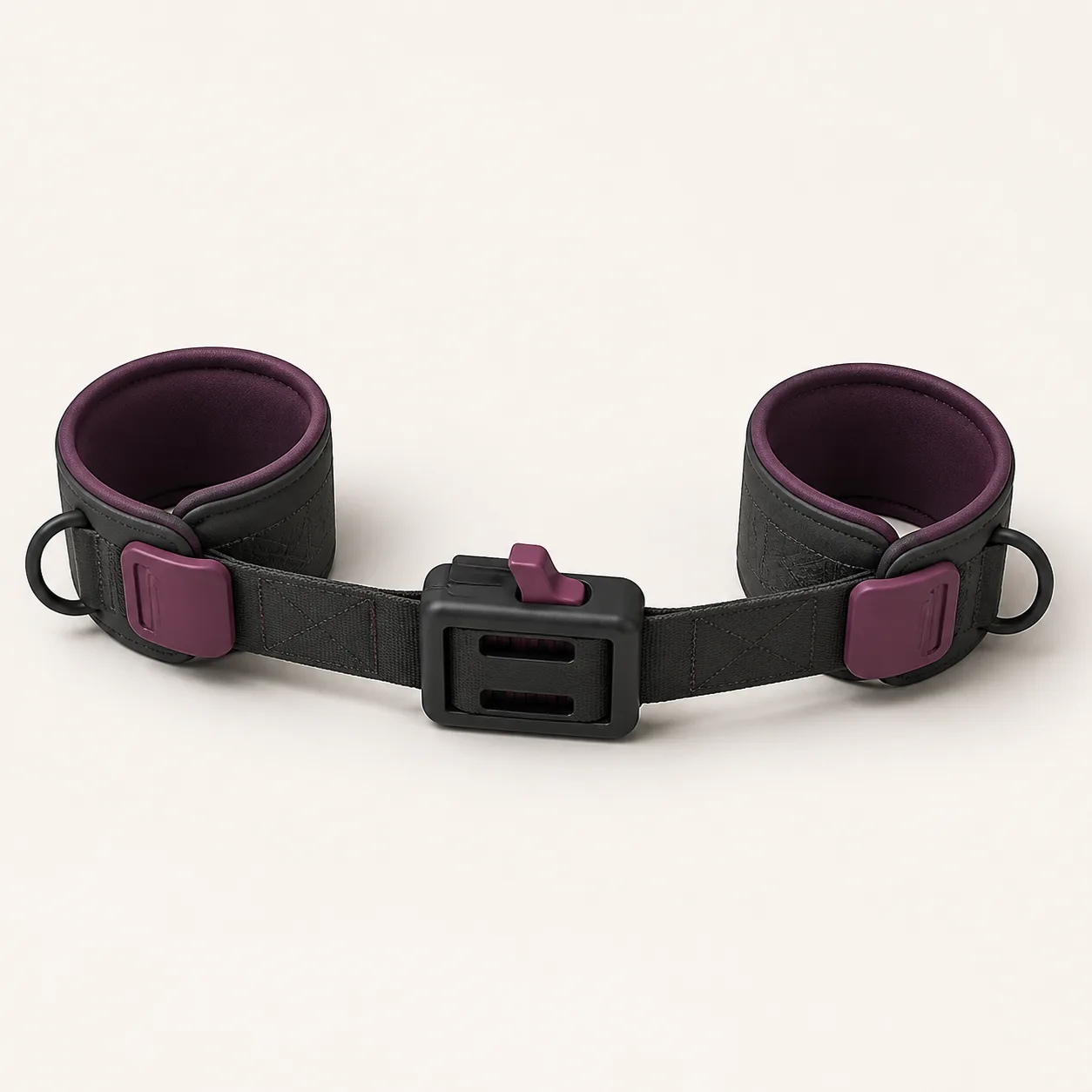
Twin-Scale Sliding Hobble Strap with Independent Ankle Cuffs
A non-powered BDSM hobble concept with two independently fitted padded ankle cuffs, one reinforced stride strap and a twin-window sliding travel limiter.
23,99 $
200 in stock
A sliding limiter sets the distance between two cuffs
This sliding hobble strap concept links two independently fitted padded ankle cuffs with one reinforced central strap. A floating carriage with two viewing windows is intended to set a measured maximum spacing, while separate plum releases keep each cuff accessible.

The image does not establish fit, stride range, load, release force, material or safe movement.
Inventory both cuffs and the limiter path
Request drawings and a bill of materials for shells, liners, padding, structural webbing, binding, thread, cuff closures, release tabs, stride strap, carriage, lever, latch, windows, end stops, D-rings, reinforcements, coatings, pigments and adhesives.
Confirm that the carriage cannot leave the strap during normal adjustment or after an end-stop impact.
Measure cuff geometry as a matched pair
Record flat and padded length, width, edge thickness, overlap, strap reserve, release reach, ring position and shortest and longest internal circumference for each cuff. Keep left and right data separate.
Compare padding compression and closure alignment rather than assuming mirrored parts fit identically.
Map the full stride-adjustment range
Measure clear distance between cuff attachment points at both end limits and every indicated carriage position. Record visible bar alignment in both windows, unused strap, end-stop clearance and carriage orientation.
Exclude positions where the two windows disagree or the carriage sits over stitching, folds or damaged webbing.
Verify the twin windows show one setting
Inspect the limiter from both sides while unloaded and after a gentle fixture check. Confirm that the same indexed section is visible and that neither window is obscured by tilted webbing or a lifted lever.
A window is only a position aid; it does not prove latch depth or allowable force.
Challenge carriage seating and lever rebound
Close the limiter slowly, quickly and slightly off axis. Measure lever force, travel, latch engagement, rebound and false-seat resistance, then check for strap movement under a capped pull.
Reject a proud lever, sticky latch, skewed carriage or state that looks closed before the strap is fully captured.
Test both end stops without impact use
Apply low controlled axial loads toward each stop on a fixture, never by jerking the assembly. Record stop compression, stitch movement, carriage contact, strap damage and permanent displacement.
End stops are retention features, not permission for sudden loading, running or deliberate impact.
Measure cuff pressure before linking movement
Fit each cuff to traceable compliant cylinders across the verified range. Record pressure at closures, liner edges, ring roots and opposite sides, plus rotation and padding recovery after unloading.
Only settings that maintain comfort, warmth, color, sensation and movement can proceed to complete-assembly testing.
Assess low-speed movement on a clear surface
Use a controlled test fixture or trained supervised protocol to evaluate slow, deliberate steps below the confirmed spacing. Keep the floor level, dry, clear and free of stairs, edges or obstacles.
This concept is not for walking normally, running, jumping, standing unattended or any situation where balance loss could cause injury.
Keep three releases visible at all times
The two cuff tabs and central limiter lever must remain reachable and unobstructed. Clothing, bedding and accessories must not cover, snag or press any release.
Stop immediately for pain, numbness, tingling, coldness, swelling, color change, weakness, panic, strap slip, carriage movement or balance difficulty.
Limit every connection to verified low loads
Apply separately capped axial, lateral and twisting fixture loads to cuff rings, strap roots and the complete assembly. Record ring rotation, seam movement, carriage skew, closure opening and padding migration.
No suspension, lifting, dragging, fall-arrest, body-weight, overhead or animal-restraint use is included.
Cycle fit, adjustment and release together
Run repeated cuff-open, fit, limiter-set, low-load and release cycles across approved positions. At intervals inspect webbing, stitches, windows, carriage, lever, stops, rings, padding and tabs.
Track closure and release forces, carriage slip, window alignment, strap elongation and padding recovery as well as visible wear.
Verify materials for sweat and floor exposure
Obtain exact compositions for shells, liners, foam, webbing, binding, thread, carriage, latch, lever, windows, rings, coatings, pigments and adhesives. Review abrasion, colorfastness, corrosion, restricted-substance and skin-contact evidence.
Leather, vegan, hypoallergenic and sweatproof claims remain unconfirmed until exact-model documentation supports them.
Clean open cuffs and both carriage faces
Disconnect approved accessories, open all releases and wipe liners, edges, straps, tabs, rings, carriage faces, windows, lever, strap channel and end stops by the confirmed method. Slide the empty carriage only as needed for access.
Machine washing, soaking, bleach, alcohol, high heat, oil and mechanism disassembly require specific textile, coating and reassembly evidence. Dry flat and open.
Price the limiter above a basic cuff pair
An Alibaba padded ankle-cuff listing currently shows USD 4.39-4.69. It is a category benchmark only and does not confirm this twin-window sliding limiter, reinforced hobble strap, exact pair configuration or approved supplier.
The procurement reference supports an EUR 23.99 planning price after allowing for China-origin freight, pair measurement, stride mapping, twin-window checks, lever and stop retention, pressure testing, supervised low-speed evaluation, complete-assembly cycle life, material review, cleaning validation, protective packing and discreet fulfillment. Exact quotation, MOQ, packed dimensions, weight, freight, duty, tax, insurance, payment fees and delivery terms remain pending.
Frequently asked questions
Is the limiter a rigid spreader bar?
No. It is a flexible strap with an adjustable maximum spacing, and it has no rigid-bar or balance-support function.
Can the carriage slide while fitted?
Adjustment should occur only while unloaded and fully visible; the lever must then be completely seated.
Why are there two scale windows?
They allow both sides of the captured strap position to be compared, but do not establish load capacity.
Can the assembly be used for normal walking?
No. Only slow, controlled movement within a verified supervised protocol is considered.
May the D-rings support body weight?
No suspension, lifting or body-weight rating is included.
Which faults require retirement?
A slipping cuff, false seat, sticky release, cracked window, bent carriage, damaged stop, torn webbing, broken thread, bent ring, compressed padding or rough edge.
Reviews
There are no reviews yet.