



Triple-Band Floral-Lace Bralette and High-Waist Brief Set
August 14, 2026
Three-Link Floating Posture Collar Restraint with Twin Sliding Wrist Cuffs
August 14, 2026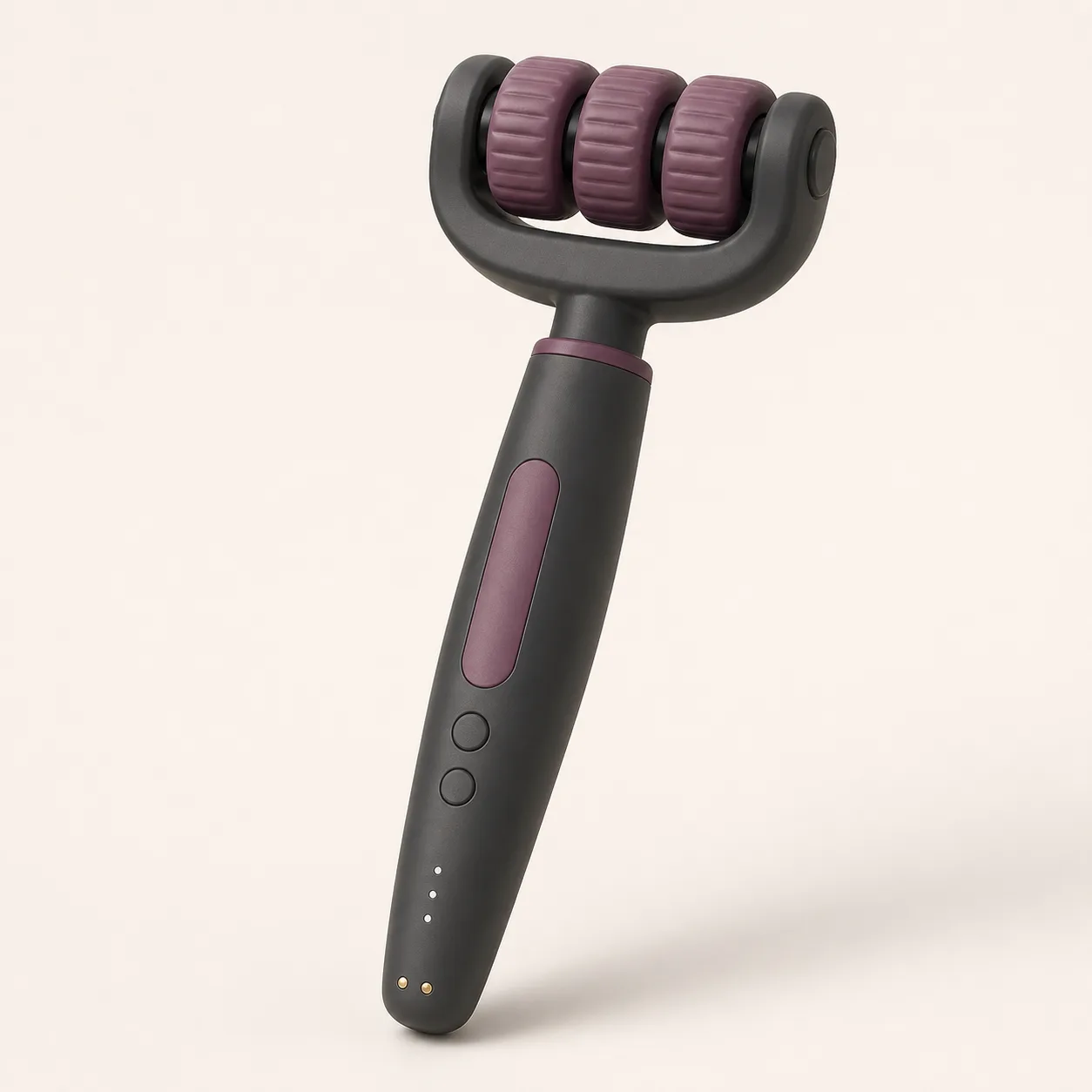
Three-Roller Bridge Wand Massager with Independent Axle Gaps
A rechargeable wand concept with three parallel ribbed rollers inside one broad bridge head for separately testable axle motion, per-roller output and compliant rolling behavior.
41,99 $
200 in stock
Span one broad head with three captive rollers
This three roller wand massager concept places three parallel ribbed cylinders inside a shallow U-shaped bridge head. Separate axle gaps invite measurement of each roller’s motion, while an isolation collar separates the bridge from the rechargeable handle.

The image does not prove roller rotation, bearing type, independence, motor count, output, waterproofing, runtime, material or approved contact location.
Inventory rollers, axles and the bridge
Request an exploded drawing and bill of materials for all three roller skins, cores, axles, bushings or bearings, thrust washers, axle caps, retainers, yoke arms, lower bridge, neck core, isolation collar, handle shell, actuator, controller, battery, buttons, indicators, charging contacts, pigments, seals, lubricants and adhesives.
Trace whether roller motion is passive, powered, geared together or fixed around an internal vibrator.
Measure roller alignment from one yoke datum
Record each roller diameter, width, crown, rib count, rib pitch, axle height, center spacing, end clearance and surface runout. Measure parallelism relative to the yoke arms and neighboring axles.
A broad head can look symmetric while the middle roller sits higher or one outer axle points inward.
Verify axle capture and working gaps
Inspect every axle cap, retainer, washer and bridge socket for seating, play and tool marks. Measure gaps between rollers, between roller ends and yoke arms, and beneath each cylinder through the full approved load range.
Use calibrated probes to screen for pinch, hair entrapment and hidden sharp edges without assuming that visible spacing remains constant.
Determine rotation and friction
Mark all three rollers with fixture references and measure breakaway torque, running torque, direction, free spin, drag, rebound, lateral play and sound. Repeat after conditioning and cycle intervals.
Document whether one roller drives the others through a belt, gear or shared axle, or whether each turns independently.
Measure every rib profile
Scan rib height, width, radius, spacing, taper and edge finish along the left, center and right rollers. Compare the full circumference for mold mismatch, flat spots or a seam that crosses the contact path.
Inspect transitions near the axle ends where residue and localized pressure can be overlooked.
Map vibration on each roller
Measure amplitude, frequency, startup, decay, sound and temperature at the center and both ends of every roller for each confirmed program and charge level.
Repeat with rollers stationary and turning if both states are possible. A rotating surface can alter sensor position and apparent output.
Quantify cross-coupling through the bridge
Use synchronized sensors on all three rollers, both yoke arms, the lower bridge, isolation collar and grip. Compare phase and amplitude to distinguish local output from structure-borne vibration.
Check whether axle preload or one stalled roller changes output on its neighbors.
Apply compliant rolling contact
Move the head across a compliant instrumented surface at controlled speed and verified low loads. Record contact area, pressure, roller rotation, slip, stick-slip, vibration loss, current, sound and temperature.
Repeat straight, diagonal and gently curved passes. Stop for roller stall, abrupt drag, axle lift, yoke contact, unstable head, unusual noise or rising heat.
Test bridge and neck strain
Instrument both yoke arms, lower bridge, collar and neck during centered and one-sided compliant loads. Log deflection, twist, vibration transfer, shell movement and conductor strain.
Reject cracks, permanent yoke spread, a loose collar or a neck that lets the roller surface contact the frame.
Control entrapment around moving surfaces
Keep hair, jewelry, film and loose fabric away from roller and axle gaps. Verify the exact cleaning and safety instructions before using any moving-surface program.
Stop immediately for pinching, pulling, snagging, numbness, sudden resistance, damaged ribs or a retainer that moves.
Assess handle balance and controls
Measure center of mass, grip pressure, slip, button reach and accidental activation with the head unloaded and under centered or edge load. Include several verified orientations and dry or lightly damp gloves.
Confirm rolling drag cannot rotate the handle unexpectedly or bring fingers toward the yoke.
Confirm programs, battery and heat
Document button sequences, program order, lockout, memory, indicator meanings, charger input, contact polarity, charge time, runtime, standby drain and operation during charging.
Keep the device off and dry while charging unless exact instructions state otherwise. Under the highest verified loaded setting, log current and temperature at every roller, axle, retainer, yoke, bridge, collar, neck, controller, battery, grip and charging contact.
Cycle rollers, load and cleaning
Run repeated free rotation, controlled rolling, vibration, centered load, edge load, button, charge and cleaning cycles. At planned checkpoints measure roller torque, axle play, gap size, retainer seating, rib wear, yoke spread, output, current and heat.
Obtain the exact cleaning method and ingress rating. Clean each roller circumference, inter-roller gap, axle end, cap recess, yoke interior, collar seam, buttons and contacts with approved tools, then dry concealed gaps fully.
Price after axle and bearing tests
An Alibaba rechargeable dual-sided wand listing currently shows USD 6.09-7.29 with an MOQ of one. It is a category benchmark only and does not confirm this three-roller bridge, axle system or approved supplier.
The procurement reference supports an EUR 41.99 planning price after allowing for China-origin freight, complete part inventory, three-roller metrology, axle capture and gap checks, friction and rotation mapping, rib inspection, per-roller output, bridge cross-coupling, compliant rolling tests, neck strain, entrapment review, electrical and thermal analysis, complete mechanism cycling, materials and battery evidence, cleaning validation, protective packing and discreet fulfillment. Exact quotation, packed dimensions, weight, freight, duty, tax, insurance, payment fees and delivery terms remain pending.
Frequently asked questions
Do all three rollers spin freely?
That remains unconfirmed until breakaway and running torque are measured on each axle.
Are the rollers powered independently?
Motor, gear and coupling architecture require teardown and synchronized output testing.
Can hair enter the axle gaps?
Any moving gap can snag loose material, so hair and fabric must remain clear and gap safety needs sample verification.
Does rolling reduce pressure?
Not automatically; pressure depends on load, rib geometry, drag, yoke angle and contact path.
Can the head be rinsed?
Only after ingress protection and a method for cleaning and drying axle cavities are documented.
Which faults require immediate retirement?
A lifted roller, loose cap, bent axle, cracked yoke, sharp rib, unstable drag, exposed conductor, unusual noise, heat, swelling or corrosion.
Reviews
There are no reviews yet.