



Floor-Length Satin Duster Robe with Floral-Lace Shoulder Yoke and Twin Side Slits
August 14, 2026
LilyLouhome Black Lace-Trim Wrap Robe: S-2XL
August 14, 2026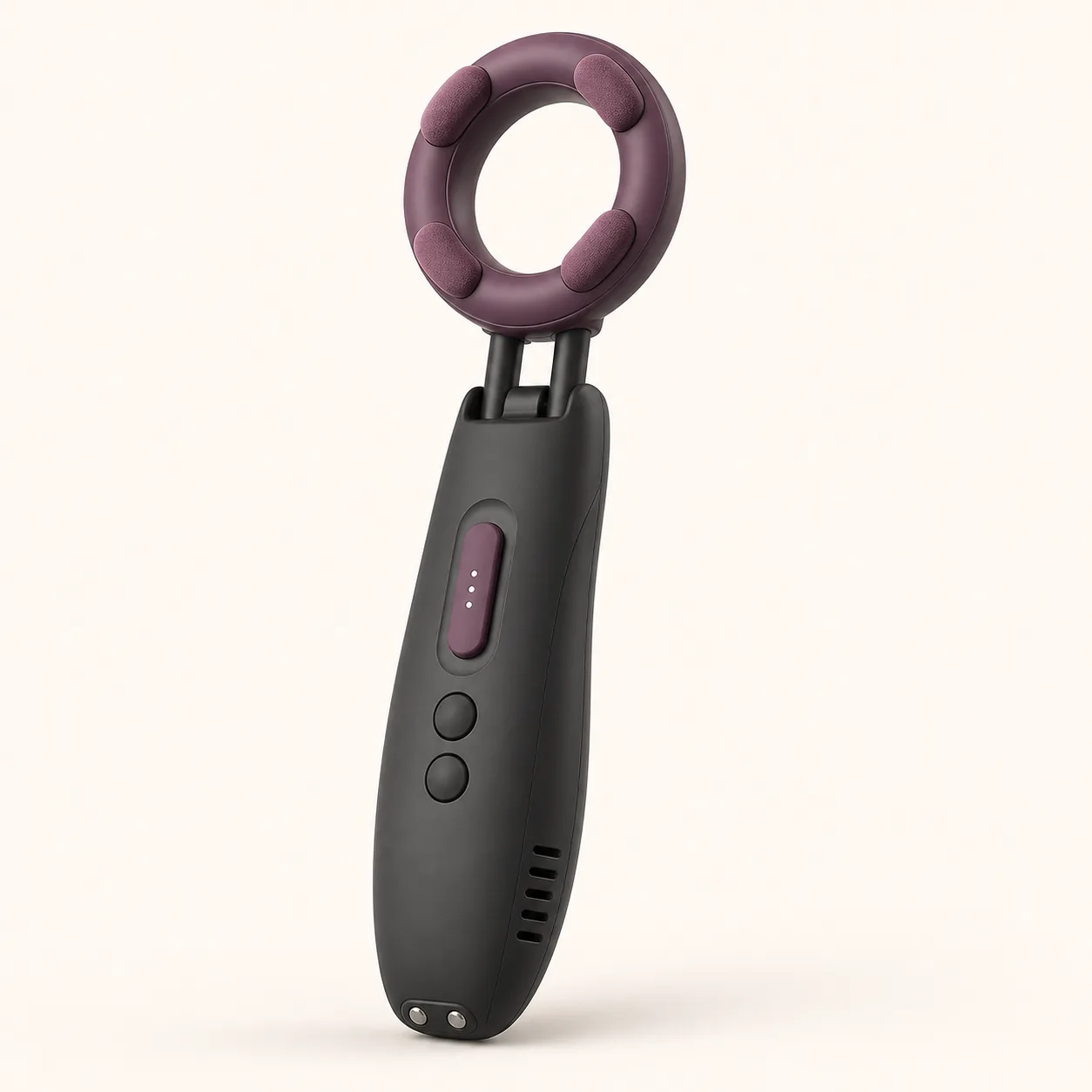
Twin-Rail Three-Stroke Halo Wand Massager
An open-halo wand concept with four contact pads, two visible guide rails and a three-position stroke selector.
78,99 $
200 in stock
Set a measured halo travel window
This twin-rail three-stroke halo wand massager concept uses one open smoky-plum ring with four discrete contact pads. Two visible parallel rails connect the halo carriage to a charcoal handle, while a plum slider and three index dots propose repeatable short-stroke settings.

The image describes a validation target; it does not confirm rail motion, stroke length, pad output, materials, battery or production status.
Index the mechanical and electrical stack
Label handle H0; halo Q0; pads P1-P4; guide rails R1-R2; carriage C0; slider S0; marks M1-M3; controls B1-B2; vents V1-V5; contacts J1-J2; actuator, bearings, controller, cell, seals, pigments, adhesives and fasteners.
Require exact-sample drawings and firmware identity before assigning a function to any visible part.
Measure the open halo geometry
Record outer and inner diameter, ring thickness, face flatness, pad pitch, mass, runout and carriage offset. Gauge every hard transition around the opening and the rail sockets.
Reject sharp edges, asymmetric mounting, visible cracking, excessive ring twist or contact between the halo and handle through the proposed travel.
Map four pad contact zones
Measure P1-P4 area, height, hardness, texture, edge blend and compression under identical fixture load. Compare recovery time and lateral shear at each quadrant.
Four pads are not equivalent until dimensions, compliance and output remain within a defined tolerance band.
Align both parallel guide rails
Measure R1 and R2 diameter, spacing, straightness, surface finish, bearing clearance and parallelism at rest and under modest off-axis load. Inspect rail ends and retention features.
Reject binding, unequal extension, abrasion debris, loose sockets or rail exposure beyond a guarded envelope.
Characterize carriage travel and end stops
Log C0 displacement, velocity, acceleration, reversal dwell, stop force and positional drift over repeated cycles. Approach both ends at every verified program and fixture preload.
End stops require durable damping and a fault response that prevents repeated impact after a stall.
Calibrate three proposed stroke states
Map S0 and M1-M3 to measured peak-to-peak travel, cycle rate, current and carriage temperature. Enter each state from both directions and repeat after warm-up.
Three white dots remain reference marks until direct measurement confirms three distinct retained settings.
Build spatial output and trajectory maps
Record acceleration, frequency and harmonics at P1-P4, the halo rim, carriage, both rail sockets, grip and lower shell. Plot phase and displacement through complete cycles.
Separate intended pad motion from rail chatter, ring resonance, handle transfer and end-stop impulses.
Repeat the maps under controlled preload
Use calibrated compliant fixtures centered on one pad, two adjacent pads and the full halo face. Log stroke compression, output, current, temperature, rail deflection and slider drift.
Reject abrupt travel loss, asymmetric carriage loading, hard-edge contact or unstable programs.
Document controls and immediate stop
Map B1, B2 and S0 actions for startup, intensity, pattern, stroke selection, pause, immediate stop, lockout and low-battery response. Test dry, damp and gloved fixture input.
The shortest stop action must work from every confirmed stroke state without cycling through other programs.
Assess grip isolation and control stability
Measure dry and damp friction, shell compression, balance, vibration transfer and accidental actuation across all programs. Record handling force as the carriage reverses.
A moving head must not make the handle rotate, walk across a fixture or obscure the stop control.
Validate charging heat and vent behavior
Confirm J1-J2 polarity, input limits, charge time, operating time, low-voltage cutoff, standby drain and contact temperature. Monitor V1-V5 for obstruction, residue and heat concentration.
Battery chemistry, capacity, cable specification, vent function and transport documents remain pending supplier evidence.
Clean rails pads seams and recesses
Apply visible test soil to P1-P4, halo seams, rail surfaces, sockets, carriage gap, controls, vents and contacts. Record residue, drying time, swelling, corrosion and post-cleaning drag.
No waterproof or immersion claim is made without exact-model ingress documentation and testing.
Confirm materials and fatigue resistance
Request declarations for pads, halo, rails, bearings, shell, controls, pigments, adhesives and seals. Cycle stroke changes, output, preload, cleaning, charging and storage, then remeasure travel, alignment, sound and heat.
Retire samples for cracks, pad separation, rail scoring, carriage drift, abnormal heat, fluid entry, charging faults or cell swelling.
Build landed price after rail validation
An Alibaba magic-wand massager category page showed one example at USD 2.11 to 2.45 with a three-piece minimum. It is a broad benchmark only and does not identify this twin-rail halo design or an approved supplier.
The public procurement benchmark supports an EUR 78.99 planning price after provisional allowance for China-origin freight, exact samples, halo and rail metrology, three-stroke calibration, spatial and loaded output maps, sound, heat, charging, cleaning, fault and fatigue work, protective packing and discreet fulfilment. Exact supplier, quote, MOQ, dimensions, materials, actuator, battery, packed weight, freight, duty, tax, certification, payment terms and lead time remain pending.
Frequently asked questions
How many contact pads are shown?
The concept uses exactly four pads spaced around one open halo.
Why are two rails visible?
The paired guides propose controlled axial travel; their alignment and guarding require measurement.
Are three stroke lengths confirmed?
No. The three-dot slider requires direct travel, retention, heat and current data.
Can the halo be used while charging?
That behavior is unspecified and must remain disabled unless exact-model documentation permits it.
Is the wand waterproof?
No ingress rating is claimed for the rail sockets, carriage gap, vents, controls or contacts.
Which faults require retirement?
Cracks, pad separation, rail scoring, carriage drift, heat, fluid entry or cell swelling.

Reviews
There are no reviews yet.