


Three-Face Indexed Sensory Paddle with Guarded Flip Yoke
August 14, 2026
Spark CLZ002 Red Longline Plus-Size Lingerie Set: XL-4XL
August 14, 2026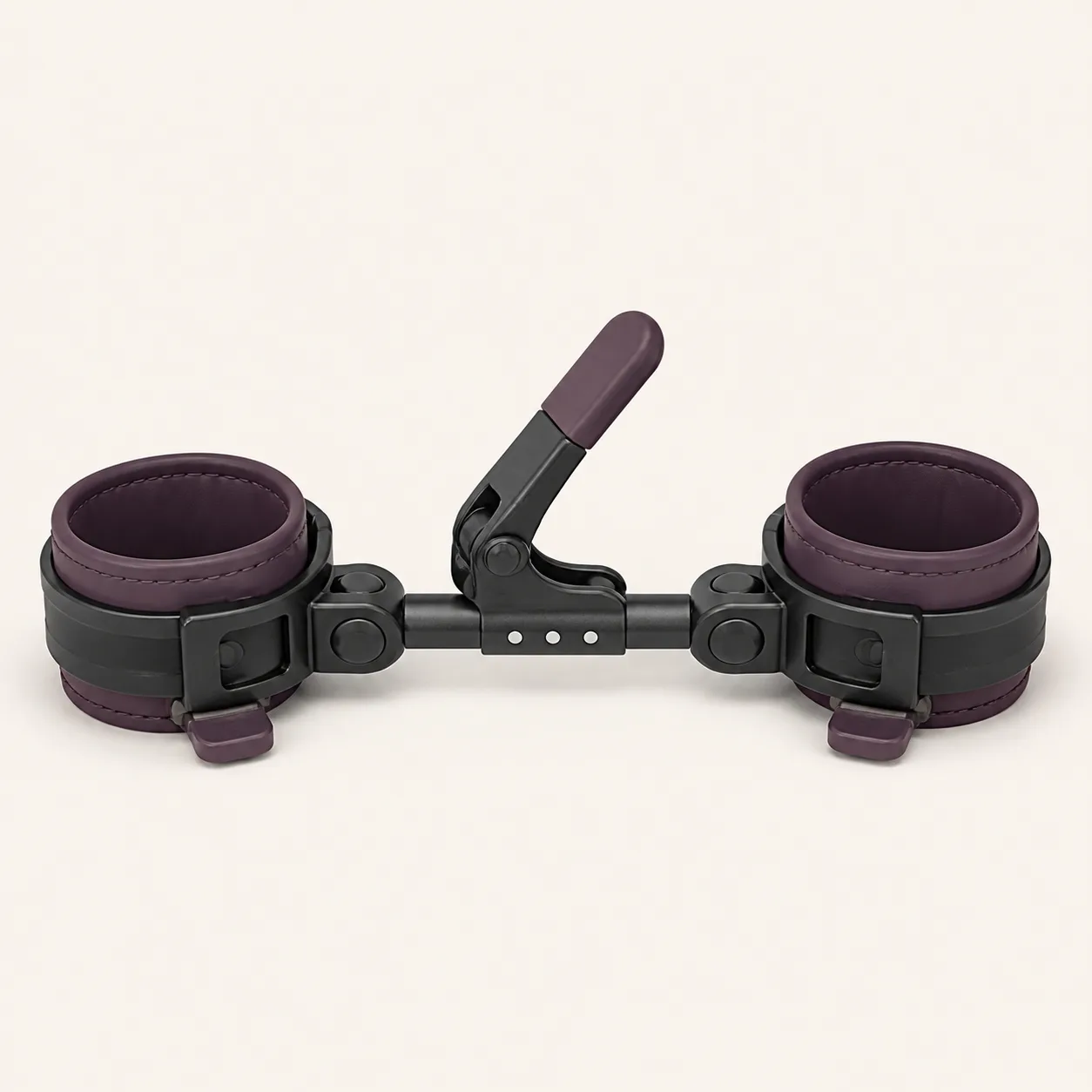
Twin-Cuff Three-Stop Over-Center Lever Restraint
A compact twin-cuff restraint concept with a telescoping three-position distance bar, guarded pivots, one over-center lever and two quick releases.
52,99 $
200 in stock
Lock two padded cuffs with one over-center lever
This twin-cuff three-stop over-center lever restraint concept joins exactly two smoky-plum padded cuffs through a compact charcoal distance bar. One central folding lever with a plum grip works between two guarded pivots, while three white dots propose repeatable spacing states and two cuff tabs provide separate release paths.

The image establishes a testable layout and does not confirm dimensions, lever action, lock strength, load limits, materials or production status.
Map the complete cuff and linkage assembly
Label cuffs F1-F2; liners P1-P2; closures C1-C2; release tabs Q1-Q2; connectors K1-K2; pivots H1-H2; distance bar R0; telescoping section T0; lever L0; grip G0; index states I1-I3; stops, fasteners, bushings, stitching and coatings.
Require exact-sample drawings showing every load path and hard stop.
Measure both cuffs independently
Record F1-F2 inner range, padding thickness, liner friction, closure overlap, seam placement, edge radius and connector freedom. Use compliant cylinders across the supplier-supported size range.
Reject uneven compression, exposed hardware, lining bunching, stitching pullout or connector contact with the fixture.
Inspect the telescoping distance bar
Measure collapsed and extended length, section overlap, wall thickness, straightness, torsional play and bending stiffness. Remeasure after centered, offset and twisting fixture loads.
Reject burrs, permanent bow, excess rattle, thin overlap or movement beyond guarded stops.
Calibrate the over-center lever path
Record L0 angle, hand force, linkage displacement, mechanical advantage, lock transition, final preload and opening force. Approach the closed state slowly and at controlled speed.
A lever that appears closed is not secure until the mechanism passes the verified center point and holds within defined tolerances.
Verify pivot H1 and pivot H2
Measure axial play, radial play, rotation range, fastener retention, bushing clearance and cover movement at both pivots. Compare left and right motion under symmetric and offset load.
Reject binding, skipped motion, visible loosening, cover lift or accessible closing gaps.
Confirm three spacing states
Map T0 and I1-I3 to cuff-center distance, section overlap, lever preload and lateral play. Approach each state from extension and contraction directions.
Three dots remain visual references until dimensional repeatability and lock retention are demonstrated.
Test both quick-release tabs under load
Measure Q1-Q2 access, actuation force, travel, tactile feedback and release time with no load, one cuff loaded and both cuffs loaded. Confirm that one release does not eject uncontrolled hardware.
Separate releases require independent validation rather than mirrored appearance alone.
Build centered offset and torsional load maps
Apply bounded fixture loads through each cuff, both cuffs and diagonal directions. Log cuff pressure, connector angle, bar deflection, pivot play, lever movement and lock slip.
Publish a working-load statement only after exact samples, safety-factor review and documented acceptance limits.
Probe pinch snag and hard-edge zones
Inspect cuff closures, connectors, pivot covers, telescoping overlap, index holes, lever slot, grip transition and end stops throughout opening and closing. Use standardized probes and fabric snag tests.
Reject accessible closing gaps, protruding fasteners, sharp seams, loose covers or abrasive edges.
Confirm materials padding and workmanship
Request declarations for shell parts, bar, pivots, bushings, padding, liner, thread, pigments, adhesives and coatings. Test odor, color transfer, corrosion, coating adhesion and seam strength on production samples.
No leather, silicone, body-safe, hypoallergenic or certification claim is made while evidence remains pending.
Design cleaning drying and inspection steps
Challenge liner folds, cuff seams, connector recesses, pivot covers, bar overlap, lever slot and release tabs with visible test soil. Record residue, drying time, corrosion, swelling and lubricant migration.
No immersion method is claimed without exact construction and corrosion evidence.
Cycle lever locking spacing and release
Cycle I1-I3 changes, lever closing, centered and offset loads, Q1-Q2 operation, cleaning, drying and storage. Remeasure cuff range, bar play, pivot clearance, lever force, release time, seams and coatings.
Retire samples for cracks, bar bow, pivot loosening, lever drift, release faults, torn padding, corrosion or exposed sharp parts.
Specify packing and batch traceability
Protect the raised lever, pivot covers, cuff padding and bar surface with shaped supports and abrasion barriers. Define carton size, packed mass, batch code, inspection record and handling tests.
Final packing, discreet-shipping details and packed weight remain pending supplier and route confirmation.
Build landed price after lever validation
An Alibaba adjustable-cuff category page showed one padded cuff example at USD 0.67 to 0.69 with a one-piece minimum. It is a broad benchmark only and does not identify this linked twin-cuff mechanism or an approved supplier.
The public procurement benchmark supports an EUR 52.99 planning price after provisional allowance for China-origin freight, exact samples, cuff and bar metrology, lever and pivot calibration, three-spacing validation, load and release tests, pinch probing, cleaning, fatigue work, protective packing and discreet fulfilment. Exact supplier, quote, MOQ, dimensions, materials, load limits, packed weight, freight, duty, tax, certification, payment terms and lead time remain pending.
Frequently asked questions
How many cuffs are included?
The concept shows exactly two separately padded cuffs joined by one compact linkage.
What does the center lever do?
It proposes an over-center lock whose force, travel and secure state require sample calibration.
Are there three confirmed distances?
No. The three-dot bar requires dimensional and retention testing at each state.
Can either cuff release separately?
Each visible tab requires independent force and release-time validation.
What load can the restraint support?
No load rating is claimed without documented exact-sample testing and safety review.
Which faults require retirement?
Cracks, bar bow, pivot loosening, lever drift, release faults, torn padding or sharp exposure.
Reviews
There are no reviews yet.