



Inflatable Dual-Level Positioning Lounger
August 14, 2026
SMOOTH ZD9014 Over-Door Padded Strap Swing
August 14, 2026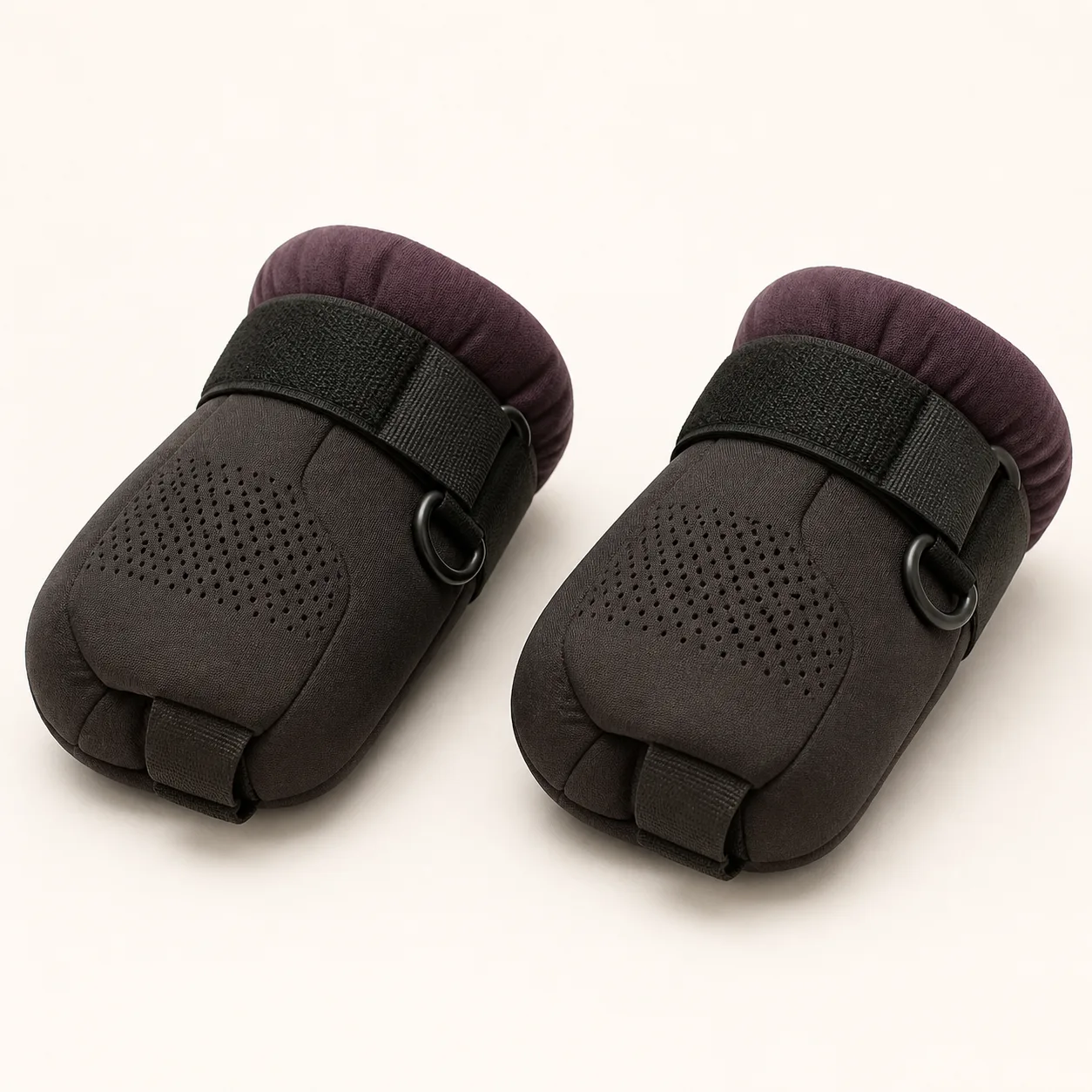
Breathable Padded Fist Restraint Mitt Pair with Quick-Release Tabs
A pair of padded fist-form restraint mitts with broad wrist closures, external release tabs, perforated panels and positioning rings for supervised fit checks.
49,99 $
200 in stock
Fist-form mitts change both movement and communication
These padded bondage restraint mitts are planned as a matched pair with enclosed fist-shaped chambers, plum wrist collars, broad exterior straps, oversized release tabs, perforated back panels and small attachment rings. The design limits fine hand use while keeping the wearer, partner and release hardware visible.

The image does not prove breathability, closure strength, handedness, load capacity or that a tether is included.
Check pair completeness and left-right construction
Confirm that the package contains two compatible mitts and identify whether they are handed, reversible or one-size. Compare internal seams, strap direction, tab position, D-ring placement and padding thickness side by side.
A visually matched pair can still differ in cavity depth or closure alignment, so both pieces need individual inspection records.
Measure the internal hand chamber before fitting
Record internal length from collar to fingertip end, palm width, chamber depth, wrist opening and the usable strap range. Compare those figures with the wearer’s relaxed closed hand and wrist circumference without compressing fingers into a smaller shape.
The mitt should contain the intended fist position without forcing knuckles together, bending the thumb sharply or pressing nails into skin.
Inspect every hidden surface that touches the hand
Turn the liner outward only if the construction permits and check fingertip zones, thumb side, palm bed, wrist edge and seam allowances for knots, hard ridges, exposed hook material, adhesive, debris or sharp ends. Feel through the padding for concealed hardware.
Any rough point, collapsed foam or inaccessible residue disqualifies the sample until corrected.
Padding needs compression and recovery data
Measure thickness at the knuckle, palm, sidewall and collar, then compress each location with a defined low load. Log bottoming-out, rebound time and permanent dents after repeated cycles.
Thick appearance does not guarantee pressure distribution, especially where a seam or ring anchor sits behind the foam.
Perforations must not be mistaken for proven ventilation
Confirm whether the back panel holes pass through the shell and liner or are decorative surface marks. During a short empty-hand fit, monitor moisture, skin temperature and any blocked zones without extending wear to chase a result.
Remove the mitts after heat buildup, sweating that cannot escape, clamminess, numbness or color change.
Map the wrist range without overtightening
Mark the minimum and maximum usable overlap that keeps the broad strap flat and leaves the release tab exposed. The padded collar should distribute pressure around the wrist without covering the thumb base or compressing one edge.
Do not add extra wraps, knots, tape or a smaller secondary cuff over the mitt closure.
Test hook-and-loop holding and peel behavior
On an empty mitt fixture, close the strap at several approved overlaps and apply low measured opening loads in the direction expected during use. Repeat attachment cycles to check lint pickup, edge curl, stitch movement and loss of peel strength.
A closure that creeps, catches skin, hides its tab or changes dramatically after a few cycles is not ready for body contact.
The oversized tab must remain reachable from outside
With the wearer relaxed and observed, confirm that a partner can locate and peel the tab immediately without pulling the D-ring. Practice complete removal in neutral light and reduced light before any connector is added.
Scissors are not the primary release method for a closure that is designed to open by hand, but appropriate backup equipment should remain nearby.
Treat each D-ring as a positioning point only
Supplier limits for ring material, anchor patch, thread and seam pattern remain pending. Use only light slack positioning below the confirmed rating and keep connectors arranged so they cannot tighten the wrist strap.
These mitts are not for suspension, body-weight support, dragging, impact, overhead loading or any setup that prevents immediate access.
Establish consent signals that do not require fingers
Agree on a spoken stop word, a second audible signal and a movement-based signal that remains possible with both hands enclosed. The observing partner maintains continuous attention and checks the signals before restriction begins.
Do not use with a sleeping, impaired, unattended or non-communicative person.
Start with one mitt and a short timed check
Fit one hand, close the strap only within the measured comfort range and verify warmth, color, sensation and wrist movement after a brief interval. Remove it completely before repeating on the other side.
Only after both single-hand checks pass should the pair be worn together, still without external tension during the first trial.
Monitor circulation, temperature and joint position
Use frequent agreed check-ins and visually inspect the exposed wrist edge for swelling, indentation or color change. Keep shoulders, elbows and wrists in neutral supported positions and avoid twisting a constrained arm.
Release immediately after tingling, numbness, coldness, heat, pain, cramping, panic, shortness of breath or inability to answer clearly.
Remove before cleaning and dry the lining fully
Open the straps, detach any compatible connector and clean shell, lining, collar, tabs and rings according to each verified material. Avoid soaking foam, trapping cleaner under hook-and-loop or sealing damp mitts together.
Air-dry with chambers open and inspect for odor, residue, delamination, rust, fraying, compressed padding or weakened closure before uncompressed storage.
Sourcing must test the pair rather than one sample
An Alibaba mitten-restraint results page lists padded fist mittens with locking-buckle wording at USD 19.69-36.69 and MOQ 1 piece. Supplier identity, whether one piece means one mitt or one pair, exact release design, materials, fit range and every marketplace claim remain pending.
The procurement reference supports inquiry only. The EUR 49.99 plan allows for China-origin freight, pair and handedness checks, internal measurement, padding and ventilation review, strap-range mapping, closure cycle tests, release-access trials, D-ring and anchor inspection, material review, cleaning trials, protective packing and discreet fulfillment; packed size, weight, freight, duty, tax, insurance, payment fees and destination terms remain pending.
Frequently asked questions
Are the mitts sold as a confirmed pair?
Pair completeness is a purchasing requirement but must be confirmed in the supplier quote and receiving inspection.
Can the wearer open them alone?
Self-release is not assumed. A sober attentive partner must control and practice the external quick-release tabs.
Do the perforations guarantee cool hands?
No. Airflow path, lining and heat buildup require exact-sample testing during short supervised checks.
Can the D-rings support body weight?
No. They are treated only as low-load positioning points unless a documented lower limit requires even less.
How often should circulation be checked?
Use continuous observation and frequent pre-agreed checks, releasing immediately at the first sensory or color change.
When should a mitt be withdrawn from service?
After torn lining, exposed hard parts, collapsed padding, frayed seams, loose rings, strap creep, lost peel strength, retained moisture, odor or any release-tab obstruction.
Reviews
There are no reviews yet.