


Counter-Oscillating Twin-Pad Palm Vibrator with Central Pinch-Guard Spine
August 14, 2026
Care-Accessory Air-Drying Rack with Removable Drip Tray
August 14, 2026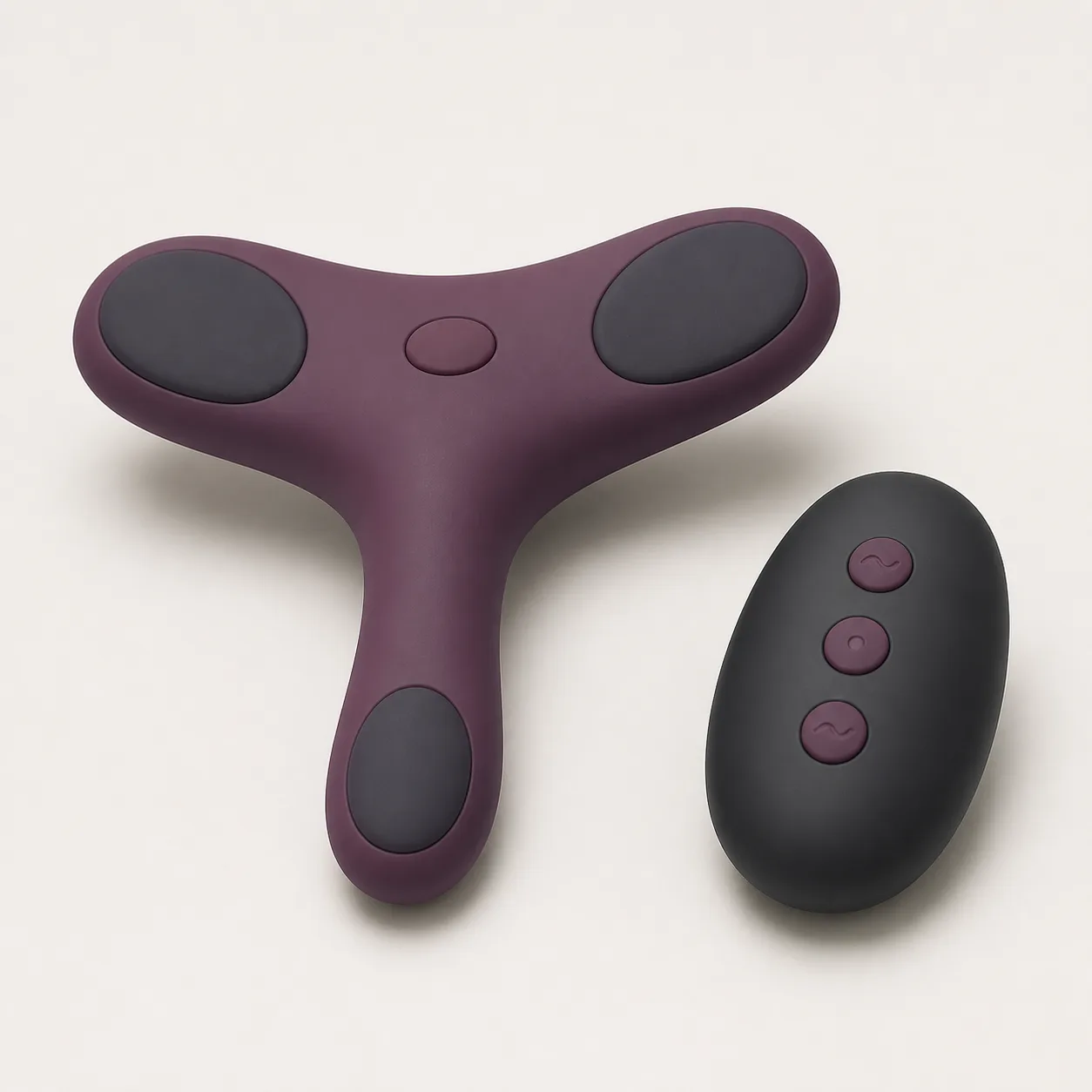
Three-Pad T-Bridge Wearable Couples Vibrator with Compact Remote
A smoky-plum wearable couples vibrator concept with one flexible T bridge, exactly three charcoal oval contact pads and a separate compact three-button remote.
59,99 $
200 in stock
Arrange three contact pads across one flexible T bridge
This three-pad T-bridge wearable couples vibrator uses one smoky-plum T-shaped body with two broad charcoal oval pads at the ends of a curved crossbar and one third pad near the rounded tip of its downward stem. A separate charcoal pebble remote carries exactly three smoky-plum buttons.

The image defines design intent only. Dimensions, materials, flexibility, motor layout, remote operation, battery, ingress resistance and production readiness remain pending.
Confirm the two-piece electronic pack
The proposed set contains one T-bridge vibrator and one compact remote. Any charging lead, receiver, storage item, protective cap or printed guide must be listed separately if later approved because none is shown in the concept.
Final component count, charging interface, cable, packaging, labels and pairing state require supplier confirmation.
Measure the T silhouette from seven landmarks
Record crossbar span, left and right end width, centre thickness, stem length, stem-tip width and overall height. Add the distance from the bridge centre to each pad centre and a contour scan through every rounded edge.
Usable dimensions and tolerances must come from approved production drawings and physical samples, not the rendering.
Label the three oval pads P1 through P3
Assign P1 and P2 to the crossbar ends and P3 to the stem tip, then measure major axis, minor axis, projection, edge radius, surface texture and position for each. Compare samples in a fixture so flex or perspective does not hide asymmetry.
Exactly three pads are proposed. Their firmness, bond method and final contact feel remain unverified.
Map pressure across the curved crossbar
Place P1 and P2 against an instrumented compliant surface at defined bridge deflections and record contact area, peak pressure and left-to-right balance. Repeat with the centre of the crossbar free and supported.
No universal fit or shared-stimulation result is claimed; bodies, positioning, force and preference vary between consenting adults.
Characterize the stem and third-pad load path
Measure stem curvature, bend force, torsional stiffness, P3 contact angle and elastic recovery across a verified movement range. Inspect the junction where the stem meets the bridge for wrinkles, separation, hard edges or permanent set.
Do not force the body beyond tested limits. Stop use if a surface cracks, a rigid element becomes exposed or discomfort persists.
Cycle the T junction under combined bending and twist
Run repeated crossbar flex, stem flex and alternating torsion while the three pad zones carry representative loads. Inspect dimensions, seals, surface finish and output before, during and after the cycle schedule.
Fatigue life and rejection thresholds remain pending engineering validation.
Define the single centre-button behaviour
Document short press, long press, power state, local mode changes, travel lock, pairing indication and shutdown. Verify that the oval centre control remains accessible without accidental activation during bridge flex.
Mode count, memory, indicator behaviour and lock sequence require firmware and sample agreement.
Separate the remote’s three-button functions
Assign a unique function to the upper, middle and lower plum buttons and verify tactile distinction, debounce, long-press behaviour, low-battery state and pairing recovery. Icons or labels must be readable if later added.
The image shows three buttons but does not establish the final command map or radio technology.
Verify pairing range, interference and fail-safe state
Measure command success and latency at defined distances, orientations and obstruction conditions, then test loss of signal, reconnection and multiple nearby units. Confirm that unintended commands cannot be sent by another production sample.
Remote range, frequency, encryption, regulatory region and fail-safe behaviour remain pending documented testing.
Measure output at all three pads and the grip zones
Record frequency, acceleration and displacement at P1, P2, P3, the bridge centre, stem junction and remote-free body across every verified setting. Repeat under free-air and compliant-load conditions to identify damping or imbalance.
Motor count and marketing strength labels are withheld until measured ranges and tolerances are available.
Control temperature, sound and duty cycle
Run the longest verified operating sequence at representative load and ambient conditions, logging temperature at all pads, the bridge, stem, control, battery zone and charging area. Measure acoustic output at a fixed distance in a controlled room.
Operating time, maximum temperature, sound and rest intervals remain pending. Stop testing after abnormal heat, odour, swelling or intermittent output.
Validate batteries and charging for both pieces
Identify the cell, capacity, protection circuit and charger used by the main body, then determine whether the remote uses a replaceable or rechargeable source. Test polarity, current, full-charge cut-off, standby drain, short-circuit response and cycle retention.
No cable or battery type is promised by the visual. Only the approved charging system should be used after electrical verification.
Confirm skin-contact materials, ingress and cleaning
Request traceable composition, hardness, restricted-substance and migration data for the smoky-plum surface, three charcoal pads, buttons, pigments, shell, seals and adhesives. Test seams, controls and charging areas to a documented ingress method before defining cleaning.
Silicone, body-safe, hypoallergenic, medical-grade and waterproof claims are withheld without evidence. Keep charging areas dry until ingress testing supports another instruction.
Set a landed-price plan from remote wearable references
An Alibaba public category page displayed a Bluetooth wearable egg reference at USD 2.76 to 3.21 with MOQ 1 and a remote couples vibrator at USD 4.36 to 4.98 with MOQ 1. A couples category page displayed a U-shaped remote vibrator at USD 5.90 to 7.90 with MOQ 1. These are broad benchmarks, not quotations for this three-pad T bridge or approved suppliers.
The public procurement benchmark supports an EUR 59.99 planning price after provisional allowance for China-origin freight, custom T-bridge and three-pad tooling, flex and fatigue cycles, pressure mapping, remote, interference, vibration, thermal, acoustic, battery, charging, ingress, material and cleaning validation, discreet fulfilment and quality-loss provisions. Exact supplier, quote, MOQ, dimensions, materials, modes, radio, battery, packed weight, freight, duty, tax, certification, payment terms, lead time and production availability remain pending.
Frequently asked questions
How many contact pads are on the wearable body?
Exactly three charcoal oval pads are proposed: two on the crossbar and one on the stem.
How many objects are included?
The concept contains two: one T-bridge vibrator and one separate three-button remote.
Is the bridge adjustable?
It is proposed as flexible, but bend force, safe range and recovery require physical cycle tests.
How far does the remote work?
Range, latency and interference performance remain pending radio testing in defined environments.
Can the device be immersed?
Immersion is not claimed. Ingress level and cleaning instructions await documented tests.
How many modes are available?
The final mode count and control map require firmware and production-sample verification.

Reviews
There are no reviews yet.