


Four-Bellows Flex-Neck Wand Massager with Tall Oval Dome Head
August 14, 2026
Four-Facet Swivel-Head Wand Massager
August 14, 2026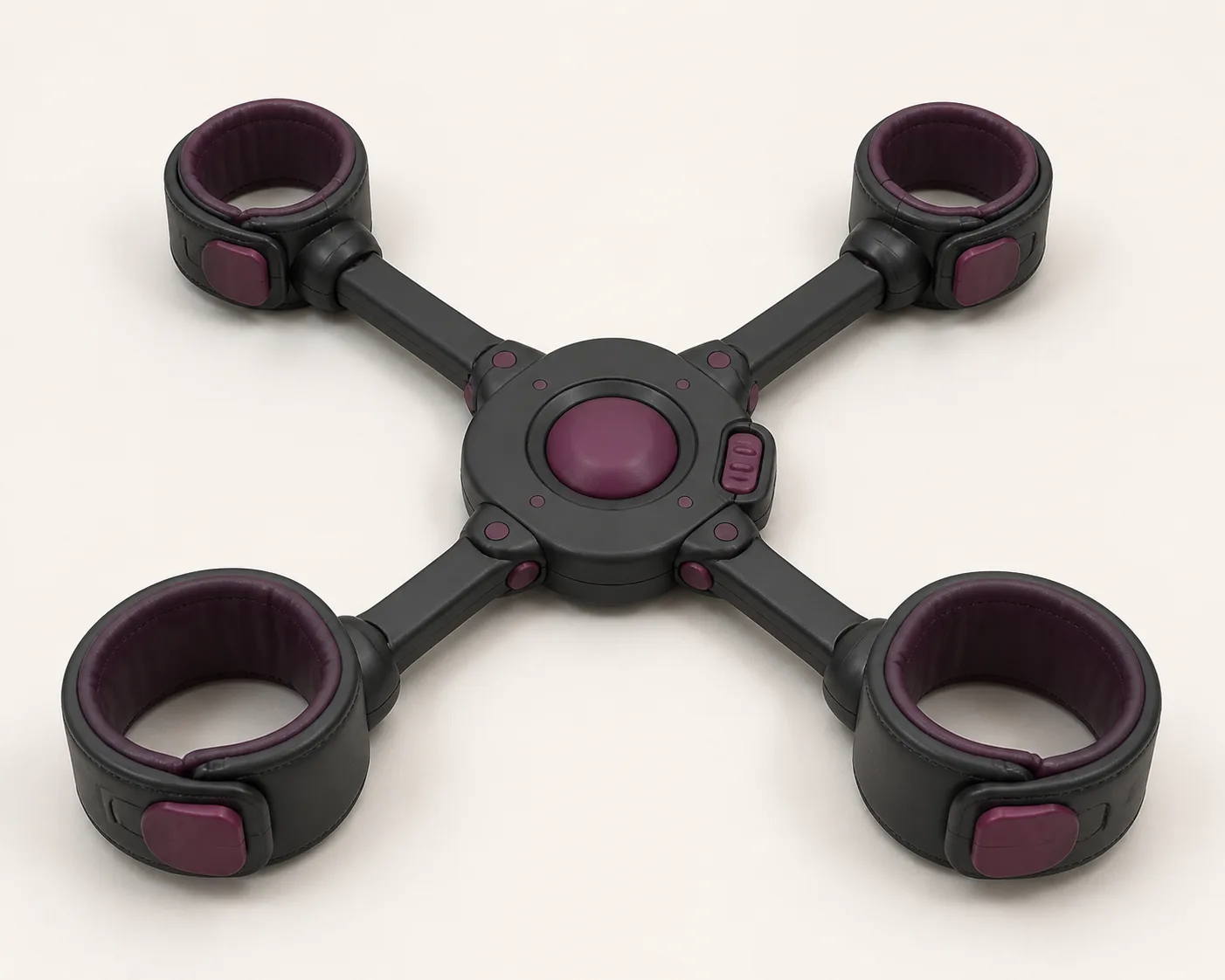
Four-Cuff Articulated Diamond Restraint Frame with Master Release
A low-profile non-suspension BDSM restraint concept with two wrist cuffs, two ankle cuffs, four articulated arms, independent cuff tabs and a central master release.
69,99 $
200 in stock
Arrange four cuffs around one low diamond frame
This four-cuff articulated diamond restraint frame concept connects two smaller wrist cuffs and two broader ankle cuffs to four short arms around one central hub. Every cuff has its own release, while a central master puck and three-stop span slider add separate control paths.

The image does not establish fit, span, articulation, release force, load rating, material, certification or manufacturing availability.
Inventory the complete four-corner system
Require a serialized list for wrist cuffs W1-W2, ankle cuffs A1-A2, shells, liners, padding, bindings, straps, closures, individual tabs, four arms, outer joints, hub pivots, pins, bushings, guards, stops, central hub, master mechanism, slider, detents, reinforcement, fasteners, coatings, pigments, thread and adhesives.
Confirm whether the frame ships assembled and identify every captive, removable and handed part.
Measure frame span and neutral geometry
Record diagonal and adjacent cuff-center spacing, arm lengths and sections, hub diameter and height, pivot locations, stop angles, cuff orientations, overall footprint, folded envelope, mass and balance. Use a flat reference plane.
Repeat at every confirmed span state and after bounded articulation, release, cleaning and storage cycles.
Fit wrist and ankle cuffs independently
Measure flat length, padded length, usable circumference, width, edge thickness, overlap, closure position, strap reserve and tab reach for all four cuffs. Use separate cylindrical and tapered reference fixtures.
Do not treat the two cuff sizes as interchangeable or infer an anatomy range from strap length.
Calibrate four arms and eight joint stations
At each hub and cuff-end joint, measure axis, range, friction, backlash, stop position, lateral play and neutral repeatability. Record how one joint changes the angle and pressure at the other seven stations.
Reject pin migration, guard lift, stop impact, progressive looseness, arm twist or any joint that can fold a release beneath the frame.
Calibrate the three-stop span slider
Measure slider travel, detent and unlock force, backlash, indication and actual cuff-center geometry at all three positions approached from both directions. Repeat under conservative equal and diagonal fixture tension.
Reject false seating, asymmetric arm movement, hidden intermediate states or span drift after release.
Verify four independent cuff releases
Measure closure force, positive seating cues, strap slip, tab force, direction, travel and time to slack for W1, W2, A1 and A2. Test dry, damp and gloved access under bounded tension.
Each tab must remain visible and reachable without moving another limb path or operating the master mechanism.
Verify the central master release
Document which connections the master puck actually opens, force and travel, response time, reset sequence, partial actuation and failure state. Test simultaneous and asymmetric cuff tension in protected fixtures.
A master release must not create a false assumption that all cuffs open if the exact mechanism releases only the frame arms.
Map cuff pressure and circulation warnings
Use pressure film around liner edges, closures, arm roots and opposite cuff faces at every accepted fit and frame state. Measure contact area, peak pressure, compression recovery and pressure change during articulation.
Maintain continuous supervision and stop immediately for pain, numbness, tingling, coldness, swelling, discoloration or withdrawn consent.
Measure frame load sharing and distortion
Apply conservative axial, diagonal, one-corner and alternating fixture loads while recording arm deflection, hub rotation, pivot reaction, cuff angle and slider movement. State direction, rate and dwell.
Reject progressive distortion, one-arm overload, hub lift, cuff rotation onto an edge or a setting that tightens as another corner moves.
Screen gaps false seating and entanglement
Probe closures, tabs, cuff-arm interfaces, outer joints, hub pivots, guards, stops, slider and master puck through all accepted movement. Map capture, shear and hair or fabric entanglement paths.
Challenge partial closures, hidden straps, twisted cuffs, intermediate pivots, slider misalignment and blocked master travel; every unsafe state needs an obvious cue.
Confirm materials cleaning and drying
Request exact compositions and traceability for shells, liners, padding, webbing, frames, arms, pivots, pins, guards, coatings, pigments, thread, lubricants and adhesives. Seek restricted-substance, skin-contact, corrosion and colorfastness evidence.
Validate cleaning around cuff seams, joint gaps, hub underside, slider and master recess, then measure drying before reassembly or storage.
Enforce a strict non-suspension boundary
This concept is not for suspension, lifting, overhead anchoring, dragging, fall restraint, impact, body-weight support, transport, sleep, intoxication or unattended use. The central hub and four arms are not rigging hardware.
Use only within exact verified low-load limits, with continuous communication, immediate release access and a separate backup release method.
Cycle joints releases and retirement rules
Cycle cuff fit, all eight joints, three span states, individual and master releases, bounded load, cleaning, drying and storage. Recheck dimensions, play, stops, pressure, release timing, slider drift, hub movement and material condition.
Retire the set for torn padding, frayed straps, false closure, delayed release, pin migration, cracked guards, bent arms, rising joint play, hub distortion, slider drift, corrosion, exposed reinforcement or persistent residue.
Build landed price after release validation
An Alibaba wrist-and-ankle-cuff page showed an adjustable cuff category example at USD 0.67-0.69 with MOQ one. It is a benchmark only and does not confirm this articulated diamond frame or an approved supplier.
The procurement reference supports an EUR 69.99 planning price after allowing for China-origin freight, exact-set sourcing, frame and cuff metrology, joint and slider calibration, individual and master-release testing, pressure, load sharing and gap work, materials, cleaning, drying and cycle validation, protective packing and discreet fulfillment. Exact quotation, MOQ, packed size, weight, freight, duty, tax, insurance, payment fees, certifications and delivery terms remain pending.
Frequently asked questions
Is this frame suitable for suspension?
No. Suspension, lifting, overhead use, falls, impacts and body-weight support are explicitly excluded.
What does the master release open?
The exact connections, timing and failure state require protected fixture testing of the production mechanism.
What spans do the three stops provide?
All cuff-center distances, angles and tolerances remain pending exact-sample measurement.
Can each cuff open separately?
The concept shows individual tabs, but force, travel and loaded release behavior require verification.
How should the joints be cleaned?
The supplier must define material-specific cleaning, joint wetting limits, drying access and inspection.
Which defects require retirement?
Torn cuffs, false closure, delayed release, migrating pins, cracked guards, bent arms, hub distortion, slider drift, corrosion or residue.
Reviews
There are no reviews yet.