


Stackable Open-Front Care-Supply Shelf Bins, 3-Pack
August 14, 2026
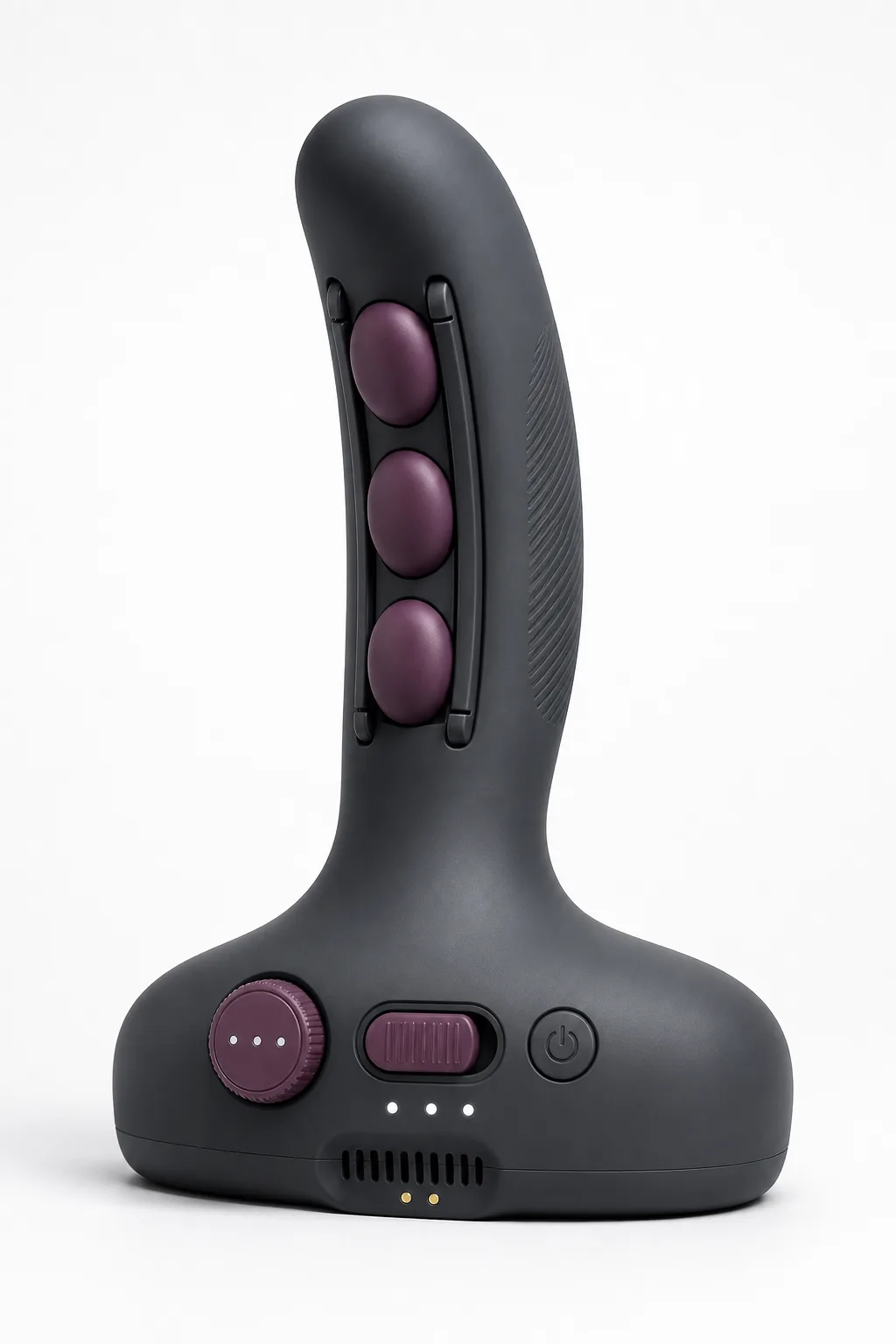
Tri-Node Kneading Automatic Stroker
August 14, 2026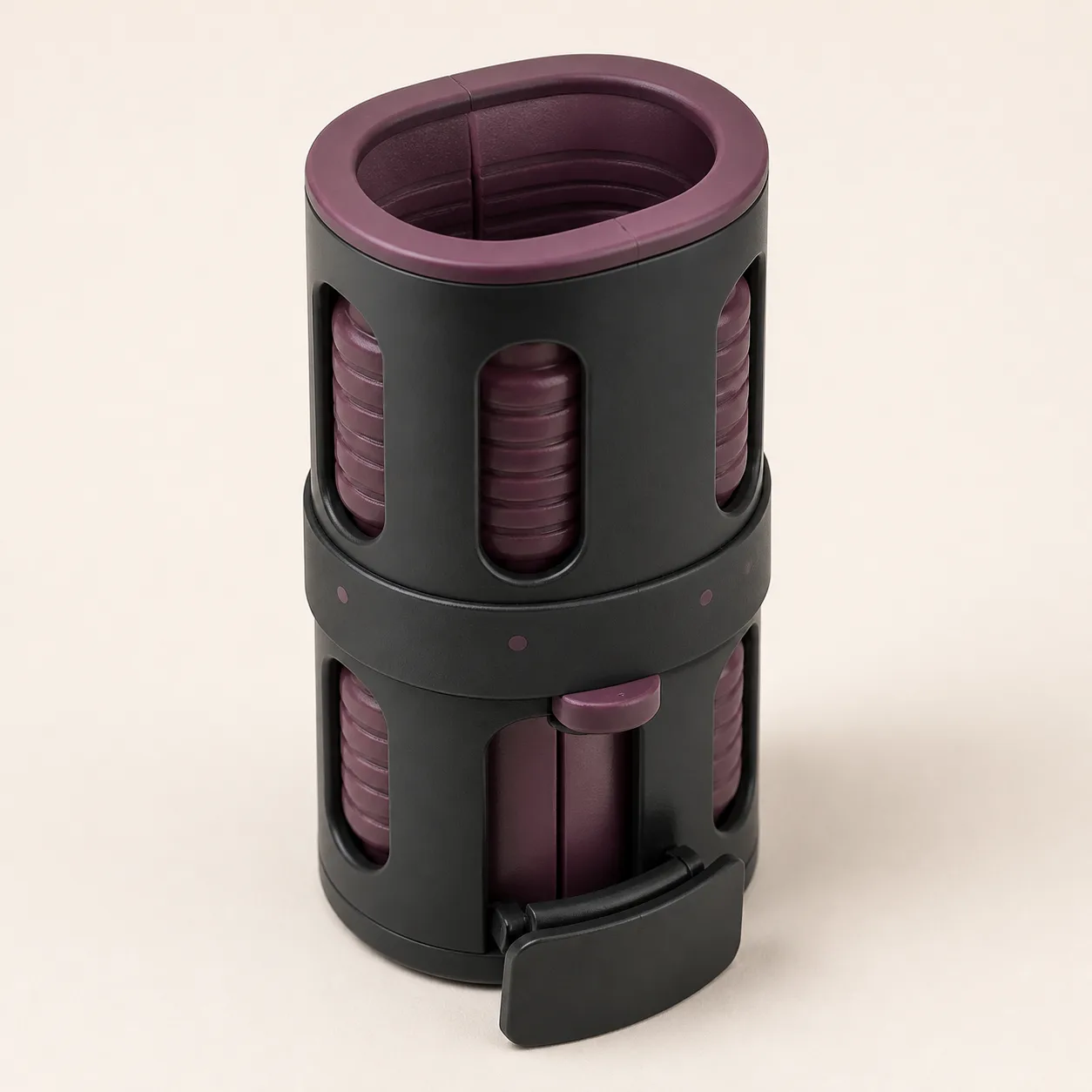
Four-Roller Compression-Ring Manual Stroker with Split-Clean Sleeve
A non-powered manual stroker concept with four surrounding roller cartridges, one central compression ring and an attached service gate for separately testable pressure, drag and cleaning access.
31,99 $
200 in stock
Surround one liner with four roller cartridges
This four roller manual stroker concept places four ribbed roller cartridges around one removable plum liner. A broad central ring is intended to alter compression, while an attached hinged service gate exposes the liner split for cleaning access.

The image does not prove roller pressure, ring settings, liner dimensions, material, suction, vacuum, waterproofing or supplier approval.
Inventory the complete shell and compression system
Request an exploded drawing and bill of materials for the top rim, liner body, split seam, internal texture, four roller skins, four roller cores, axles, bushings, cartridge frames, window edges, compression followers, central ring, grip tab, detents, stops, lower shell, gate, hinge, latch, pigments, lubricants and adhesives.
Confirm whether the four visible roller sections are separate cartridges or portions of longer linked parts.
Measure the full working geometry
Record total height, shell diameter, rim opening, liner length, internal profile, wall thickness, split overlap, roller length and diameter, axle spacing, window size, ring width, gate opening, hinge clearance and mass.
Measure at each ring reference and after the liner has settled for a controlled period outside the shell.
Identify every roller axis and support point
Map each axle relative to the shell centerline and label the four cartridges consistently. Measure parallelism, radial position, lateral play, end clearance and contact length.
A roller that leans or floats can create a concentrated edge even when the outer windows appear evenly spaced.
Calibrate the central adjustment ring
Measure ring torque, travel, detent force, free play, stop compression and accidental movement resistance from both directions. Pair every visible reference with direct internal measurements.
Check whether the ring moves all four cartridges equally, in opposing pairs or through a cam sequence. Do not describe the positions as pressure levels until load testing confirms them.
Map roller intrusion through the liner
Use a soft gauge or scan to measure internal profile change at the center and both ends of each cartridge. Record minimum clearance, circumferential symmetry and transitions beside the roller ends.
Repeat for every approved ring position with the liner dry and conditioned according to exact instructions.
Inspect the liner seam and service gate
Open the attached gate and document the straight split, overlap, edge finish, latch reach and how the liner is supported when the shell is closed. Check that gate hardware cannot touch the liner interior.
Measure opening force and verify that the hinge and latch cannot create a false-closed state or sharp step.
Measure insertion and extraction on compliant gauges
Use compliant cylindrical gauges across the verified fit envelope. Record entry force, peak compression, removal force, liner displacement, rim distortion and ring drift at every setting.
Stop for abrupt force spikes, roller edge contact, liner inversion, seam opening, gate movement or permanent deformation.
Map circumferential pressure
Place pressure film or a sensor sleeve around a compliant gauge and record contact distribution under each roller and between cartridges. Compare top, middle and lower zones.
Check whether one cartridge dominates or whether the ring creates a four-lobed profile beyond the confirmed comfort window.
Measure manual movement resistance
Move the complete device along a standardized compliant fixture at controlled speed and stroke. Record pull force, stick-slip, shell grip pressure, ring movement, roller rotation and liner migration.
Repeat from both directions and after short pauses so static friction is not confused with sustained resistance.
Check roller rotation and drag
Mark each roller with an external fixture reference and measure rotation, slip, stall and rebound through several controlled movements. Inspect axle and bushing temperature even though the product is non-powered.
A roller that does not rotate may act as a fixed rib and alter both pressure and cleaning needs.
Manage grip position and ring drift
Map where hands can hold the shell without covering the service gate, pressing a roller window or turning the adjustment ring unintentionally. Test dry and lightly damp gloves.
Confirm the grip tab remains reachable but does not catch loose fabric or create a sharp edge.
Cycle ring, rollers and service gate
Run repeated ring adjustment, detent selection, compliant insertion, controlled movement, extraction, gate opening, liner removal, reassembly and cleaning cycles. At planned checkpoints measure ring torque, cartridge position, axle play, liner fit, gate latch, hinge movement and force drift.
Retire a sample after roller lift, axle movement, cracked windows, ring creep, liner tear, seam distortion, loose hinge or unreliable gate closure.
Validate complete cleaning and drying
Obtain exact material and cleaner compatibility data before testing. Remove the liner only by the documented path, open the split, and clean the internal texture, seam, rim underside, roller skins, windows, cartridge ends, ring gap, gate and hinge.
Measure drying by mass and inspect hidden axle or cartridge wells for retained moisture or residue before reassembly.
Price after roller uniformity is proven
An Alibaba manual stroker listing currently shows USD 3.15-3.94 with an MOQ of one. It is a category benchmark only and does not confirm this four-roller cartridge system, compression ring, split liner or approved supplier.
The procurement reference supports an EUR 31.99 planning price after allowing for China-origin freight, complete teardown, geometry mapping, axle and cartridge alignment, ring calibration, internal profile scans, gate and seam checks, compliant force and pressure maps, roller rotation testing, grip review, full mechanism cycling, material evidence, cleaning validation, protective packing and discreet fulfillment. Exact quotation, packed dimensions, weight, freight, duty, tax, insurance, payment fees and delivery terms remain pending.
Frequently asked questions
Does the ring adjust all four rollers equally?
The linkage is unconfirmed; each cartridge must be measured at every visible reference.
Do the rollers actively rotate?
The product is non-powered, and free rotation or controlled drag requires sample testing.
Is the liner completely removable?
The concept shows a service gate and split liner, but the safe removal path needs exact instructions.
Do the dots indicate pressure levels?
No. They are position references until calibrated pressure and force data are available.
Can the shell be rinsed?
Only after material compatibility and the cleaning method for roller wells, ring gaps and hinge cavities are verified.
Which faults require immediate retirement?
A torn liner, open seam, exposed core, stalled or lifted roller, bent axle, creeping ring, cracked window, loose gate, sharp edge or trapped residue.
Reviews
There are no reviews yet.