


Four-Roller Compression-Ring Manual Stroker with Split-Clean Sleeve
August 14, 2026
Three-Collar Axial-Shuttle Automatic Stroker with Open-End Liner
August 14, 2026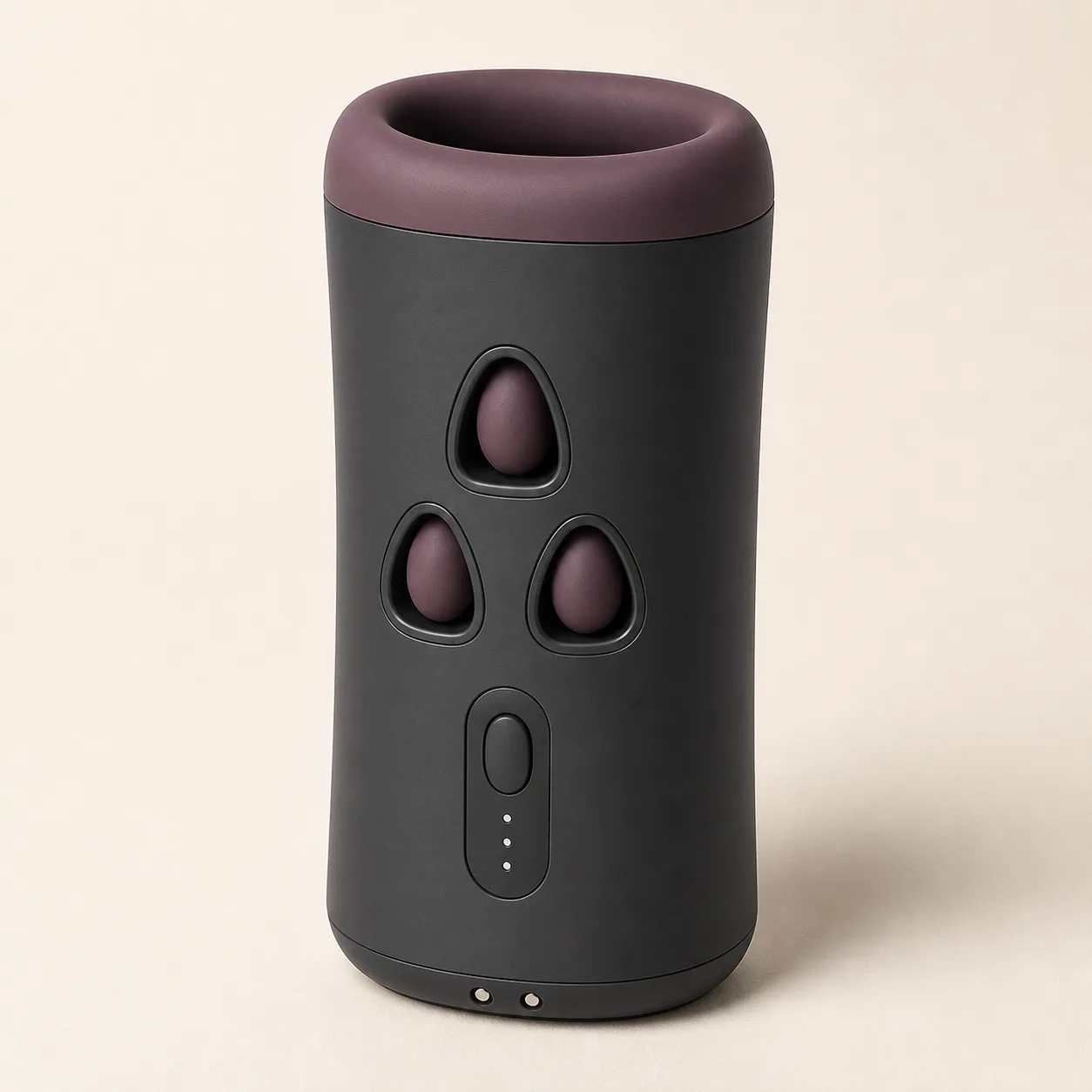
Tri-Node Kneading Automatic Stroker
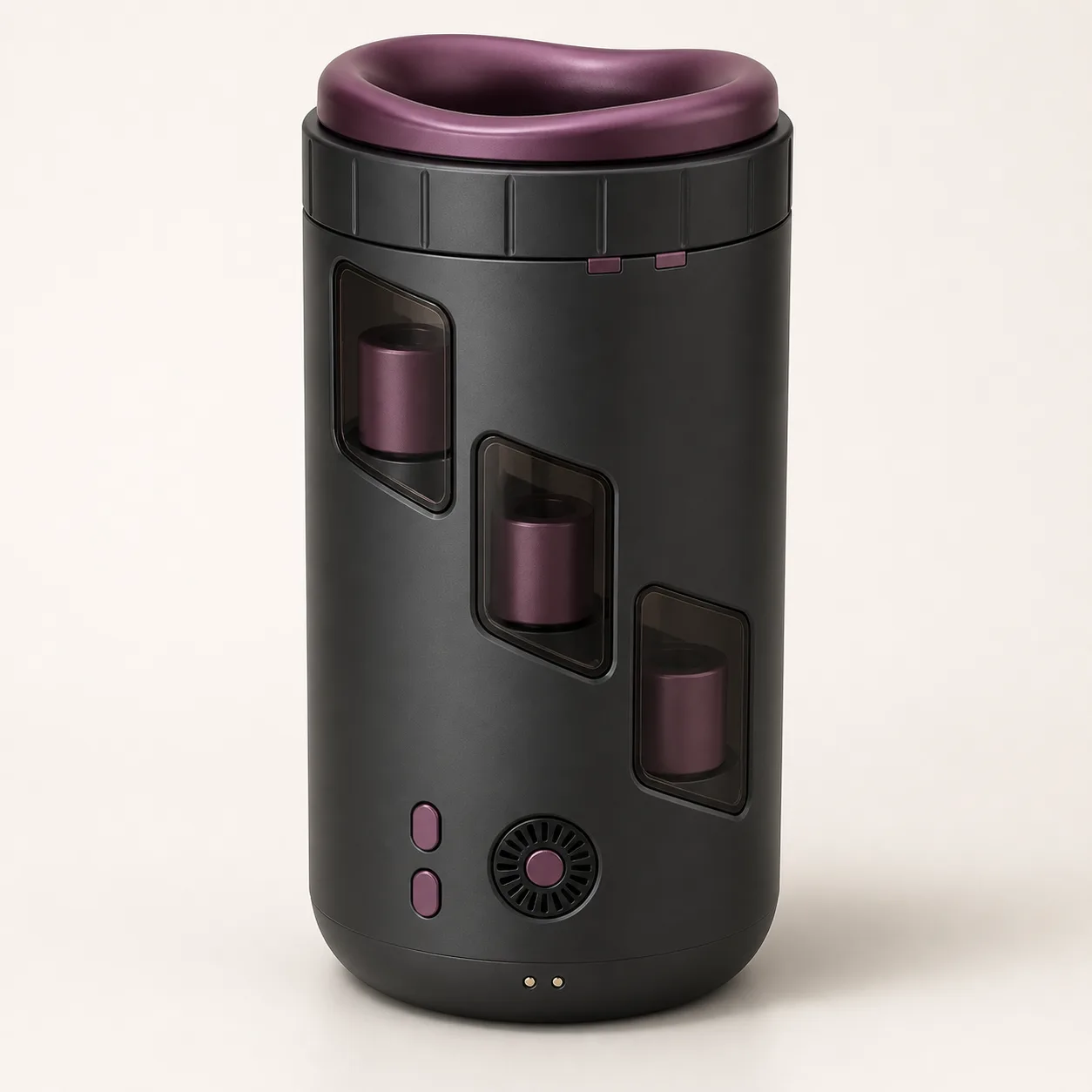
A compact automatic-stroker concept with a non-anatomical oval entry rim, exactly three guarded kneading nodes, one button, three indicators and two charging contacts.
89,99 $
200 in stock
Separate three visible nodes inside guarded windows
This tri-node kneading automatic stroker concept uses exactly three smoky-plum oval nodes, each isolated inside its own rounded-triangle front window on one matte-charcoal cup body. A non-anatomical oval entry rim, one button, three indicators and two charging contacts complete the visible architecture.

The rendering does not confirm dimensions, sleeve depth, node contact path, motion, motor count, materials, controls, battery, charging, ingress protection or production readiness.
Confirm one complete powered-device inventory
The proposed pack centres on one automatic cup device. No remote, phone holder, dock, cable, adapter, storage bag or detached sleeve is shown; final contents require an approved packing specification.
Request an exploded drawing that identifies the entry rim, internal sleeve, each node carrier, drive system, battery, controller, seals, contacts and service boundaries.
Measure the cup entry and internal depth
Record overall height, body width and depth, mass, oval entry dimensions, rim radius, entry compliance, internal usable depth, minimum internal width and distance from the entry to every moving contact zone. Use stable shell and base datums.
The outer rendering cannot establish internal fit or an insertable boundary.
Label and inspect all three nodes independently
Label the upper node N1, lower-left node N2 and lower-right node N3. Measure exposed size, softness, travel, edge clearance, carrier play and alignment, then inspect for tears, tack, seam steps and hard inclusions.
Three visible nodes do not prove three motors, independent control or equal loaded output.
Map the intended kneading path under compliant load
Use instrumented sleeves and graded fixtures to record displacement, contact force, speed, dwell, phase and recovery for N1, N2 and N3 through every verified setting. Compare unloaded and bounded loaded cycles.
Identify whether motion is in-and-out, orbital, lateral, sequential or shared through one carrier rather than inferring behaviour from the windows.
Probe every window for pinch and cleaning access
Measure node-to-guard, carrier-to-shell and window-rim clearances at rest, maximum observed travel and bounded offset loads. Use standardized soft-film and fibre probes while keeping fingers away from energized mechanisms.
Reject a closing gap, sharp guard rim, exposed linkage or recess that cannot be seen, wiped and dried by the validated method.
Verify the entry rim and removable-sleeve claim
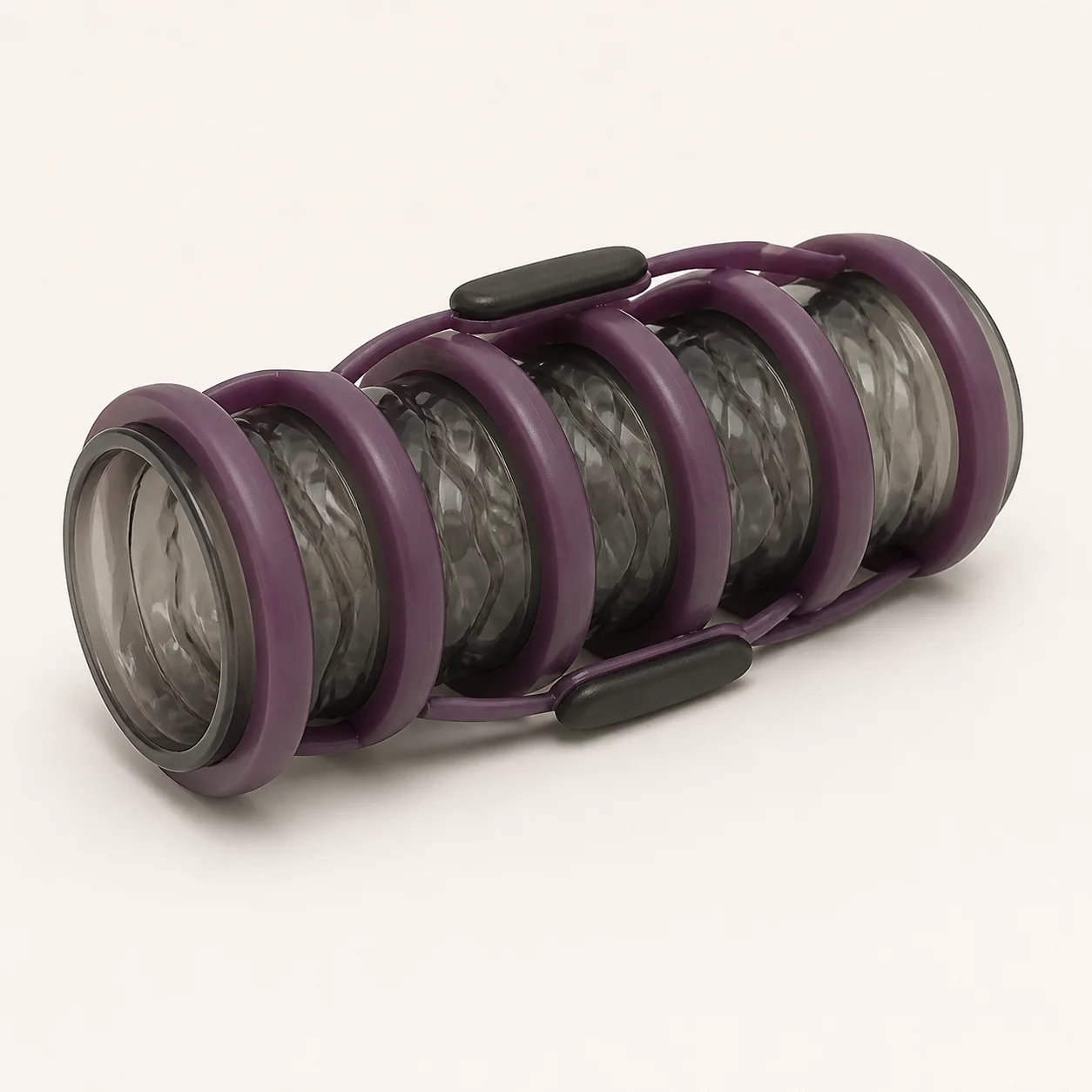
Inspect the smoky-plum rim for surface finish, attachment, compliance, edge radius and resistance to twisting. Confirm through drawings and samples whether the liner is removable, which parts may be separated and how correct reassembly is checked.
Do not pull, invert or detach any component unless exact instructions and durability evidence authorize it.
Document button logic and three indicators
Record activation hold, mode order, speed changes, pause, full-off action, lockout, memory and accidental-press behaviour. Define each indicator colour and pattern for power, setting, charging, completion and fault states.
Exactly three visible dots do not establish three speeds or battery-level steps.
Measure battery charging and contact heat
Request cell chemistry, capacity, input limits, protection circuit, charge time, runtime method, cycle life and lithium transport evidence. Test polarity protection, charge termination, low-voltage shutdown and restart.
Log temperature at the contacts, battery zone, node windows, entry rim and control panel during charging and every documented duty cycle.
Set sound vibration and duty-cycle boundaries
Measure airborne sound, shell vibration, current and surface temperature with each node mode unloaded and under bounded fixture pressure. Record startup peaks, irregular beating, drift and shutdown behaviour.
Quiet, continuous-use and low-heat language remains pending a model-specific protocol and acceptance limits.
Request exact sleeve node and shell materials
Obtain compositions, pigments, hardness, coatings, bonding, restricted-substance reports and lot traceability for the entry rim, internal sleeve, all three nodes, window guards and shell contact surfaces.
Silicone, body-safe, hypoallergenic, latex-free, phthalate-free and non-porous claims remain unavailable until exact-model evidence is approved.
Start at the lowest verified setting
Inspect the rim, sleeve, three nodes, guards, controls and contacts before use. Apply only a composition-compatible lubricant, begin with the device stopped, then select the lowest verified output while retaining immediate access to full off.
Stop for pain, numbness, bleeding, unusual pressure, pinching, rising heat, loss of control, material damage or irregular motion. Persistent symptoms require appropriate medical advice.
Clean only through validated access points
Power off and follow the approved disassembly, cleaner, water temperature, contact time, rinse and drying method. Wipe the entry rim, internal sleeve, N1 through N3, all window guards, button recess and shell seams without forcing liquid into unverified openings.
Immersion, boiling, bleach, solvents, abrasive brushes and energized cleaning are excluded unless exact evidence supports them.
Cycle nodes charging and cleaning together
Define endurance testing that combines loaded node motion, control operation, charging, cleaning, drying, sleeve assembly and storage. Inspect carrier play, guard clearance, node tearing, seal change, contact corrosion, cell condition and noise drift.
Record cycle counts and failure photographs for each node because a three-zone device can degrade asymmetrically.
Build landed price from an automatic-stroker benchmark
An Alibaba automatic-stroker category page displayed one hands-free heated automatic example at USD 10.98 to 11.90 with MOQ 1. It is a broad procurement benchmark only and does not identify this three-node windowed design or an approved supplier.
The public procurement benchmark supports an EUR 89.99 planning price after provisional allowance for China-origin freight, exact-sample measurement, node motion and pressure mapping, pinch screening, materials, controls, battery, charging, heat, sound, ingress and cleaning validation, discreet fulfilment and expected electronic-product handling loss. Exact supplier, quote, MOQ, dimensions, materials, packed weight, freight, duty, tax, certification, payment terms and lead time remain pending.
Frequently asked questions
How many kneading nodes are shown?
Exactly three separate oval nodes are visible through three guarded front windows in a one-above-two arrangement.
Do the three nodes move independently?
That remains unconfirmed until motor allocation, carrier design, control logic and loaded motion are measured.
What do the three indicator dots mean?
Their colours and patterns remain pending the approved electronics specification and instructions.
Is the internal sleeve removable?
Removal, permitted disassembly and reassembly checks require exact supplier documentation and sample verification.
Is the device waterproof?
No ingress claim is accepted without a model-specific report covering the entry, node windows, seams, control and charging contacts.
Which charger is included?
The cable, adapter, input rating and destination pack contents remain pending supplier confirmation.

Reviews
There are no reviews yet.