


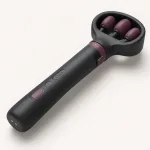
Three-Paddle Differential-Swing Wand Massager with Guarded Yoke Head
August 14, 2026
Triple-Band Floral-Lace Bralette and High-Waist Brief Set
August 14, 2026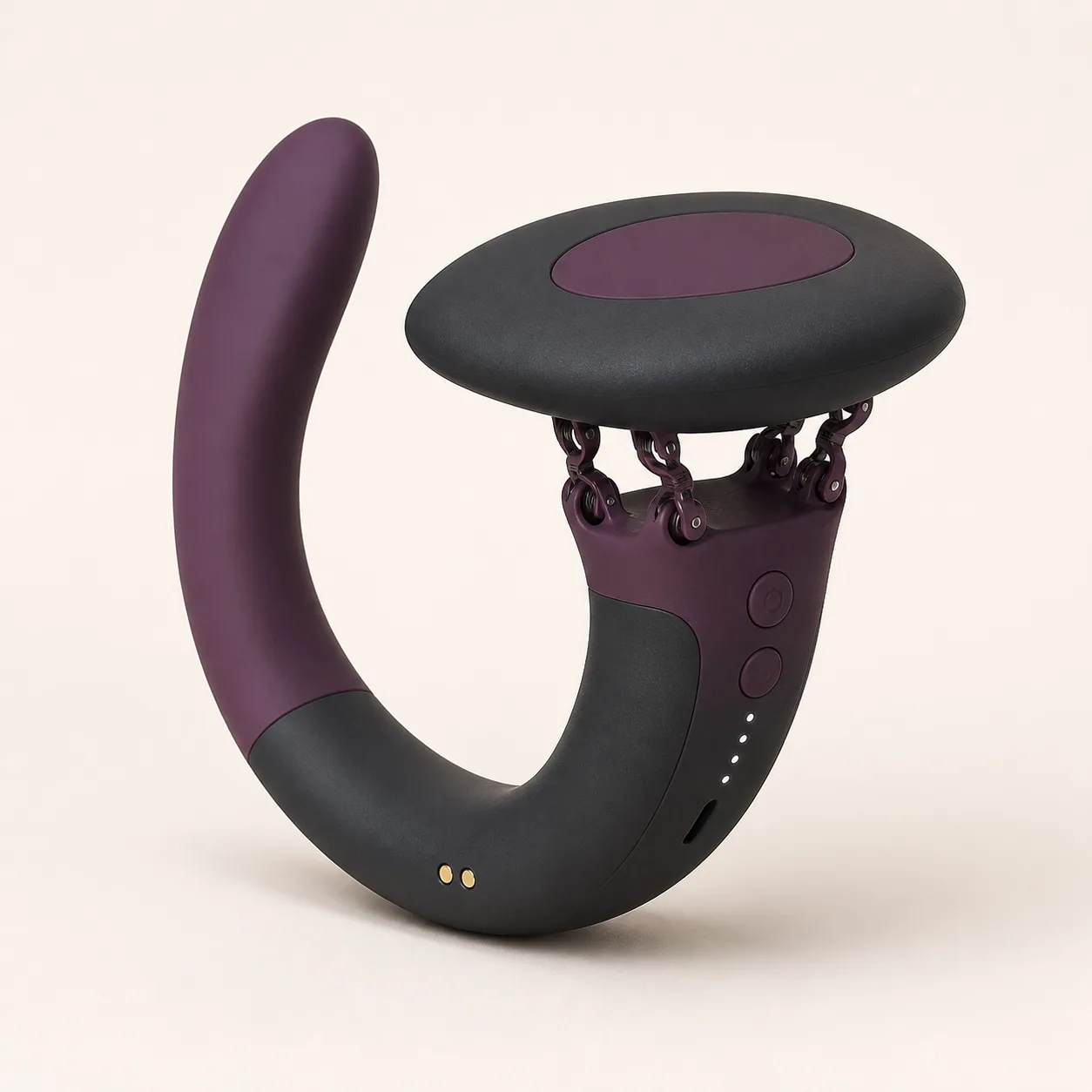
Four-Strut Floating Saddle Couples Vibrator with Slim Counterarm
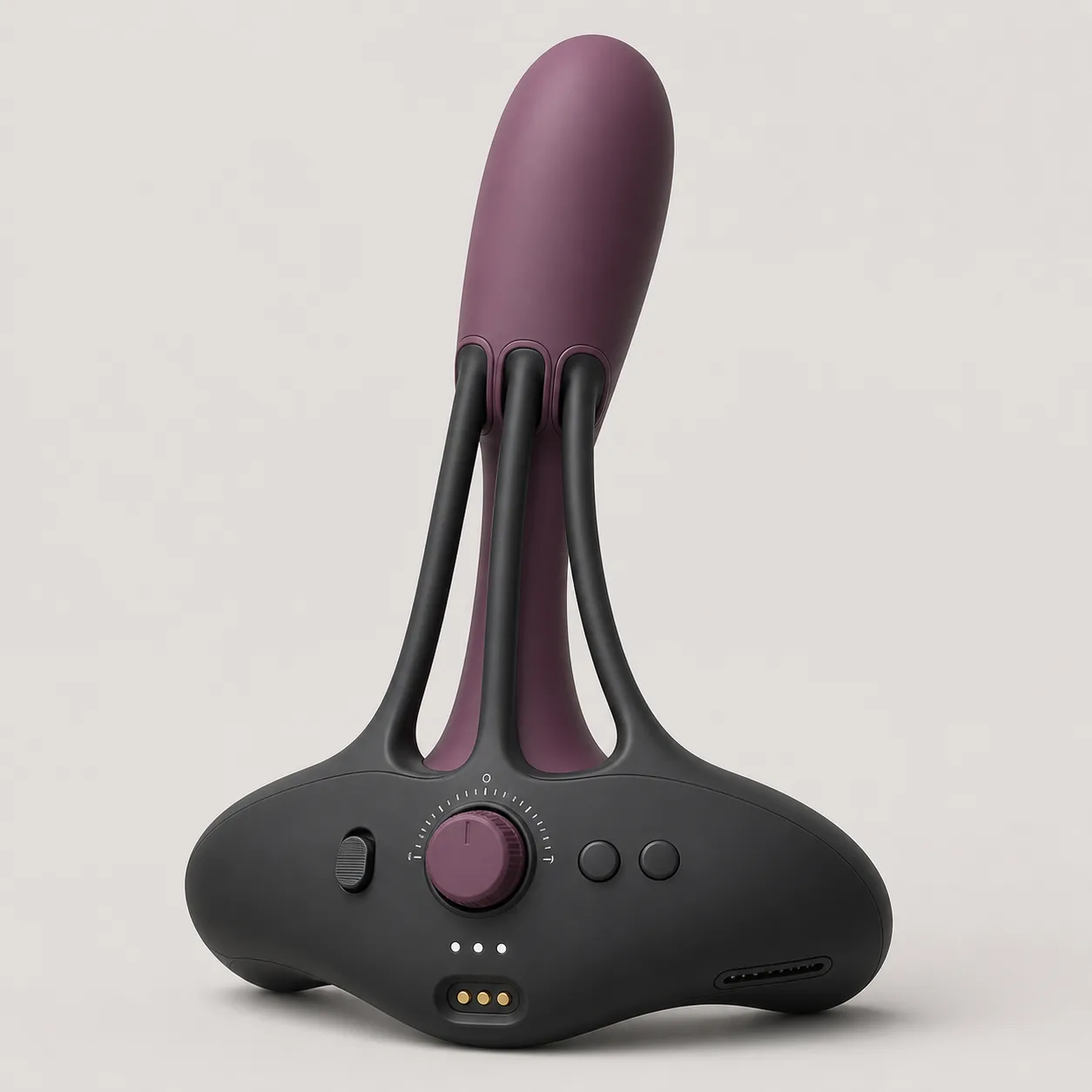
An asymmetric U-shaped couples vibrator concept with a slim counterarm and broad contact saddle suspended on four guarded twin-link strut stations.
49,99 $
200 in stock
Let a broad saddle float above a slim counterarm
This four-strut floating saddle couples vibrator concept uses an asymmetric U profile. A rounded inner counterarm faces a broad external saddle proposed to self-level through four guarded twin-link struts, giving the contact pad limited compliant travel without a sliding rail or single central hinge.

The image does not prove strut count inside the saddle, degrees of freedom, travel, fit range, outputs, controls, materials, sealing, runtime or production availability.
Inventory the four-strut assembly
Request an exploded drawing for the counterarm skin, inner core, U bridge, saddle shell, contact inset, four upper links, four lower links, eight pivots, axle retainers, bushings, limiters, guards, preload elements, carrier frame, actuators, motors, sensors, controller, buttons, indicator lenses, vent, contacts, cell, conductors, seals, pigments, lubricants and adhesives.
Identify which parts carry normal force, fore-aft load and reactive motor torque.
Establish the unloaded reference geometry
Measure overall height, width and depth, counterarm length and axes, tip profile, bridge radius and thickness, saddle axes and curvature, contact-inset axes, strut station spacing, neutral gap, control positions, mass and center of gravity.
Record the saddle plane relative to the counterarm at four indexed orientations before conditioning.
Map every strut as a separate linkage
For each station, measure link length, width, thickness, pivot diameter, axial play, radial play, guard clearance, neutral angle, stop angle, friction and preload. Compare all eight links rather than averaging the four stations.
Marking each joint makes asymmetric loosening visible during cycle tests.
Capture saddle motion in six degrees
Track vertical travel, fore-aft shift, lateral shift, pitch, roll and yaw under calibrated forces at the center and four saddle quadrants. Repeat at several bridge openings and with each supported vibration state.
Confirm that the permitted envelope is bounded by deliberate stops rather than by a link, conductor or seal reaching its strain limit.
Measure self-leveling under offset load
Apply compliant loads near each edge and map contact-plane angle, recovery time, residual tilt, per-strut load sharing and oscillation. Compare slow ramps, brief pulses and repeated off-center cycles.
A saddle that tips toward one station or develops persistent rock requires joint and frame inspection.
Characterize the saddle contact inset
Measure the oval inset profile, height above the surrounding rim, surface transitions, local compliance and output uniformity. Record acceleration and pressure at the center, long-axis ends, short-axis edges and outer shell.
Separate pad output from motion created by the suspension structure.
Map the slim counterarm independently
Capture counterarm curvature, tip coordinates, flex force, torsional stiffness, local output, pressure distribution and movement under symmetric and offset saddle loading. Check whether bridge opening changes tip orientation or contact amplitude.
Individual channel tests are needed if the saddle and counterarm use separate actuators.
Separate bridge flex from suspension travel
Measure bridge strain, opening force, elastic recovery and neutral drift while optically tracking both arm roots and all four strut stations. Repeat after temperature conditioning, sustained opening and combined-output cycles.
Fit claims should be based on the verified working envelope, not maximum forced separation.
Inspect pivot guards and access gaps
Probe every upper and lower pivot, link overlap, saddle underside, carrier edge, bridge junction, shell seam, button, vent and charging recess throughout the full motion envelope. Use articulated fixtures rather than fingers.
Guards must prevent access while still permitting debris inspection, cleaning and measured drying.
Verify controls and channel logic
Document startup hold, saddle selection, counterarm selection, level changes, combined mode, pause, immediate stop, memory, lockout and every indicator meaning. Measure command latency and conflict handling if channels can be adjusted separately.
Loss of signal, sensor disagreement or low voltage must lead to a predictable state.
Measure power sound and heat
Record current, acoustic output and temperature at the saddle inset, four strut stations, carrier, counterarm tip, bridge, controls, vent, contacts and cell during free operation, compliant load, offset load and a partly restricted vent.
Confirm cell chemistry, capacity, protection, charge input, polarity, charging interlock, charge time, runtime method and transport documents.
Challenge a single-strut fault
Increase drag at one pivot, restrict one station, add controlled play and simulate a position mismatch while the saddle is compliantly loaded. Record load redistribution, tilt, peak force, current, detection time, shutdown, residual motion and restart behavior.
Do not energize a sample with a cracked link, missing retainer, exposed conductor, binding saddle, swollen cell or abnormal heat.
Cycle fit motion and cleaning together
Run repeated bridge openings, central and offset saddle loads, channel changes, pauses, immediate stops, charging, cleaning, measured drying and storage. At checkpoints repeat geometry, joint play, six-axis travel, load sharing, pressure, output, gaps, sound, current and heat.
Validate residue removal beneath the saddle, around all eight pivots, at guards, bridge seams, controls, vent and charging recess without forcing the linkage.
Build the landed price after mechanism proof
An Alibaba massager-vibrator results page currently shows a U-shaped app-controlled wearable category example from Shenzhen Xindeli Technology Industrial Co., Ltd. at USD 2.65-2.98 with MOQ three pieces. It is a category benchmark only and does not confirm this four-strut floating saddle, contact inset or counterarm geometry.
The procurement reference supports an EUR 49.99 planning price after allowing for China-origin freight, exact-model sourcing, teardown, linkage metrology, six-axis saddle capture, load-sharing and self-leveling tests, pressure and output maps, bridge and counterarm analysis, gap review, channel logic, battery and thermal testing, single-strut fault work, combined cycle life, material evidence, cleaning validation, protective packing and discreet fulfillment. Exact quotation, MOQ, materials, packed size, weight, freight, duty, tax, insurance, payment fees and delivery terms remain pending.
Frequently asked questions
Does the saddle move freely in every direction?
No assumption is safe; measured translations, rotations and mechanical stops must define the permitted envelope.
Are there four independent strut stations?
The visualization shows four twin-link stations, but production construction requires teardown and joint-by-joint inspection.
How is self-leveling confirmed?
Apply offset loads at each quadrant and compare plane angle, recovery and load sharing across the four stations.
Can the links create pinch gaps?
Every pivot and overlap needs articulated gap testing throughout bridge and saddle motion.
Are the two contact zones separately controlled?
Only a sample and control-state matrix can confirm channels, combinations and conflict behavior.
Which damage ends evaluation?
A cracked link, loose retainer, persistent saddle tilt, binding, rising joint play, surface tear, exposed conductor, failed stop, abnormal heat or cell swelling.
Reviews
There are no reviews yet.