


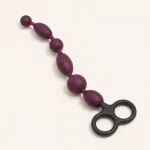
Alternating-Profile Anal Bead Strand with Twin-Loop Base
August 14, 2026
Lever-Release Parallel-Pad Sensory Clamps with Three-Stage Load Windows
August 14, 2026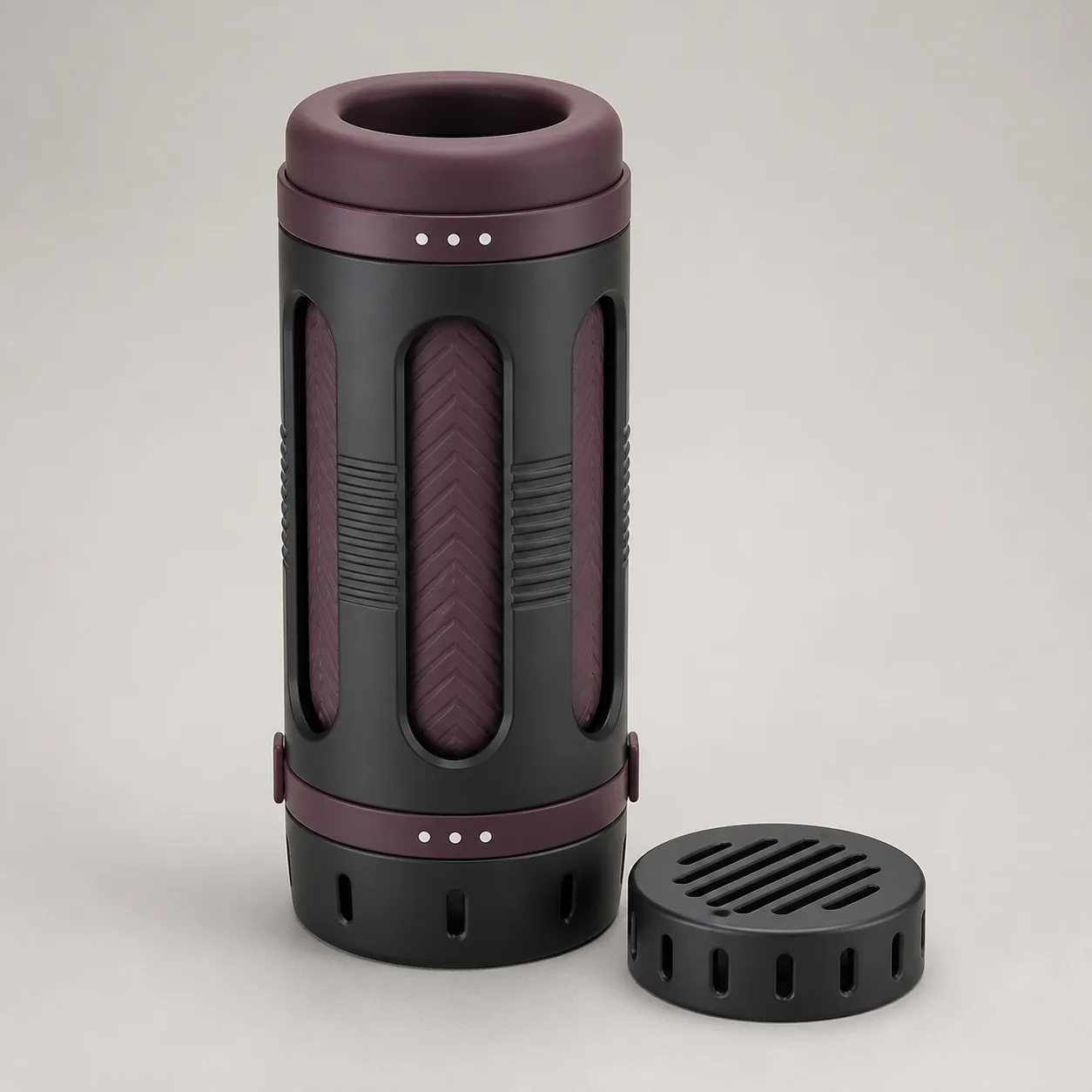
Four-Window Phase-Shift Manual Stroker with Twin Indexed Collars
A manual stroker concept with four arched liner windows, one removable chevron liner and two independently indexed three-position collars.
54,99 $
200 in stock
Use two collars to expose phase rather than promise pressure
This four-window phase-shift manual stroker concept uses one continuous smoky-plum chevron liner behind exactly four tall arched shell windows. Separate upper and lower collars each carry three white index dots, creating a visible way to document relative collar position without assuming what the mechanism changes.

The render fixes component identity for evaluation; it does not prove compression, fit, material, cleaning or production claims.
Assign identities before rotating anything
Label shell S0; liner L0; windows W1-W4; upper collar CU; lower collar CL; upper and lower three-dot scales; tabs T1-T2; grip ribs G1-G2; base vents V1-V4; cap K0; collar retainers; seals; pigments; lubricants and adhesives.
Require exact-sample drawings so a styling ring cannot be mistaken for an adjusting part.
Measure all four observation windows
Record height, width, corner radius, angular spacing, wall thickness and edge blend for W1-W4. Probe every boundary under grip load and during collar movement.
Reject sharp edges, shell whitening, liner extrusion, closing pinch gaps or window-to-window asymmetry outside the approved tolerance.
Profile the single chevron liner
Map L0 length, wall thickness, neutral aperture, chevron pitch, ridge height, hardness, friction, mass, deformation and rebound at several depths. Confirm that visible panels belong to one continuous removable component.
Reject tears, tack, pigment transfer, thin spots, bonded debris, residual set or hard structure exposure.
Calibrate the upper indexed collar
Measure CU rotation range, three index positions, detent torque, backlash, axial play and effect on the upper liner zone. Approach every index clockwise and counterclockwise.
Record whether CU moves a carrier, twists L0, changes shell clearance or performs no mechanical adjustment.
Calibrate the lower indexed collar
Repeat the same protocol for CL while monitoring the lower liner zone, base vents and cap interface. Compare torque and positional repeatability with CU.
Reject collar lift, skipped detents, uncontrolled spin, vent obstruction or contact with T1-T2.
Build a nine-state phase matrix
Combine the three verified CU positions with the three verified CL positions to create nine indexed states. For each state record collar angle, liner alignment, aperture profile, shell contact and restoring torque.
Do not describe the matrix as intensity levels unless controlled measurements support that interpretation.
Check liner retention and extraction
Measure T1-T2 pull force, liner-to-shell friction, axial migration, twist, buckling and reseating repeatability in every phase state. Inspect hidden retainers and collar interfaces after removal.
The liner must not creep into a window or block a vent during the approved handling cycle.
Map opening geometry without universal-fit claims
Measure rim diameter, thickness, edge radius, deformation, rebound and alignment with S0 and L0. Use standardized compliant gauges to map entry load and local pressure.
Individual suitability cannot be inferred from one aperture measurement or the visual size of the opening.
Verify cap fit and the four base vents
Measure K0 engagement torque, retention, vent open area, alignment with V1-V4 and effect on airflow and drainage. Test cap installation at every CL index.
Reject cross-threading, accidental release, trapped residue, blocked vents, brittle tabs or loose rattling.
Quantify grip and shell reaction
Record grip diameter, rib pitch, wet and dry friction, hand torque, shell ovalization and window displacement under standardized one-hand and two-hand fixtures.
Observe whether grip force changes CU or CL position or pushes L0 through W1-W4.
Measure pressure torque and liner phase
Use instrumented compliant forms to log insertion force, local pressure, drag, liner twist, collar torque and shell deformation in all nine indexed states. Separate repeatable mechanical effects from lubrication and temperature effects.
Publish only bounded results from production-equivalent samples.
Design cleaning around windows and chevrons
Challenge chevron valleys, window edges, collar gaps, detents, tabs, grip ribs, vents and cap slots with visible test soil. Record disassembly order, rinse access, drying time and residual mass.
No boiling, dishwasher, chemical or ingress claim is accepted without exact material and supplier evidence.
Cycle phase changes removal and cap use
Cycle CU and CL through the nine-state matrix, liner extraction, reseating, grip loading, cap engagement, cleaning, drying and storage. Remeasure backlash, tab force, window clearance, liner set and vent condition.
Retire test units for tears, loose collars, broken detents, shell cracks, liner migration, persistent residue or cap failure.
Build landed price after the phase matrix passes
An Alibaba simple-manual-stroker category page showed one example at USD 3.15-3.94 with a one-piece minimum. It is a broad benchmark only and does not identify this four-window design or an approved supplier.
The procurement benchmark supports an EUR 54.99 planning price after provisional allowance for China-origin freight, exact samples, liner and shell metrology, four-window clearance tests, CU and CL calibration, nine-state mapping, pressure, grip, cap, vent, cleaning and fatigue work, protective packing and discreet fulfilment. Exact quote, MOQ, dimensions, materials, packed weight, freight, duty, tax, certification, payment terms and lead time remain pending.
Frequently asked questions
What do the two collars change?
Their mechanical effect requires exact-sample teardown and nine-state measurement.
Are the three dots intensity levels?
No intensity meaning is claimed until each index is linked to measured behavior.
Is the chevron liner removable?
L0 is designed as removable in this concept; extraction force and reseating need verification.
Why are there four windows?
They expose liner position for inspection while edge safety and shell stiffness remain test items.
Can the cap stay fitted during storage?
Drying state, vent alignment and supplier care instructions must guide storage.
Which defects require retirement?
Tears, liner migration, loose collars, broken detents, shell cracks, persistent residue or cap failure.
Reviews
There are no reviews yet.