


Slide-On Under-Shelf Care-Supply Drawer with Opaque Bin
August 14, 2026
Three-Lever Zoned-Compression Manual Stroker with Depth Windows
August 14, 2026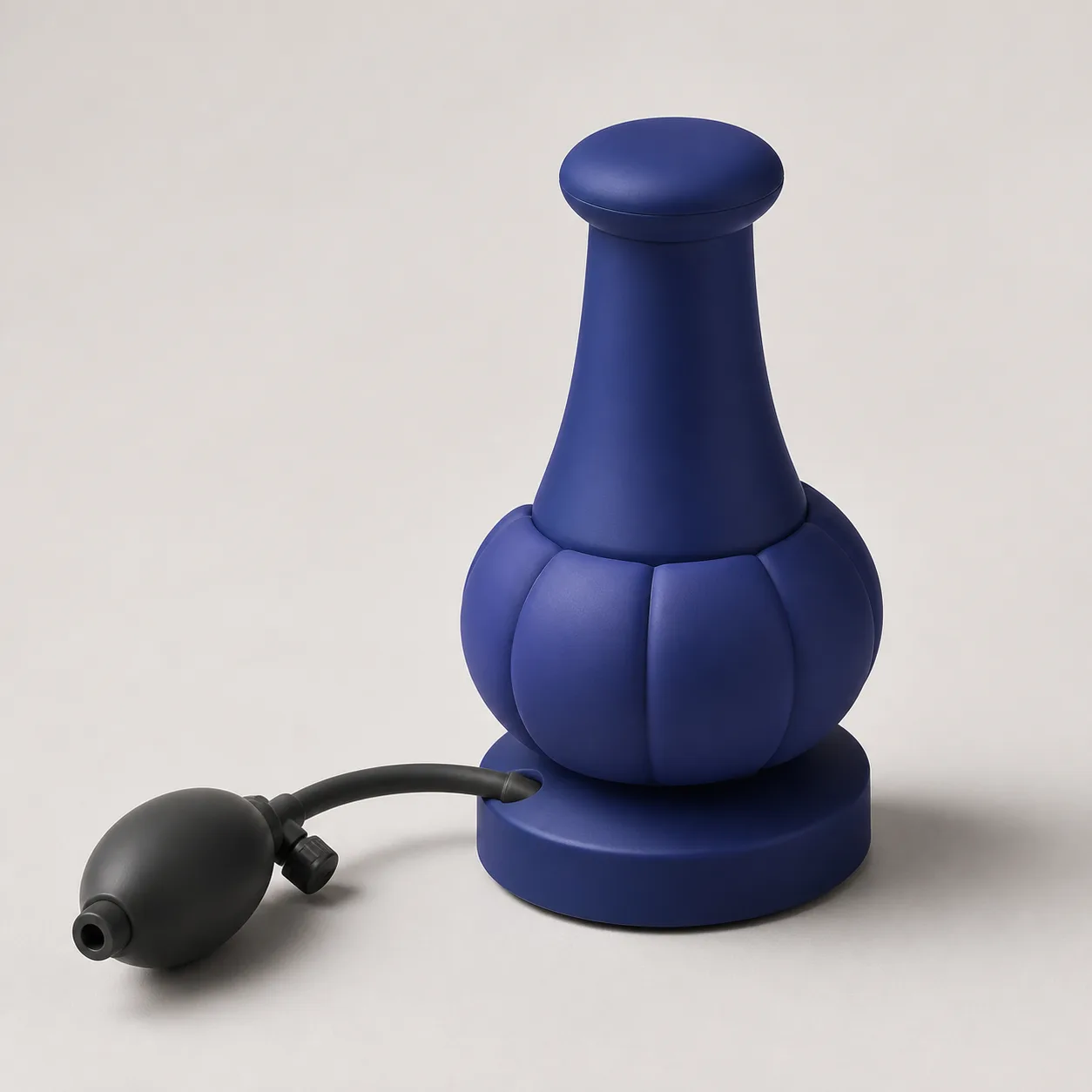
Inflatable-Knot Fantasy Suction Wand
An adjustable fantasy suction wand concept with a hand-pump cushion and evidence-led checks for pressure, valves, materials and cleaning.
49,99 $
200 in stock
Controlled expansion is the defining feature
This inflatable knot fantasy wand concept combines a tapered non-anatomical profile, an expandable segmented cushion, a broad suction base and a separate hand bulb. Its value depends on a measurable pressure range and a predictable shape change rather than on an unchecked maximum size.

No therapeutic, diagnostic or other medical outcome is claimed.
Both resting and expanded dimensions must be published
Measure overall length, usable length, tip width, shaft width, cushion diameter and circumference before inflation. Repeat every measurement at each approved inflation step and state tolerances so shoppers can compare actual profiles instead of relying on a dramatic image.
The specification must identify a hard maximum that is below the bladder’s test limit.
The internal bladder and outer skin need separate evidence
Request a cross-section drawing showing whether the air bladder is bonded, floating or moulded into the outer layer. Confirm the chemistry, thickness and supplier for the bladder, outer skin, tube, bulb, valve parts and every adhesive.
No silicone grade, latex-free status or body-safe claim is approved without model-specific documents.
Inflation pressure matters as much as circumference
Record the bulb strokes and internal pressure required for every approved size. The final instructions should define a conservative working range, a stop point and a method for recognising overinflation without asking the user to judge firmness alone.
Never continue pumping after the approved limit or after uneven swelling appears.
The hand bulb needs repeatable one-way flow
Test bulb volume, grip force, tube connection and check-valve operation across multiple samples. Air should move toward the chamber during pumping without backflow, intermittent sticking or a sudden pressure jump.
Inspect the bulb, tube and connectors for cracks, loosening or deformation before every session.
The release valve must deflate immediately
Measure how quickly the chamber depressurises from every approved setting while unloaded. The release control should be easy to identify by touch, remain accessible and open without excessive force.
Do not adjust inflation internally; deflate and withdraw at once if discomfort, numbness or a valve problem occurs.
Leak-down testing reveals slow faults
Inflate a conditioned sample to each approved pressure, isolate the bulb and log pressure and circumference over time. Define an acceptable leak-down limit and reject any unit with asymmetric softening, hissing or connector movement.
A product that will not hold its verified setting should not be used.
Seams require cyclic fatigue inspection
Cycle the bladder repeatedly between rest and the approved upper setting, including cleaning and storage conditioning. Examine cushion lobes, bonded edges, valve seat, tube joint and base transition under magnification for whitening, bubbles, separation or surface change.
Production sampling must use the same cycle count and rejection standard.
The suction base needs its own retention test
Confirm base diameter, flexibility and flatness, then test lateral and vertical retention on named smooth non-porous surfaces in dry and damp conditions. Publish the test surface and load rather than describing suction as universally strong.
The base is not a substitute for holding and monitoring the product.
Cleaning must keep liquid out of the air path
Validate an external wash, rinse and dry process that protects the valve, tube and bulb from liquid ingress. If components detach, the instructions must show the correct orientation and a drying check before reassembly.
Do not immerse the pump system or flush liquid through it unless the final manufacturer instructions explicitly approve that method.
Residue can hide around lobes and connectors
Inspect the valleys between cushion segments, valve recess, tube socket and base edge after cleaning. A lint-free swab and magnified visual check should show that the approved method reaches every contour without damaging the outer skin.
Store only when all surfaces and air-system connections are fully dry.
Compatibility testing must include the inflated state
Condition samples with each approved cleaner and lubricant while both relaxed and expanded. Look for swelling, tack, discoloration, cracking, valve stiffness, seam movement and changes in leak-down performance.
Only combinations that pass the finished-model protocol should appear in the final care guide.
The sourcing lead is not a finished specification
The Alibaba page displays USD 15.84 for 1 to 50 units, USD 15.34 for 51 to 100 and USD 14.34 from 101. Supplier identity, rights to the unbranded model, exact pump system, dimensions, materials, performance and packaging remain pending.
The procurement reference is a sourcing lead only. Any liquid-dispensing feature is excluded from the approved catalog concept unless its reservoir, route, cleaning protocol and measured operation are fully defined.
The provisional price funds pneumatic validation
The EUR 49.99 plan allows for China-origin freight, a sample, dimensional mapping, controlled-pressure trials, valve response, leak-down, seam fatigue, suction, material, cleaning and packaging checks. Freight, duty, tax, insurance, payment fees and destination terms remain pending.
Price and launch status should be reviewed after a complete landed-cost record and passed sample.
Compare adjustable and fixed fantasy shapes carefully
An inflatable cushion changes both girth and firmness, while a fixed fantasy wand offers stable geometry with no air path. Adults considering this design should prefer verified incremental measurements and reliable deflation over the novelty of the largest possible setting.
This is an advanced adjustable concept, not a shortcut around fit, preparation or conservative progression.
Frequently asked questions
What is the maximum inflated diameter?
The approved diameter, circumference, pressure and dimensional tolerance remain pending controlled sample measurement.
How many pump strokes should be used?
A stroke-to-pressure chart must be created from the final bulb, tube, valve and bladder assembly before instructions are approved.
Can the cushion be adjusted during use?
No internal adjustment is recommended. Deflate and withdraw before changing the setting, and stop immediately if release is not prompt.
Is the entire product silicone?
Outer skin, bladder, bulb, tube, valve, adhesive and base materials each remain pending model-specific evidence.
Can the pump and tube be submerged?
Not unless the final manufacturer method explicitly permits it. The care protocol must prevent trapped liquid in the air path.
What should be inspected before use?
Check the surface, cushion seams, valve, tube joints, bulb and base for cracks, separation, leaks, tack, deformation or blocked airflow.
Reviews
There are no reviews yet.