


Quad-Cam Three-Zone Compression Stroker with Reversible Open-End Liner
August 14, 2026
Dual-Rail Interleaved-Vane Manual Stroker with Split Tension Sliders
August 14, 2026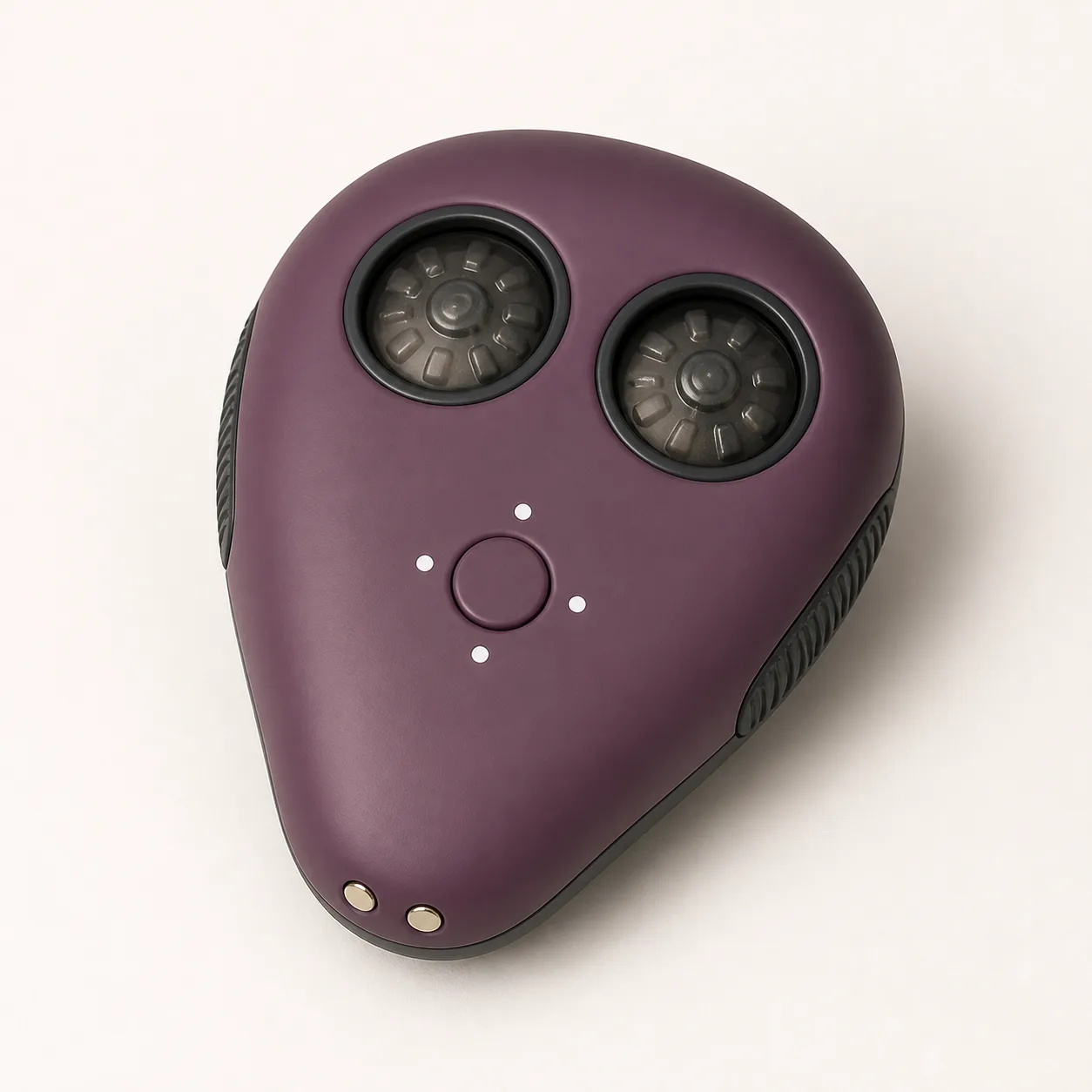
Twin-Drum Four-Phase Palm Vibrator
A compact teardrop palm vibrator concept with two visible eccentric drums, four proposed phase states, dual side grips and tail charging contacts.
49,99 $
200 in stock
Compare two visible drums in one palm body
This twin-drum four-phase palm vibrator concept places exactly two circular eccentric-drum windows side by side in a smoky-plum teardrop shell. One central selector and four white phase dots propose four relationships between the two moving sources rather than a simple single-motor intensity ladder.

The image establishes a testable architecture and does not verify the internal mechanism, output, materials, battery or production status.
Name the complete mechanical and electrical stack
Label shell S0; underside U0; drum bays D1-D2; transparent windows W1-W2; rotors R1-R2; eccentric masses M1-M2; mounts K1-K2; selector B0; indicators I1-I4; side grips G1-G2; contacts J1-J2; controller, cell, seals, fasteners, pigments and adhesives.
Match teardown observations to an exact-sample bill of materials and firmware identity.
Measure the teardrop shell and underside
Record length, maximum width, thickness, edge radius, mass, center of gravity, surface hardness, shell deflection and underside curvature. Map seams and hard transitions around the wide drum end and tapered charging tail.
Reject rocking, sharp parting lines, local collapse, tack, discoloration or shell movement around either bay.
Characterize both drum windows independently
Measure W1-W2 diameter, bezel height, lens thickness, clarity, scratch resistance and seal geometry. Use high-speed imaging to determine whether visible R1-R2 motion matches commanded behavior.
Windows make the mechanism inspectable but add seal, impact and cleaning questions that require direct evidence.
Decode all four proposed phase states
Map B0 actions and I1-I4 indications to motor speed, direction, relative phase, modulation and stop behavior. Measure the commanded and observed relationship between D1 and D2 at every state.
Four dots do not prove four distinct phase programs until synchronized sensor data separates them.
Map output across the entire contact face
Record acceleration, frequency, harmonics and phase at both drum centers, the midpoint, wide corners, tapered nose, underside and side grips. Use a fixed grid and consistent sensor orientation.
Plot areas of reinforcement and cancellation so buyers can compare spatial patterns rather than one peak number.
Repeat measurements under controlled preload
Test each confirmed state against calibrated compliant fixtures at several bounded forces. Log drum speed, output map, shell deflection, current, temperature and program stability.
Reject rotor contact, window chatter, abrupt stalls, excessive output collapse or mode changes caused by preload.
Assess grip security and hand isolation
Measure the two ribbed charcoal grips for texture depth, edge comfort, wet and dry friction, compression and bond strength. Record vibration transfer to G1-G2 at every program.
A secure palm hold depends on geometry and isolation together; ribbing alone does not establish control.
Verify selector priority and state visibility
Document startup, state advance, intensity control if present, pause, immediate stop, travel lock and low-battery behavior. Test B0 with dry, damp and gloved fixtures and view I1-I4 under bright and dim lighting.
The shortest documented action must always reach stop without cycling through additional programs.
Validate the charging and battery system
Confirm J1-J2 polarity, input limits, charge time, operating time, low-voltage cutoff, overcurrent protection and standby drain. Measure contact and cell temperature during charge and repeated discharge.
Battery chemistry, capacity, cable type, charger compatibility and transport documentation remain pending exact-model evidence.
Log sound heat and structural resonance
Measure A-weighted sound and temperatures at D1-D2, the midpoint, grips, selector, controller, cell and contacts. Use a repeatable acoustic room position and stabilized ambient conditions.
Distinguish intended beat patterns from loose bezels, window chatter, shell buzz, bearing noise and mount fatigue.
Probe seals seams and cleaning recesses
Inspect both window bezels, shell joint, selector edge, grip bonds and charging recess with magnification and visible test soil. Record residue, drying time, window fogging, swelling and corrosion after repeated wiping.
No waterproof or immersion claim is made without exact-model ingress documentation and independent testing.
Confirm materials and surface durability
Request declarations for the shell, underside, window lenses, bezels, grips, button, pigments, adhesives and internal mounts. Test odor, color transfer, coating adhesion, abrasion and chemical compatibility on production samples.
No silicone, body-safe, hypoallergenic or certification claim is accepted while traceable composition evidence is pending.
Cycle phase switching load and fault events
Cycle all confirmed programs, preload changes, selector actions, charging, cleaning and storage. Challenge single-drum restraint, dual restraint, partial stall, low voltage, interrupted charging and power loss in guarded fixtures.
Retire test units for cracks, loose windows, rotor contact, unstable phase, abnormal heat, charging faults, fluid entry, cell swelling or unexpected restart.
Build landed price from twin-source evidence
An Alibaba rechargeable mini-vibrator category page showed one example at USD 2.24 to 2.43 with a ten-piece minimum. It is a broad benchmark only and does not identify this twin-drum palm design or an approved supplier.
The public procurement benchmark supports an EUR 49.99 planning price after provisional allowance for China-origin freight, exact samples, dual-drum teardown, four-phase synchronization, spatial and loaded output maps, sound, heat, charging, ingress, cleaning, fault and fatigue work, protective packing and discreet fulfilment. Exact supplier, quote, MOQ, dimensions, materials, battery, packed weight, freight, duty, tax, certification, payment terms and lead time remain pending.
Frequently asked questions
Are both drum windows functional?
The concept proposes two moving sources; teardown and synchronized measurement must confirm the mechanism.
What do the four dots represent?
They propose four phase states whose exact speed, direction and timing require firmware mapping.
Can each drum be controlled separately?
No independent-control claim is made without verified input and output behavior.
Is the device waterproof?
No ingress rating is claimed for the windows, selector, shell seam or charging contacts.
How loud is it?
Sound must be measured across every confirmed state under unloaded and controlled-preload conditions.
Which defects require retirement?
Cracks, loose windows, rotor contact, unstable phase, heat, charging faults, fluid entry or cell swelling.
Reviews
There are no reviews yet.