


Clip-On Care-Shelf Dividers with Rounded Tops, 4-Pack
August 14, 2026
Rail-Indexed Sliding-Pad Rabbit Vibrator with Independent Dual Controls
August 14, 2026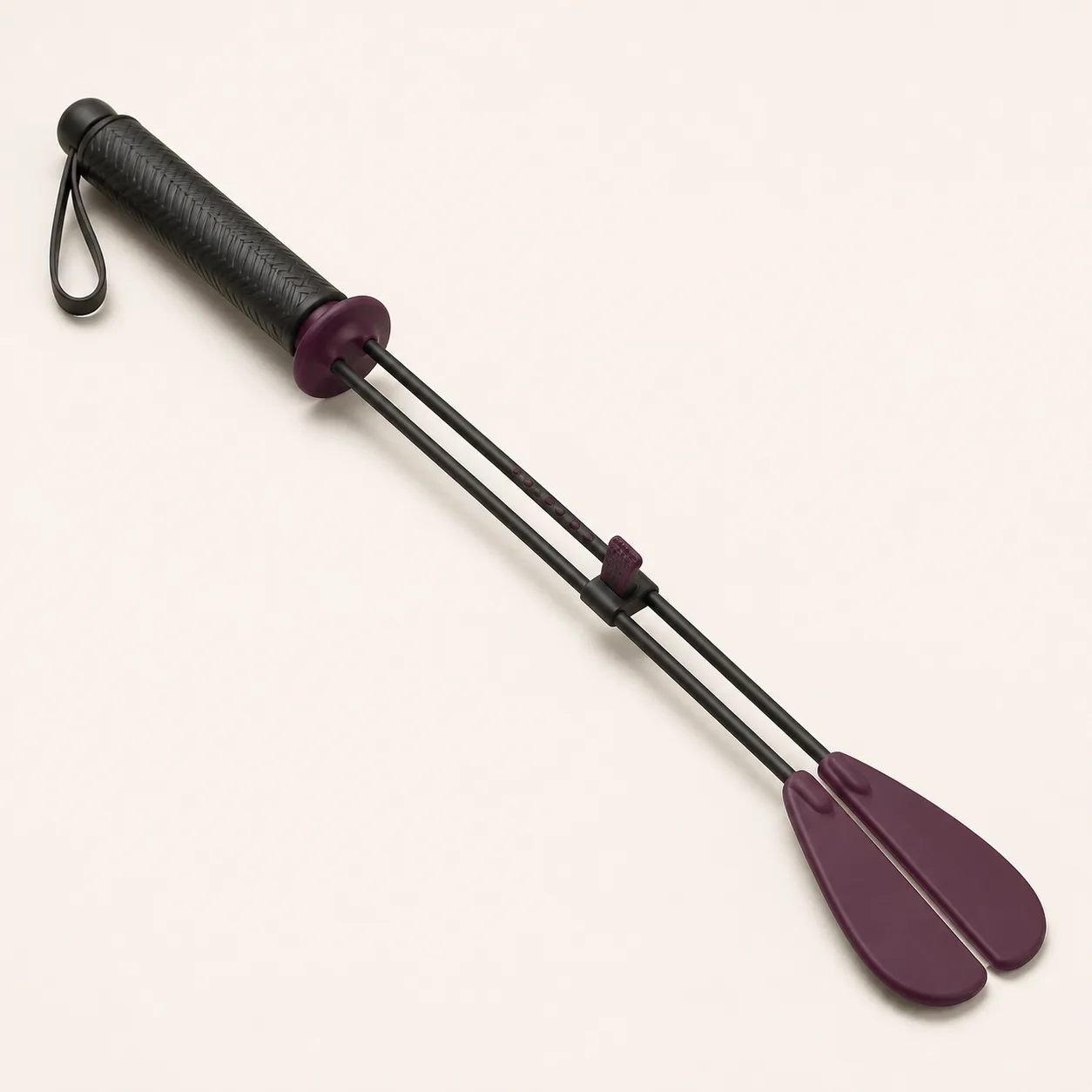
Twin-Spine Split-Head Sensory Crop with Sliding Flex Gate
A non-powered sensory crop concept with two parallel flexible spines, separate rounded head paddles and a sliding gate for measurable free-length changes.
28,99 $
200 in stock
Vary twin-spine free length through one sliding gate
This twin spine sensory crop concept uses two separated flexible shafts, one rounded paddle on each shaft and a sliding gate intended to change the unsupported spine length. A broad guard, textured grip and wrist loop complete the connected assembly.

The image does not prove overall length, gate settings, flex range, impact force, material, edge softness, durability or supplier approval.
Inventory the complete crop assembly
Request an exact drawing and bill of materials for the grip shell, core, end cap, wrist-loop strap, loop anchor, guard, two spines, spine jackets, gate frame, bushings, thumb tab, detents, stops, markers, two head paddles, paddle cores, coverings, stitching, pigments, coatings, lubricants and adhesives.
Identify every mechanical joint and confirm whether the twin shafts are separate from the handle core or branches of one formed reinforcement.
Measure handle, guard and balance
Record grip length, oval circumference, texture depth, guard span and thickness, cap dimensions, loop opening, total mass and center of gravity. Measure dry and damp grip friction with several glove surfaces.
Map hand clearance to the guard and verify that the loop anchor cannot rotate into a sharp edge or alter balance during a controlled swing.
Map both spine profiles independently
Measure each shaft’s diameter, straightness, free length, spacing, parallelism, jacket thickness, root fillet and head alignment. Compare left and right bending stiffness in two planes.
Inspect the entire gap between shafts for snag points, crossed spines, hidden ties or inconsistent spacing.
Calibrate the sliding flex gate
Measure gate travel, sliding force, detent depth, side play, tilt, stop compression and accidental movement resistance. Record the unsupported length of both spines at every visible reference.
Check whether the bridge clamps, guides or merely spaces the shafts, and never label positions as intensity levels without instrumented evidence.
Inspect the two rounded head paddles
Measure each paddle’s length, width, thickness, face area, edge radius, mass, spine insertion and covering overlap. Inspect seams, rolled edges, voids, hard spots, exposed core and adhesive squeeze-out.
Confirm both paddles remain separate through the full flex range and cannot scissor, cross or expose the spine tips.
Measure head alignment and phase
Track paddle centerlines, angular offset, face parallelism and separation while the crop is still and during slow controlled bending. Record whether both heads move together or one lags.
A small mismatch can create two distinct contacts rather than one split contact and must be included in pressure and timing tests.
Build load-deflection curves for every gate position
Support the handle in a repeatable fixture and apply known low loads at each paddle center. Record displacement, restoring force, shaft curvature, gate movement, left-right difference and permanent set.
Repeat in both primary bend planes and stop before buckling, jacket wrinkling, gate lift or paddle rotation.
Compare controlled low-energy contact traces
Use an instrumented compliant target and a controlled arc to record peak force, contact duration, head separation, rebound and sound at conservative energies. Test each gate position separately.
Do not test on a person. Use the measurements only to define conservative training limits and to detect unstable double contacts.
Evaluate gate position without intensity claims
Compare deflection curves and instrumented traces to determine how gate location changes timing, head spread and energy transfer. Check whether short unsupported lengths create abrupt stops or higher local pressure.
Document the results as measured mechanical behavior, not subjective severity, and prohibit untested intermediate positions.
Check grip, guard and wrist-loop handling
Run slow handling drills with the product unloaded and aimed away from people. Measure grip rotation, finger-to-guard clearance, thumb contact with the gate and the loop’s effect on release and recovery.
The wrist loop is a handling aid only; it is not a restraint, suspension point or reason to keep holding damaged equipment.
Cycle spines, gate and paddle joints
Run repeated gate adjustment, low-load bending, controlled target contact, recovery, grip rotation, cleaning and storage cycles. At checkpoints measure sliding force, spine stiffness, spacing, head alignment, edge condition, joint play and balance.
Retire a sample after shaft cracking, exposed core, jacket split, gate creep, lost detent, paddle twist, seam opening, hardened edge, loose guard or damaged loop anchor.
Apply consent and conservative placement rules
Use explicit consent, a clear stop signal, sober judgment, good lighting and an agreed low-energy plan. Avoid the head, face, front or side of neck, spine, kidneys, abdomen, joints, hands, feet, injured tissue and any area with reduced sensation or impaired circulation.
Stop immediately for unexpected pain, numbness, dizziness, breathing difficulty, broken skin, swelling, loss of communication, equipment damage or uncertain placement.
Validate surface care and drying
Obtain exact material and cleaner compatibility data before testing. Clean both paddle faces and edges, spine jackets, gate channels, thumb tab, reference recesses, guard, grip texture, cap and wrist loop.
Measure drying by mass and inspect the split-head seams, gate bushings, guard roots and loop anchor for retained moisture or residue before closed storage.
Price after flex behavior is measured
An Alibaba slim riding-crop listing currently shows USD 2.30-2.61 with an MOQ of one. It is a category benchmark only and does not confirm this twin-spine structure, sliding gate, split head or approved supplier.
The procurement reference supports an EUR 28.99 planning price after allowing for China-origin freight, complete teardown, balance and grip review, two-spine metrology, gate calibration, paddle and edge inspection, load-deflection curves, instrumented low-energy contact tests, fatigue cycling, material evidence, cleaning validation, protective packing and discreet fulfillment. Exact quotation, packed dimensions, weight, freight, duty, tax, insurance, payment fees and delivery terms remain pending.
Frequently asked questions
Do the reference dots define intensity?
No. They indicate gate positions until mechanical and instrumented testing establishes allowed settings.
Does the gate lock both spines?
Its internal action is unconfirmed; travel, detents, clamping and spacing require sample inspection.
Why are there two head paddles?
The split head creates two separately measurable contacts, but alignment and timing must be verified.
Is the wrist loop a restraint point?
No. It is only a handling aid and has no restraint or body-load rating.
Can cleaners be used on every surface?
Only formulations approved for the exact coverings, jackets, grip, pigments, adhesives and loop strap.
Which faults require immediate retirement?
A cracked spine, exposed core, creeping gate, lost detent, crossed head, twisted paddle, open seam, hard edge, loose guard or damaged loop anchor.
Reviews
There are no reviews yet.