



Double-Layer Asymmetric-Hem Mesh Babydoll and High-Waist Brief Set
August 14, 2026
Four-Panel Padded Posture Collar
August 14, 2026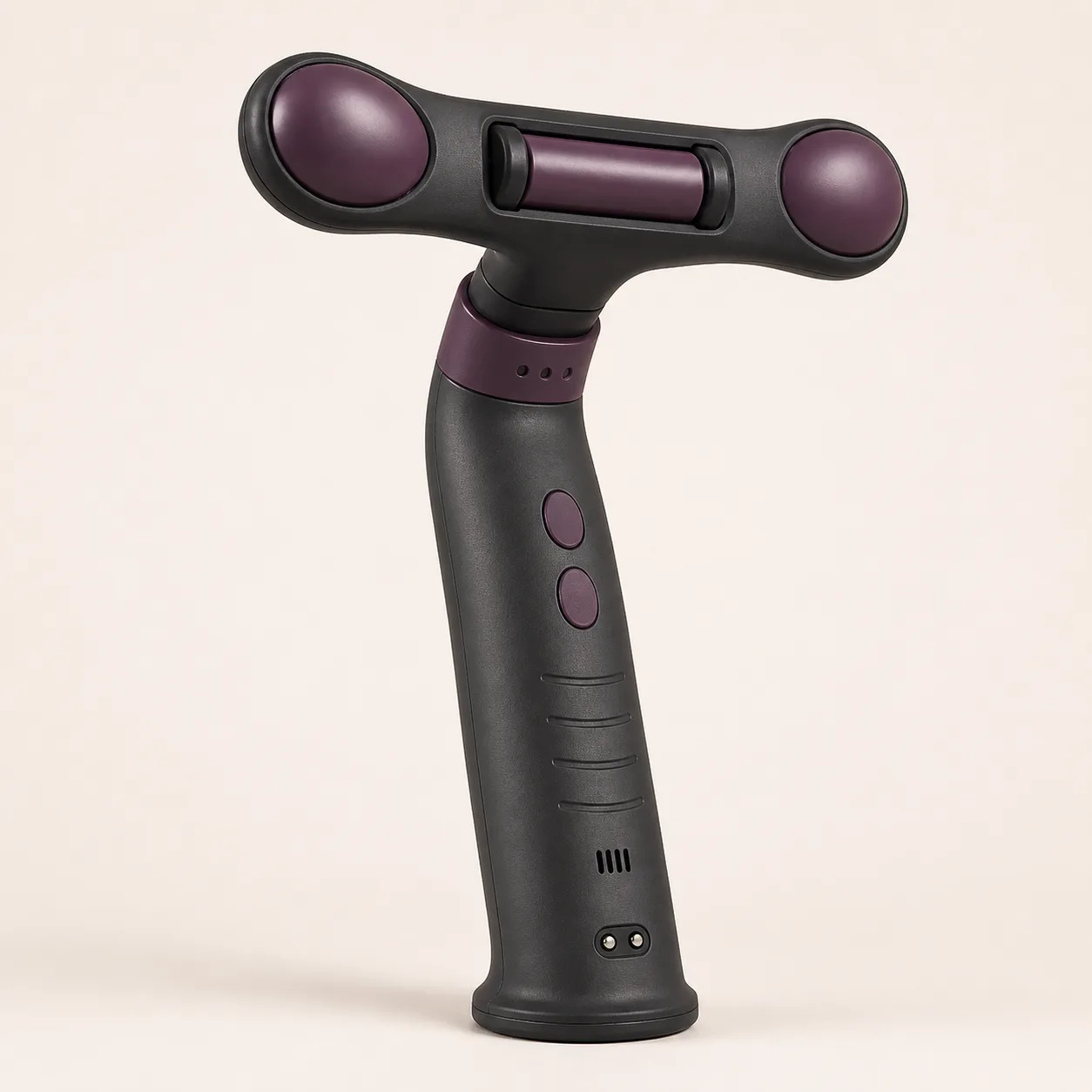
T-Bar Twin-Dome and Center-Roller Wand with Hinged Crosshead and Three-Stop Angle Collar
A standing T-bar wand concept with two rounded plum end domes, one guarded centre roller, hinged crosshead, three-dot collar, two controls and four grip grooves.
64,99 $
200 in stock
Combine twin end domes with one guarded center roller
This T-bar twin-dome center-roller wand concept places one smoky-plum oval dome at each end of a charcoal crosshead and one horizontal cylindrical roller in the centre. A hinged neck, three-dot angle collar, two buttons, four shallow grip grooves, one vent and two charging contacts complete the standing handle.

The image establishes visible architecture only. Motion, output, materials, charging and ingress protection remain pending physical evidence.
Keep the sales unit to one assembled wand
The proposed pack contains exactly one powered wand. A cable, adapter, dock, remote, phone application, detachable head, replacement roller, case and cleaner are excluded unless an approved packing list changes.
The two domes and centre roller are integrated into the crosshead.
Measure the T-bar crosshead from one common datum
Record total span, centre thickness, end thickness, curvature, mass and alignment relative to the handle axis. Check left-right symmetry and crosshead deflection under centre, single-end and two-end loads.
The broad bar must not twist enough to bring a rigid edge into contact.
Match the left and right oval dome profiles
Label domes D1 and D2 and measure length, width, height, crown radius, edge transition, local hardness and surface finish. Compare compression and recovery after repeated loaded vibration cycles.
Identical appearance does not prove matched output or motor allocation.
Set one horizontal cylinder inside the center recess
Record roller length, diameter, end radius, exposed arc and distance from both domes. Measure breakaway torque, running torque, runout, wobble and lateral play before and after conditioning.
Rotation, passive rolling and powered motion remain unconfirmed.
Guard both roller axles and screen every recess gap
Probe the spaces at each axle cap, roller end and window edge across all hinge angles. Test for hair, fibre and skin entrapment plus residue and drying access.
Do not use the wand if the roller binds, an axle moves or any gap can pinch tissue.
Validate the hinged neck across supported angles
Measure angular range, torque, play, stops and crosshead drift with the device off and running. Apply repeated bending cycles and inspect the hinge shell, conductors and seals.
Angle locking and one-handed repositioning claims remain pending.
Map the three-dot collar to verified angle states
The plum collar shows three charcoal dots. Confirm whether they correspond to three detents, alignment references or decoration, and measure seating force and false-lock behaviour at every state.
No three-angle claim is made until the collar and hinge mapping are proven.
Compare single-zone and mixed-zone load paths
Load D1, the centre roller and D2 separately, then in pairs and together. Measure crosshead deflection, hinge moment, handle vibration, current and contact pressure so mixed contact does not exceed structural limits.
Uniform pressure and balanced handling remain pending measured data.
Define the two-button control map through firmware tests
Document power timing, short and long presses, zone selection, sequence, intensity, pause, travel lock, memory, status feedback and emergency stop after firmware is fixed. Check accidental activation during storage.
Independent dome or roller control is not promised.
Use four shallow grooves as grip references
Measure groove width, depth, spacing and relationship to the buttons across production samples. Test wet and dry handling with several adult hand sizes while logging wrist angle and slip.
Grip grooves do not establish non-slip performance without testing.
Map output at D1 roller D2 hinge and handle
Measure frequency, acceleration, amplitude, startup, decay, sound and heat at each contact and through the structure across every verified state. Repeat under single, paired and triple compliant loads.
Dual-motor, triple-zone, rolling, tapping, synchronized-phase and quiet-operation claims remain withheld.
Set conservative external-use boundaries
Use only on intact external skin after confirming cleanliness. Begin with the lowest verified output, keep fingers clear of the roller recess and stop immediately for pain, numbness, swelling, discoloration, bleeding, pinching, unusual noise, heat or loss of control.
No internal-use dimension, medical benefit, recovery, therapy or performance claim is made.
Validate battery charging materials ingress and cleaning
Request cell chemistry, rated capacity, charging input, cable type, charge time, runtime method, protection circuits and transport evidence. Obtain traceable composition for domes, roller, axles, head, hinge, collar, handle, buttons, vent and contact surround, then test the complete assembly for heat, cleaner compatibility and liquid ingress.
Silicone, ABS, metal, latex-free, phthalate-free, hypoallergenic, body-safe and waterproof claims remain withheld. Clean and dry the roller recess, hinge, collar, grooves, vent and contacts only by a validated method; stop use for cracks, tackiness, corrosion, seized motion, loose parts or erratic output.
Price from mini-wand benchmarks and mixed-head validation
Alibaba mini-wand pages displayed category references at USD 1.85 to 2.35 with MOQ 101, USD 2.99 to 3.49 with MOQ 500, USD 2.43 to 2.97 with MOQ 1 and a USB wand reference at USD 2.25 to 2.55 with MOQ 3. These are broad examples, not quotations for this T-bar mixed-head design or approved suppliers.
The public procurement benchmark supports an EUR 64.99 planning price after provisional allowance for China-origin freight, two dome moulds, one guarded roller, T-bar and hinge load tests, collar mapping, mixed-zone output, grip, battery, heat, sound and ingress validation, discreet fulfilment and expected electronic quality loss. Exact supplier, quote, MOQ, dimensions, materials, motors, packed weight, freight, duty, tax, certification, payment terms, lead time and production availability remain pending.
Frequently asked questions about the T-bar roller wand
How many contact domes are included?
Exactly two rounded oval domes sit at the left and right ends of the crosshead.
Does the centre cylinder rotate?
Rotation, passive rolling and powered motion remain pending teardown and torque tests.
Does the collar provide three angles?
Three dots are visible, but detent count and angle mapping remain unverified.
Can the domes and roller run separately?
Zone selection, motor allocation and firmware logic remain pending.
Is a charging cable included?
Cable type and inclusion are not confirmed by the planned one-wand inventory.
Is the wand waterproof?
No ingress claim is made until the complete roller, hinge, controls, vent and charging assembly pass documented tests.
Reviews
There are no reviews yet.