



SS0220 Ribbed-Head 10-Mode Rechargeable Wand
August 14, 2026
S-HANDE SHD-S217-2 Pink Dual-Motor Remote Finger Vibrator
August 14, 2026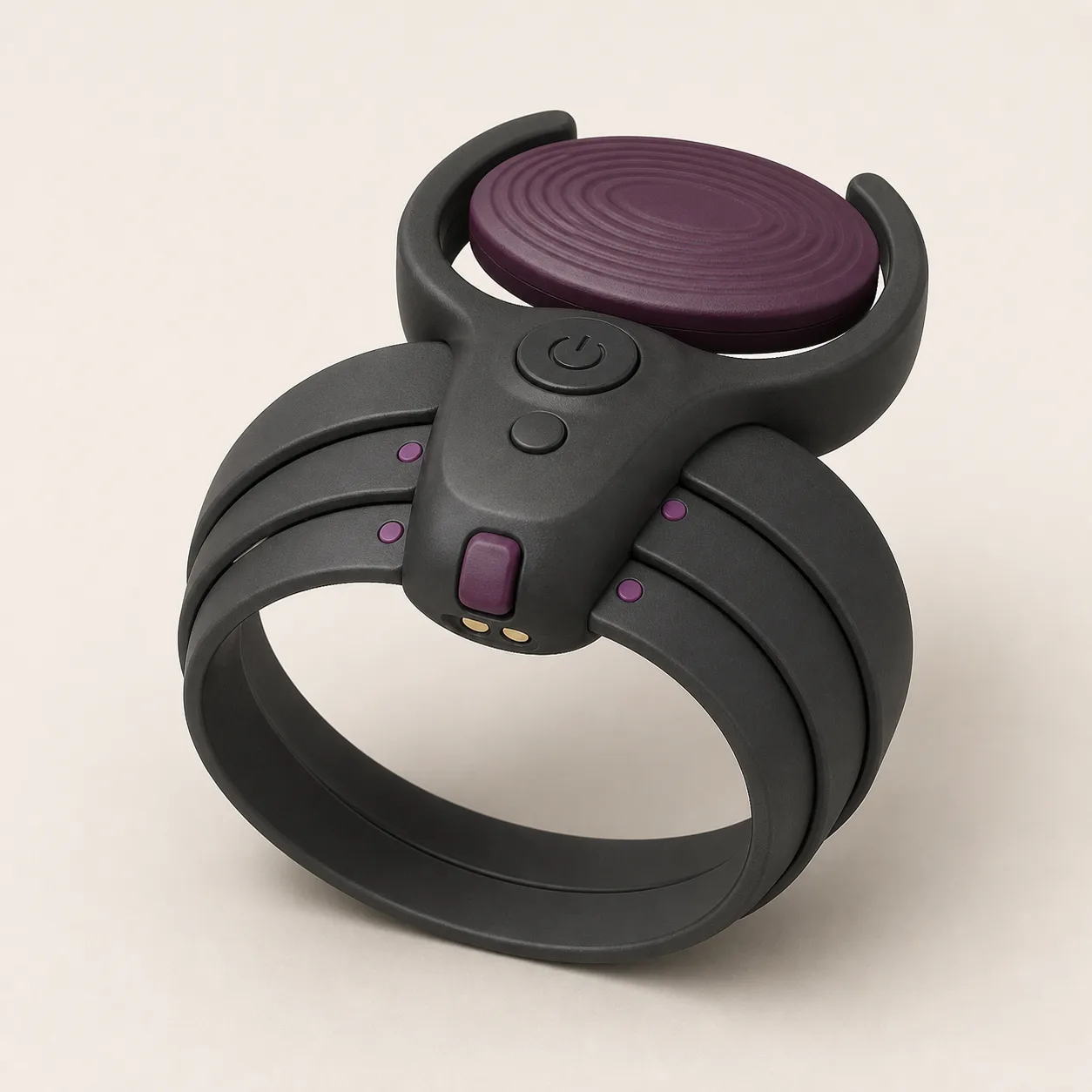
Three-Band Cam-Fit Couples Vibrating Ring with Floating Crown Pad
A rechargeable couples ring concept with three overlapping adjustable bands, a local cam release and a ribbed crown pad held inside an open yoke.
38,99 $
200 in stock
Build one loop from three separately guided bands
This three band couples vibrating ring concept forms one adjustable opening from three broad overlapping bands that enter a central cam hub. A ribbed crown pad sits inside an open yoke with visible edge clearance, separating loop adjustment questions from pad movement and vibration tests.

The image does not prove fit range, loop pressure, independent band motion, crown travel, motor count, output, materials, ingress protection or supplier approval.
Inventory the complete cam-fit assembly
Request an exploded drawing and bill of materials for all three bands, molded track ribs, band tails, cam followers, hub shell, cam plate, axle, detents, stops, fit markers, release tab, springs, crown pad, pad carrier, yoke arms, bushings, actuator, controller, buttons, indicators, battery, charging contacts, conductors, pigments, seals, lubricants and adhesives.
Trace the structural, electrical and vibration paths from the pad through the yoke and hub into every band root.
Measure each band and the combined opening
Record relaxed band arc, width, thickness, edge radius, tail length, root section and overlap. Measure the opening circumference, profile, minimum bend radius and local gap at closely spaced cam positions.
Check symmetry in several planes because three stacked paths can produce an oval or tilted opening even when the visible markers align.
Calibrate all three band tracks
Identify whether one cam motion advances the bands equally, sequentially or by unequal ratios. Measure per-band travel, reference position, backlash, friction, creep, stop compression and repeatability in both directions.
Do not name the markers as sizes until direct circumference and pressure measurements support a documented fit table.
Verify the cam hub and local release
Measure adjustment force, detent engagement, accidental movement resistance and the release tab’s direction, force, travel and response time. Test release under centered, offset and twisting low loads.
Confirm the release remains reachable with either hand and that no band tail, yoke arm or pad position blocks its full motion.
Map circumferential pressure around the loop
Use compliant ring fixtures across the proposed fit envelope and map pressure under every band, overlap, track exit and hub transition. Compare dry and approved lubricated conditions.
Stop for concentrated edges, band crossing, tail lift, progressive tightening, abrupt pressure rise, delayed opening or permanent band deformation.
Inspect every overlap edge and moving gap
Measure the step, clearance and edge radius where bands overlap and enter the hub. Flex the loop through its verified range while inspecting gaps between bands, track ribs, yoke roots and the release.
Use soft witness film to locate pinch or abrasion paths that may appear only during adjustment or asymmetric loading.
Examine the floating crown pad separately
Measure pad length, width, thickness, rib profile, edge radius, neutral clearance, permitted motion, carrier play and yoke gap. Check whether the pad truly moves, flexes in place or only appears separated by a decorative channel.
Apply centered and edge-biased compliant loads and record tilt, travel, rebound, contact area, yoke deflection and any hard-stop contact.
Measure output and transfer through the yoke
Map amplitude, frequency, startup, decay, sound and surface temperature at the pad center, pad edge, both yoke arms, hub and each band root. Repeat across all verified programs and charge states.
Compare unloaded and compliant-load readings so resonance in the open yoke is not mistaken for useful loaded output.
Map pad contact under shared loading
Use a paired compliant fixture that can control loop deformation and crown-pad contact independently. Record contact area, pressure, pad tilt, band pressure, hub movement, vibration loss, current draw, sound and heat.
Vary alignment and motion slowly, and stop for yoke edge contact, pad carrier lift, band migration, cam movement or unstable pressure.
Document controls, charging and shutdown
Record startup hold, mode order, intensity changes, memory, indicators, lockout, immediate shutdown and behavior after charging interruption. Verify the two controls remain distinguishable without viewing them.
Confirm cell chemistry, rated capacity, charger input, contact polarity, charge time, runtime method, low-voltage protection and whether operation is blocked during charging.
Check heat, obstruction and restart behavior
Log current and temperature during long verified programs with free pad motion, compliant loading, partial yoke obstruction and band deformation. Define conservative shutdown limits from measured evidence.
After any protective stop, document cool-down, reset and restart behavior without repeatedly energizing a stalled or overheated sample.
Cycle bands, cam, pad and electronics together
Run repeated adjustment, detent selection, compliant fitting, shared loading, release, pad deflection, program change, charging, cleaning and storage cycles. At checkpoints measure circumference, band travel, pressure, cam play, release time, pad clearance, yoke alignment, output, heat and battery behavior.
Retire a sample after band cracking, overlap lift, cam creep, delayed release, pad rubbing, carrier looseness, yoke distortion, exposed conductor, seal damage or abnormal heat.
Validate cleaning and measured drying
Obtain exact material and cleaner compatibility data before testing. Clean both faces of every band, overlap channels, track exits, hub seams, release recess, crown ribs, pad clearance, carrier gap, yoke roots, controls and charging contacts.
Measure drying by mass and inspect hidden track, carrier and yoke cavities for retained moisture or residue before charging or closed storage.
Price after fit and release are proven
An Alibaba rechargeable vibrating-ring listing currently shows USD 3.03-3.96 with an MOQ of one. It is a category benchmark only and does not confirm this three-band cam system, floating crown pad, yoke, local release or approved supplier.
The procurement reference supports an EUR 38.99 planning price after allowing for China-origin freight, complete teardown, multi-band metrology, cam and release calibration, pressure mapping, overlap inspection, pad and yoke evaluation, loaded output, charging and thermal review, full cycling, material evidence, cleaning validation, protective packing and discreet fulfillment. Exact quotation, packed dimensions, weight, freight, duty, tax, insurance, payment fees and delivery terms remain pending.
Frequently asked questions
Do the three bands adjust independently?
The linkage is unconfirmed; each band must be tracked through the complete cam range.
Are the plum markers verified sizes?
No. They are visual references until circumference and pressure measurements establish a fit table.
Does the crown pad actively float?
The visible clearance does not prove travel; carrier motion, stops and loaded behavior need sample testing.
How is the loop released quickly?
The concept includes a local tab, but direction, load capacity, response time and damp access remain pending.
Can it operate while charging?
The charging interlock and all battery behavior require exact-model confirmation.
Which faults require immediate retirement?
A split band, lifted overlap, creeping cam, delayed release, pad rubbing, bent yoke, loose carrier, exposed conductor, damaged contact, cracked seal or abnormal heat.
Reviews
There are no reviews yet.