



M728 Waterproof Rotating Suction Automatic Male Stroker
August 14, 2026
Three-Leaf Split-Crown Rabbit Vibrator with Triple-Groove Thumb Rest and Dual Oval Controls
August 14, 2026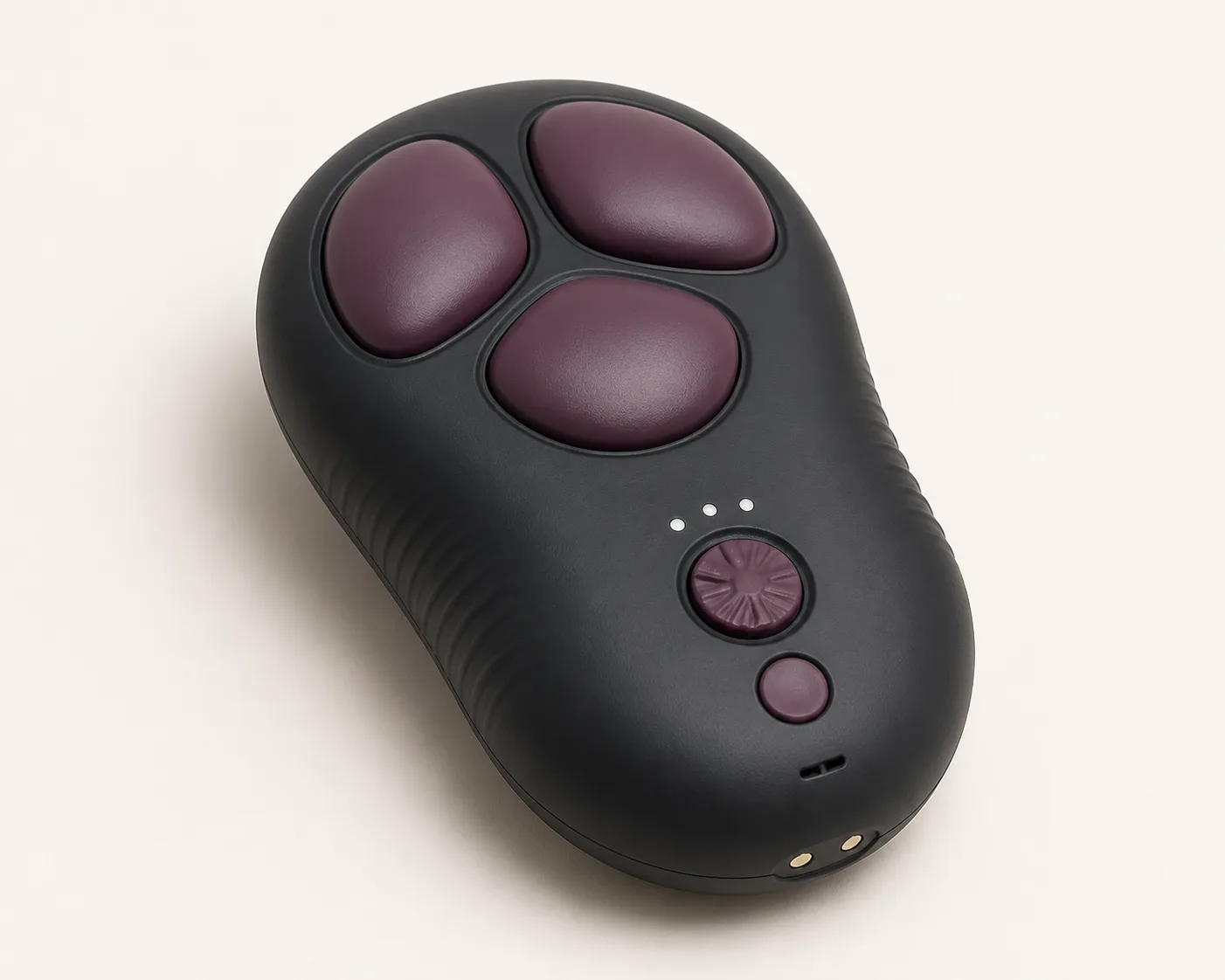
Three-Shoe Differential-Rock Pocket Vibrator with Indexed Bias Dial
A compact pocket-vibrator concept with three separately guarded contact shoes in a triangular cluster and a local three-stop bias dial.
53,99 $
200 in stock
Arrange three contact shoes on one pocket shell
This three-shoe differential-rock pocket vibrator concept places exactly three broad plum contact shoes in a triangular cluster on one low charcoal pebble shell. Guarded moats separate the shoes, while a rear three-stop bias dial is intended to alter the balance between their measured responses.

The image does not establish separate motors, motion direction, dial function, output, materials, sealing, electrical safety or production availability.
Inventory every shoe and internal path
Request an exploded bill of materials for shoes A, B and C, contact skins, shoe carriers, pivots or flexures, guards, seals, actuator, moving mass, transmission, bias mechanism, dial, detents, lock, controller, cell, controls, indicators, contacts, vent, shell, fasteners, conductors, coatings, pigments, lubricants and adhesives.
Trace shared and independent force paths before assigning any output to a particular shoe.
Measure shell cluster and control geometry
Record shell length, width, height, corner radii, mass, balance, shoe centers, crown height, exposed area, moat width and depth, dial recess, control spacing, grip zone, vent and contact locations. Use a common datum for all measurements.
Repeat after bounded compression, output, cleaning, charging and storage cycles to reveal drift or residual set.
Characterize shoes A B and C
For each identified shoe, measure major and minor axes, crown, edge blend, surface hardness, compression, recovery, friction, tilt, free play and carrier seating. Preserve identity through teardown and every test.
Inspect for thin skins, hard inclusions, voids, edge lift, tack, pigment transfer, looseness and uneven response between nominally similar shoes.
Screen guarded moats and moving gaps
Use soft film and articulated probes around every shoe perimeter through all observed displacement, loading and dial states. Measure pinch, shear and capture gaps at the outer shell and at the three-way center junction.
Check whether residue can enter below a shoe edge and whether cleaning access remains adequate without unverified disassembly.
Identify actuator allocation and transmission
Teardown must show motor count, moving masses, coupling members, bearings, flexures, stops and any dial-linked geometry. Instrument the shell and all three shoes before describing the drive as rocking, differential or independently controlled.
Reject assumptions based on surface motion alone because a shared eccentric can create phase and amplitude differences through compliance.
Resolve differential rocking and timing
Capture synchronized three-axis acceleration, displacement, frequency, phase, rise, decay and coast-down at each shoe, the center junction, shell and grip for every confirmed program. Repeat free and under standardized compliant loads.
Quantify cross-coupling, beat patterns, startup skew, drift and any shoe-to-guard contact rather than describing a visual sequence.
Calibrate the indexed bias dial
Measure dial angle, detent force, backlash, lock behavior and actual A/B/C response at all three stops approached from both directions. Repeat across battery state, temperature and load.
Reject intermediate seating, hidden drift or a setting that increases moat closure, hard contact or unstable output beyond the accepted test envelope.
Verify controls lockout and immediate stop
Document startup, levels, patterns, bias adjustment rules, pause, stop, memory and travel lock. Measure button force, recognition, response time and unintended activation under dry and damp grip conditions.
The broad stop control must end output predictably from every mode, after low voltage and after interrupted charging.
Map three-point pressure and edge loading
Use a compliant instrumented plane to record contact area, peak pressure, load sharing, shoe angle and shell contact under centered, offset and rocking fixture loads. State fixture stiffness and preload.
Reject concentrated shoe rims, abrupt center-junction peaks, progressive tilt or a configuration that transfers load onto a hard moat edge.
Measure grip isolation and handling stability
Record vibration transfer, displacement and sound at the grip ribs, controls, dial and charging end while the shoe cluster is loaded. Map grip force, orientation cues, control reach and accidental dial movement.
Check wet handling with the approved test liquid only; no usable grip or contact boundary is confirmed until measured.
Verify battery charging and ingress boundaries
Confirm cell chemistry and capacity, specified input, charging time, runtime, contact polarity, protection circuits, charge-state indication and charging interlock. Inspect conductor routing near the moving shoe assembly.
Map shoe rims, moats, dial, buttons, shell seam, vent and contacts. No water-resistance statement is accepted without exact-model ingress evidence.
Log current sound heat and protected faults
Measure current, A-weighted sound and temperatures at all shoes, carriers, drive, bias mechanism, controller, cell, grip, vent and contacts through every mode and bounded load. Challenge a restrained shoe, blocked dial, high-friction carrier, low voltage, stalled drive and power interruption in protected fixtures.
Confirm safe shutdown without cell swelling, sharp temperature rise, exposed conductive parts or automatic restart into motion.
Clean cycle and define retirement criteria
Validate a material-specific cleaning method, cleaner compatibility and measured drying around the moats, dial and controls. Cycle output, bias changes, loading, stop, charging, cleaning, drying and storage, then remeasure geometry, phase, pressure, gaps, current, sound and heat.
Retire the unit for torn skins, loose shoes, carrier migration, moat contact, dial drift, failed detents, cracked shell, delayed stop, exposed contacts, abnormal heat, cell swelling or persistent residue.
Build landed price after three-shoe proof
An Alibaba mini-bullet-vibrator page showed a rechargeable category example at USD 1.91-2.19 with MOQ three. It is a benchmark only and does not confirm this three-shoe architecture or an approved supplier.
The procurement reference supports an EUR 53.99 planning price after allowing for China-origin freight, exact-sample sourcing, three-shoe metrology, teardown, synchronized output and bias calibration, gap, pressure and grip mapping, charging, current, sound, heat, fault and cycle testing, protective packing and discreet fulfillment. Exact quotation, MOQ, materials, battery, packed size, weight, freight, duty, tax, insurance, payment fees, certifications and delivery terms remain pending.
Frequently asked questions
Do the three shoes have separate motors?
Motor count and transmission paths require teardown; the visible shoes do not prove independent actuation.
What does the bias dial change?
Actual A/B/C amplitude, phase, displacement and pressure at each detent remain pending synchronized measurement.
Can the shoe gaps pinch?
All perimeter moats and the center junction need probe and soft-film screening through load and displacement.
Is the unit waterproof?
No ingress claim is confirmed for shoe rims, moats, dial, controls, seam, vent or charging contacts.
Which materials touch the body?
Exact skins, carriers, shell, coatings, pigments, lubricants and adhesives need traceable composition evidence.
Which defects require retirement?
Torn or loose shoes, carrier shift, hard moat contact, bias drift, failed stop, cracks, exposed contacts, abnormal heat, swelling or residue.
Reviews
There are no reviews yet.