



Three-Shape Low-Temperature Wax Play Set
August 14, 2026
Ten-Piece Padded Bondage Starter Kit
August 14, 2026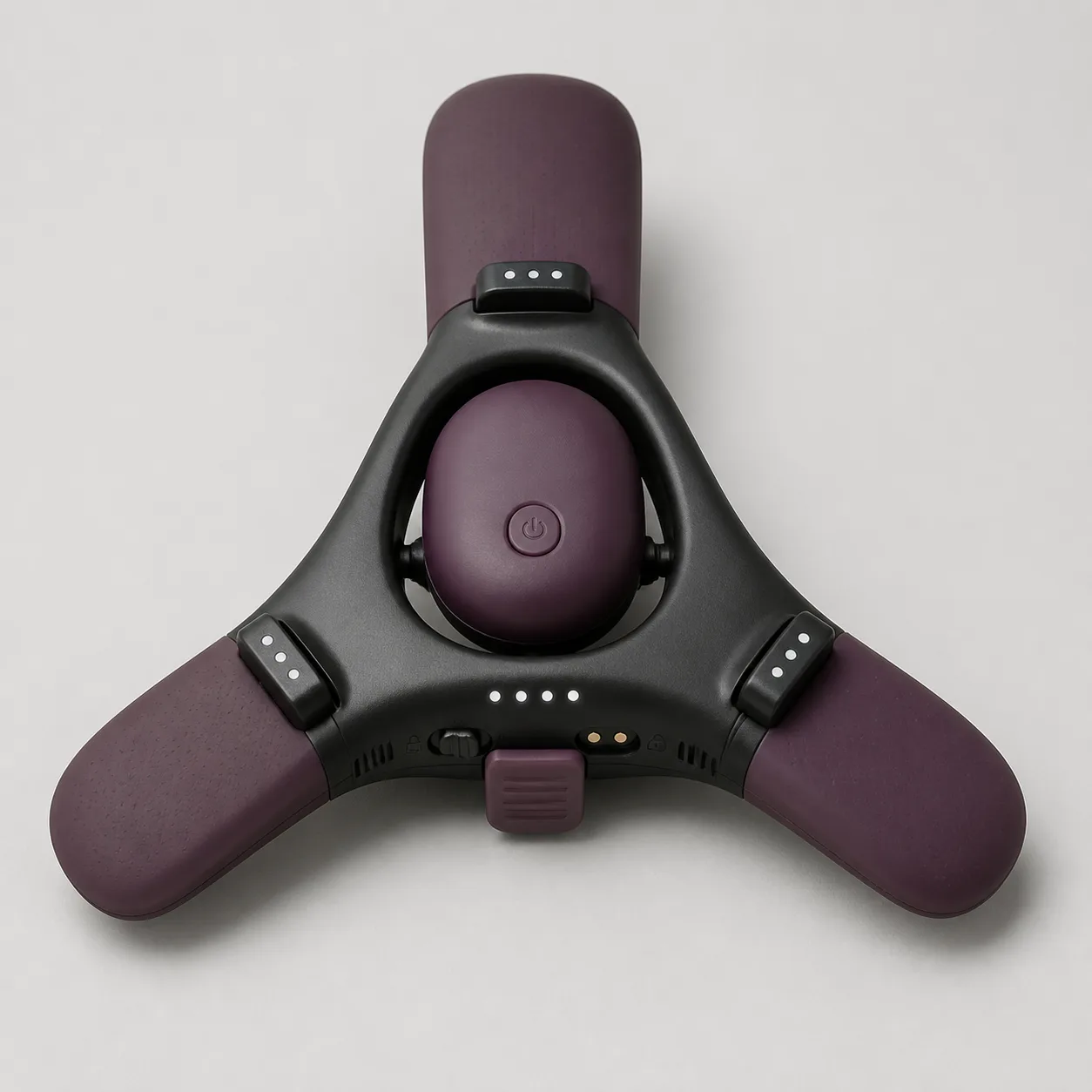
Three-Wing Tension-Balanced Wearable Couples Vibrator
A wearable couples vibrator concept with one floating oval pod, three flexible wings, three indexed tension sliders and a mechanical quick-release tab.
64,99 $
200 in stock
Balance one floating pod across three wings
This three-wing tension-balanced wearable couples vibrator concept suspends one smoky-plum oval pod inside a rounded charcoal triangular frame. Exactly three broad wings extend from guarded roots, and each wing carries one three-dot tension slider. A visible isolation gap, pod power button, wide mechanical release tab, four indicators, travel lock, vents and charging contacts complete the layout.

The image proposes a wearable geometry; it does not prove fit, retention, pressure, output, material or production claims.
Inventory pod frame and three wing channels
Require records for pod P0, surface, actuator, mass, mounts, isolation links, frame, wings W1-W3, guarded roots, sliders S1-S3, guides, detents, release tab, linkage, power button, indicators, lock, controller, cell, vents, contacts, seals, pigments and adhesives.
Trace vibration, load, heat and electrical paths before assigning independence.
Measure geometry at all slider combinations
Record frame width and thickness, pod dimensions and gap, wing length, width, thickness and angle, root radius, slider travel, contact footprint, mass and balance. Build a bounded S1-S3 setting matrix.
Repeat after loaded output, flex, cleaning and storage cycles.
Profile the floating center pod
Map crown, edge radius, compliant depth, hardness, friction, deformation, rebound, mount clearance and neutral alignment. Inspect the full isolation gap under centered and offset loads.
Reject frame contact, hard exposure, delamination, tack, tearing, pigment transfer or permanent tilt.
Characterize wing W1 and slider S1
Measure bending, torsion, rebound, residual set, root strain, slider force, detent clarity and effective preload at each mark. Test alone and with W2/W3 neutral.
Keep W1 results distinct.
Characterize wing W2 and slider S2
Repeat stiffness, strain, preload and detent tests for the second wing. Check whether its adjustment rotates the frame or changes another slider state.
Reject root lift, whitening, cracks, slip or cross-coupling outside tolerance.
Characterize wing W3 and slider S3
Measure the third branch through symmetric and asymmetric fixtures, including release access and clearance to controls and charging contacts.
Reject a setting that blocks the tab, vents or travel lock.
Map three-wing preload and pressure distribution
Use standardized compliant forms to record local pressure, engaged area, wing deflection, frame tilt, pod displacement and slider drift for approved S1-S3 combinations.
Report pressure peaks and imbalance rather than relying on average values or universal-fit language.
Measure pod isolation and output leakage
Record acceleration, dominant frequency and harmonics at P0, each mount, frame, W1-W3, sliders and release tab across every confirmed program and load state.
Quantify useful pod output, wing transmission, frame resonance and grip leakage separately.
Validate the mechanical quick-release tab
Measure reach, force, travel, linkage response, wing relaxation and pod separation from every approved preload combination, battery state and output program.
The release path must remain mechanical, visible and accessible without increasing any slider setting.
Verify controls battery charging and lock logic
Document startup, modes, intensity, indicator meanings, memory, stop priority, travel lock, cell architecture, capacity, input limits, charge time, runtime and protection circuits.
Exact specifications require model-specific documents and tests.
Log current sound heat and asymmetric faults
Measure current, A-weighted sound and temperatures at pod, mounts, frame, wing roots, controller, cell, vents and contacts. Challenge one-wing overload, pod restraint, slider obstruction, blocked release, low voltage and power loss in guarded fixtures.
Reject abnormal heat, unexpected restart, persistent rattle or delayed stop.
Screen gaps edges moisture and residue traps
Probe pod perimeter, isolation links, wing roots, sliders, release linkage, buttons, lights, lock, vents, contacts and shell seams across all settings.
No washing or ingress claim is accepted until the exact construction and drying time are verified.
Cycle flex preload output and release
Cycle W1-W3 flex, slider adjustment, combined preload, output, release, controls, charging, cleaning, drying and storage. Remeasure pressure, output leakage, detent force, gap and heat.
Retire for wing tears, root cracks, slider drift, pod contact, mount damage, delayed release, heat, charging faults or cell swelling.
Build landed price after three-wing proof
An Alibaba wearable-vibrator page showed one category example at USD 7.99-9.99 with MOQ one. It is a benchmark only and does not confirm this three-wing architecture or an approved supplier.
The procurement reference supports an EUR 64.99 planning price after provisional allowance for China-origin freight, exact samples, pod and mount teardown, wing and slider calibration, pressure and isolation mapping, release, control, charging, sound, heat, fault, cleaning and fatigue work, protective packing and discreet fulfilment. Exact quote, MOQ, dimensions, materials, cell, packed weight, freight, duty, tax, certification, payment terms and lead time remain pending.
Frequently asked questions
Do all three wings adjust independently?
The concept shows separate sliders; cross-coupling and usable ranges require testing.
What does the center gap do?
Isolation performance and frame contact under load require measurements.
Can the release work without battery power?
The proposed tab is mechanical, but linkage and loaded response remain unverified.
How is fit determined?
Only measured wing geometry, pressure maps and bounded size data can support fit guidance.
Is it waterproof?
No ingress rating is claimed for pod gaps, roots, controls, vents or contacts.
Which defects require retirement?
Wing tears, root cracks, slider drift, pod contact, heat, charging faults or swelling.
Reviews
There are no reviews yet.