


M110 Black LCD Heated Thrusting Masturbator
August 14, 2026
Tri-Lobe Squeeze-Puck Manual Stroker with Three Finger Windows and Open-End Ripple Liner
August 14, 2026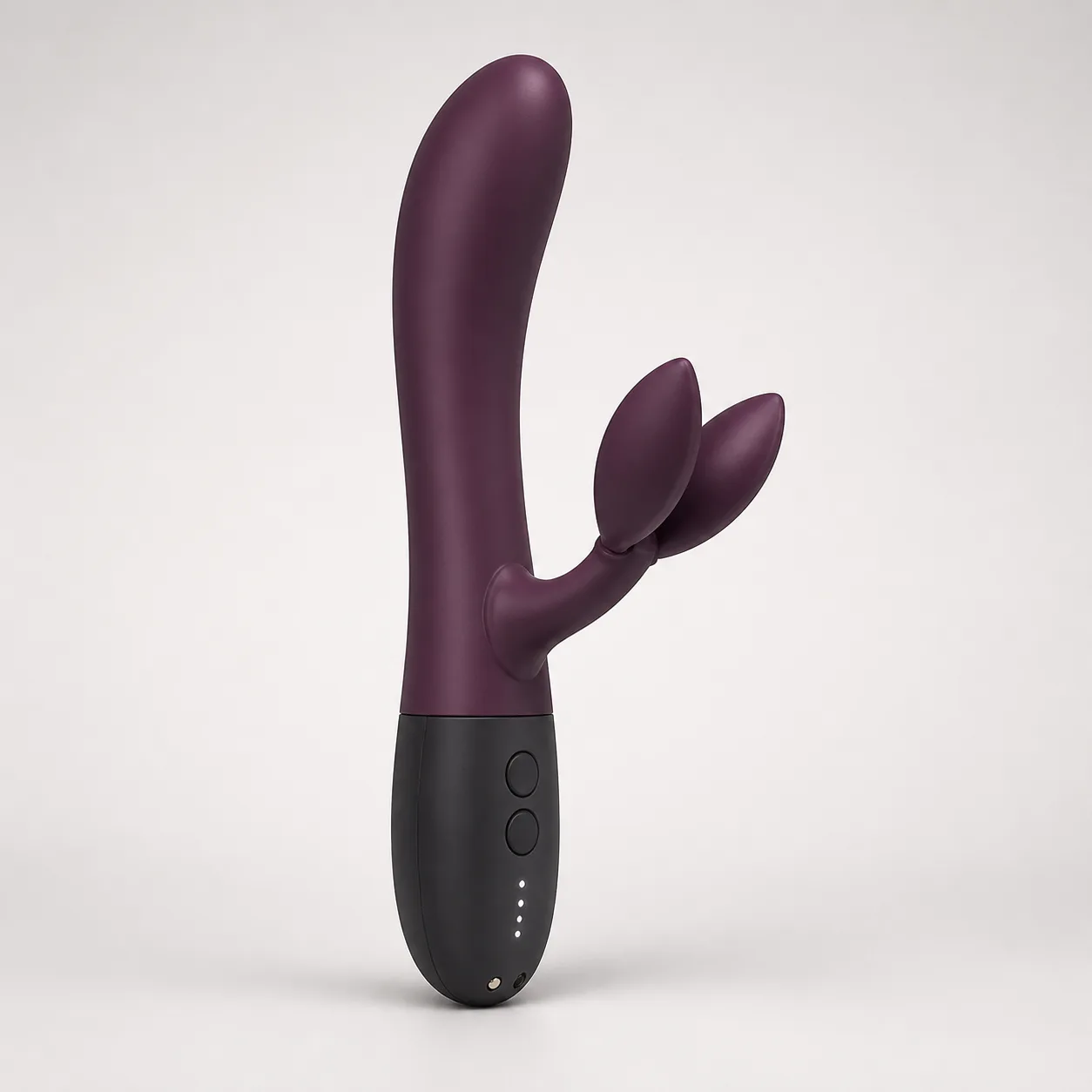
Twin-Petal Offset-Arm Rabbit Vibrator
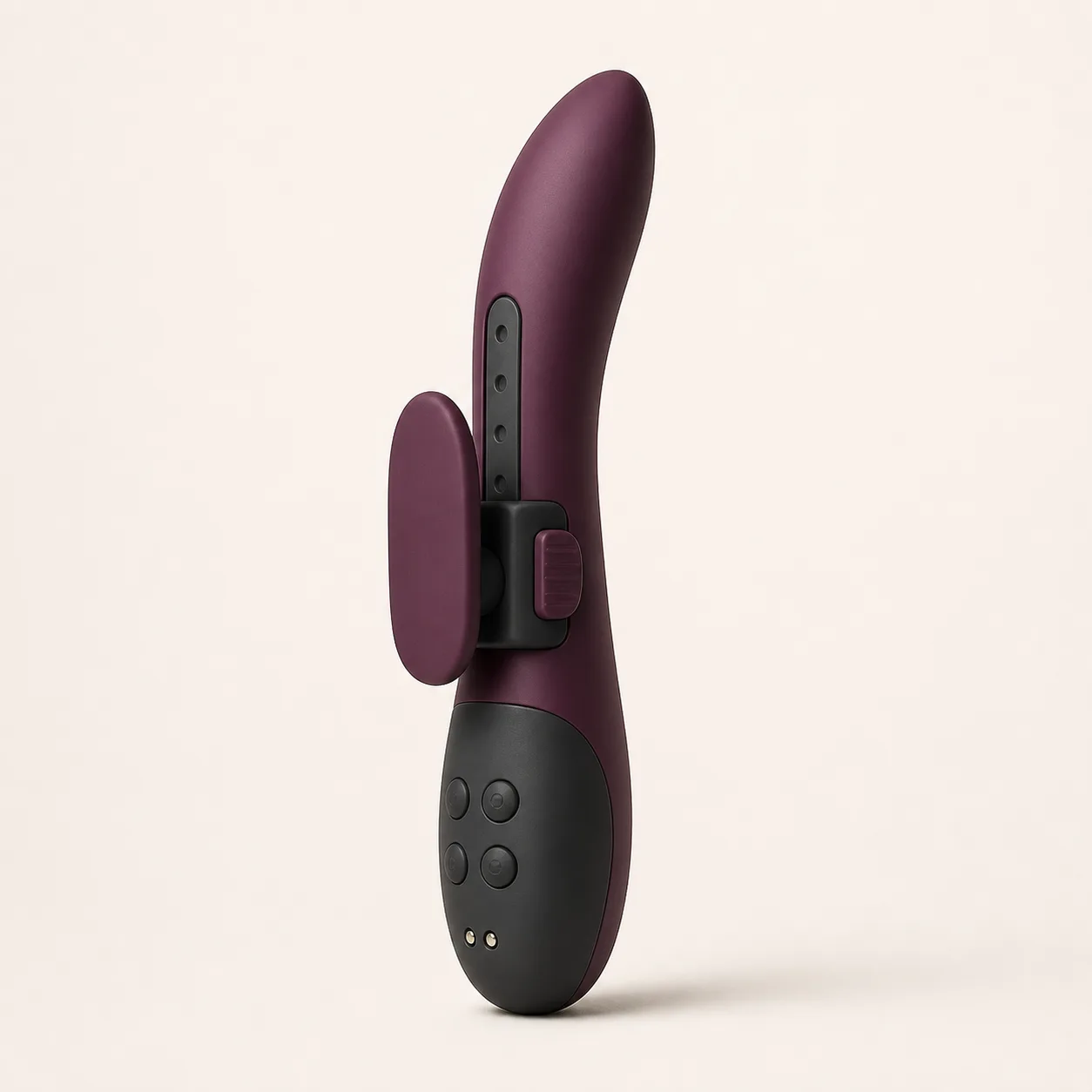
A smoky-plum dual-contact rabbit-vibrator concept with one curved main stem, one offset arm, exactly two rounded leaf petals, two buttons, four indicators and two charging contacts.
64,99 $
200 in stock
Separate one curved stem from a twin-petal side arm
This twin-petal offset-arm rabbit vibrator concept combines one softly curved smoky-plum main stem with exactly one shorter external arm. The side arm ends in exactly two separate rounded leaf petals, while the charcoal handle carries two buttons, four indicator dots and two charging contacts.

The image confirms visible geometry only. It does not establish dimensions, materials, motor count, output, arm flexibility, controls, battery, charging, ingress protection, sound, heat or production readiness.
Confirm one integrated-device inventory
The proposed pack centres on one continuous device with no detachable head, remote, phone, cable, charger, pouch or storage case shown. Require an approved bill of materials and packing list.
Document the shell, internal frame, motor mounts, cell, controller, button membrane, charging contacts and every seal path before production approval.
Measure the complete curved main stem
Record total device length, main-stem usable length, maximum diameter, taper, tip radius, centreline curve, handle width, mass and centre of gravity. Use fixed datums so measurements remain comparable across samples.
Rendered proportions cannot determine personal fit or an insertion limit.
Map the offset arm through its free range
Measure arm length, root thickness, free angle, lateral offset, separation from the main stem and clearance under bounded deflection. Record force, displacement, recovery, hysteresis and permanent set.
Inspect the root for whitening, cracks, shell separation and internal conductor strain after repeated flex cycles.
Characterize both rounded leaf petals
Label the petals P1 and P2. Measure length, width, thickness, edge radius, tip spacing, neutral angle and independent flex, then compare their symmetry after conditioning.
A split leaf shape does not prove identical stiffness or equal contact pressure at both tips.
Map motor allocation and vibration transfer
Request the exact motor count and location, then measure amplitude, frequency, phase and drift at the main tip, mid-stem, arm root, P1, P2, handle and buttons across every verified setting.
Repeat under bounded compliant loads to identify attenuation, resonance, beating and whether one zone weakens when another is pressed.
Compare independent and combined contact pressure
Use external fixtures first to measure pressure and migration with the main stem unloaded, the twin petals lightly deflected and both zones loaded together. Record grip force and output change at defined angles.
Any human evaluation requires consenting-adult protocols only after electrical, material, thermal and mechanical boundaries are approved.
Document two-button logic and four indicators
Record activation hold, zone selection, setting order, full-off action, lockout, memory and accidental-press behaviour for both oval buttons. Define every indicator colour and flash pattern.
Four dots do not establish four speeds, four modes or a four-step battery gauge.
Verify battery charging and contact protection
Obtain cell chemistry, capacity, input limits, protection circuit, charge time, runtime method, cycle life and lithium transport evidence. Test polarity protection, contact retention, termination, low-voltage shutdown and restart.
Log temperature at the main tip, arm root, both petals, motor zones, controller, cell, buttons and charging contacts during charging and all documented duty cycles.
Set heat sound and duty-cycle limits
Measure surface temperature, airborne sound, shell vibration and current with both zones unloaded and under defined compliant pressure. Record startup peaks, warm-up, drift, abnormal noise and shutdown behaviour.
Quiet, low-heat and continuous-use claims remain pending a model-specific protocol and acceptance limits.
Request exact shell petal and seal materials
Obtain compositions, pigments, hardness, coatings, bonding, restricted-substance reports and lot traceability for the stem, offset arm, both petals, handle, buttons and charging-contact seals.
Silicone, body-safe, hypoallergenic, latex-free, phthalate-free and non-porous language remains unavailable until exact-model evidence is approved.
Begin with external fit and the lowest verified setting
Inspect the entire shell, arm root, both petals, handle seam, buttons and contacts before use. Test controls in the hand, start at the lowest confirmed output and apply only light external pressure.
Stop for pain, numbness, irritation, pinching, rising heat, loss of control, arm damage or irregular output. Persistent symptoms require appropriate medical advice.
Clean the split petal head and arm root
Power off and follow the validated cleaner, water temperature, contact time, rinse and drying method. Wipe the main stem, both sides of P1 and P2, the gap between petals, arm root, handle seam, button recesses and contacts.
Immersion, boiling, bleach, solvents, abrasive tools and aggressive arm flexing are excluded unless exact evidence supports them.
Cycle flex vibration charging and cleaning together
Define combined endurance tests for arm deflection, petal flex, loaded vibration, button operation, charging, cleaning, drying and storage. Inspect cracks, shell separation, motor drift, seal change, contact corrosion and cell condition.
Track P1 and P2 separately because uneven loading can produce different wear at the two tips.
Build landed price from a rabbit-vibrator benchmark
An Alibaba USB rabbit-vibrator category page displayed one rechargeable ten-mode design at USD 6.69 to 6.99 with MOQ 2. It is a broad procurement benchmark only and does not identify this twin-petal offset-arm architecture or an approved supplier.
The public procurement benchmark supports an EUR 64.99 planning price after provisional allowance for China-origin freight, exact-sample measurement, stem and arm geometry review, petal flex, motor, output, pressure, controls, battery, charging, heat, sound, ingress and cleaning validation, discreet fulfilment and expected electronic-product handling loss. Exact supplier, quote, MOQ, dimensions, materials, packed weight, freight, duty, tax, certification, payment terms and lead time remain pending.
Frequently asked questions
How many rounded petals are shown?
Exactly two separate leaf-shaped petals terminate the short offset arm.
Does each contact zone have its own motor?
That is unconfirmed until the motor allocation and measured output map are available.
What do the four indicator dots display?
Their colours and patterns remain pending the approved electronics specification and instructions.
Can the external arm be bent?
Visible offset does not establish safe flex range; force, displacement and recovery require sample testing.
Is the device waterproof?
No ingress claim is accepted without a model-specific report covering shell seams, the arm root, buttons and charging contacts.
Which charging cable is supplied?
The cable, adapter, input rating and destination pack contents remain pending supplier confirmation.
Reviews
There are no reviews yet.