



Low-Profile Care-Washing Floor Runner
August 14, 2026
Twin-Spine Split-Head Sensory Crop with Sliding Flex Gate
August 14, 2026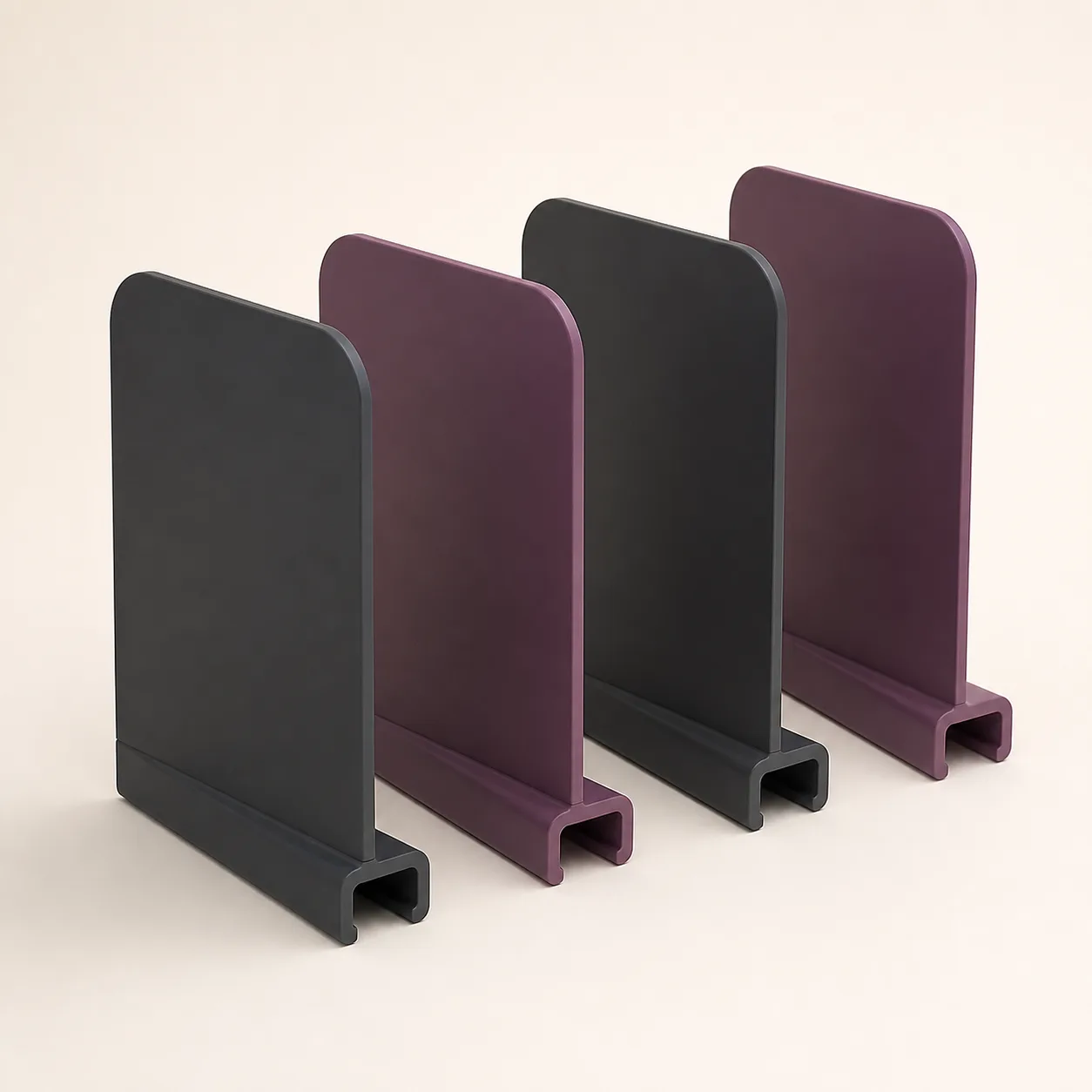
Clip-On Care-Shelf Dividers with Rounded Tops, 4-Pack
A planned four-pack of opaque rounded clip-on dividers for defining organized lanes of closed dry adult-care supplies on one compatible shelf.
19,99 $
200 in stock
Clip-on dividers can define four shelf lanes without drilling
These clip on care shelf dividers are planned as a four-piece set for separating groups of closed dry adult-care supplies on one compatible fixed shelf. Rounded panels provide visible boundaries while the integrated base channels slide over the shelf edge.

They are not privacy screens, bookends, restraints, fall guards or structural shelf supports.
Define the storage lanes on paper first
List the closed packages assigned to each section, their widths and the clearance needed for a full-hand grip. Leave unused space rather than compressing soft packaging against a divider.
The layout should reduce cross-lane searching without blocking labels or care instructions.
The image establishes no acrylic or clamping strength
The opaque colors are a catalog design, not a material specification. The rendering does not confirm acrylic, polymer type, flexibility, supported contact force, shelf thickness range, scratch resistance or chemical compatibility.
Approve the four-piece production configuration and sample data before installation.
Measure shelf thickness, depth and front-edge shape
Record the shelf at several points because edging, veneer or coatings can change its profile. Compare the maximum thickness and rounded or square edge with the confirmed clamp-channel opening and insertion depth.
Do not force a narrow channel over a shelf or use packing pieces to make a loose divider fit.
Patch-check the shelf finish before full installation
Use an inconspicuous area to assess pressure marking, scratching, color transfer, coating lift and residue through the approved trial duration. Repeat for every different shelf material and finish.
A divider that fits dimensionally may still damage paint, laminate, veneer or a soft edge strip.
Inspect all four panels and clamp channels
Check rounded corners, long edges, panel faces and the inside of each U-shaped channel for chips, cracks, sharpness, distortion or debris. Compare the channel openings so a manufacturing variation is not overlooked.
Withdraw any divider with whitening, open seams or a clamp that no longer recovers its verified shape.
Install the first divider on an empty shelf
Clear the entire shelf and support the divider with both hands while sliding it through the supplier-approved direction. Keep the panel vertical and stop if the clamp binds, spreads unevenly or presses on fragile trim.
Do not hammer, twist or heat the clamp to complete installation.
Run a light slide and deflection check
At the approved test points, apply only the documented low force from each side and observe movement, flex and shelf marking. The panel should not be used to stop a falling package or absorb an impact.
Record the result for each divider because clamp behavior can vary across a pack.
Set lane widths around closed package dimensions
Position dividers so the widest approved package enters without rubbing and remains fully supported by the shelf. Keep openings large enough to remove one item without pushing the neighboring panel.
Do not create narrow slots that hide small loose objects or trap fingers.
Place heavier supplies low and away from panels
Rest every package on the shelf itself, centered within its lane. A divider may guide organization visually, but no item should lean on it for support or transfer weight into the clamp.
Follow the furniture maker’s shelf-load limit independently of the divider layout.
Retrieve one package without side pressure
Approach at a comfortable height, grasp the selected closed supply and lift it clear of the lane. Do not spread two panels apart, pull on a divider for balance or drag a package along its face.
If access requires twisting or overhead reaching, relocate the lane rather than relying on the partition.
Reposition only after the shelf is completely empty
Remove every stored item, support the panel and release it using the confirmed direction and grip. Inspect the shelf edge and clamp channel before selecting a new location.
Repeated moves need a documented cycle limit because flex and surface wear may accumulate.
Clean the shelf and dividers as separate surfaces
Unclip each panel and use the independently approved cleaner, cloth and contact time for the shelf and divider. Wipe panel faces, edges and the full channel interior without leaving residue at the contact zone.
Do not immerse or heat the divider unless the production specification permits it.
Dry the U-shaped channels before refitting
Place the empty panels so air reaches both faces, all edges and the deepest part of each channel. Check for retained moisture, tackiness, cracks, warping, color transfer or odor before the next fit trial.
Store unused dividers flat or in the supplier-approved orientation without bending the clamp.
Sourcing needs four-piece color and clamp consistency
A Ganzhou Pangniu Technology Co., Ltd. acrylic shelf-divider listing shows USD 2.35-2.90 per two-piece pack with MOQ 1. That reference does not confirm this planned opaque four-pack, materials, dimensions, rounded profile, clamp opening, shelf compatibility or surface marking.
The procurement reference is an inquiry starting point only. The EUR 19.99 plan allows for China-origin freight, four-piece color matching, edge and channel inspection, shelf-fit and pressure-mark trials, slide and deflection checks, cleaning tests, protective packing and discreet fulfillment; packed size, mass, freight, duty, tax, insurance, payment fees and destination terms remain pending.
Frequently asked questions
Do the panels hide shelf contents?
No. They separate lanes but do not create closed or private storage.
Can they stop packages from falling?
No. They are organizational boundaries, not load-bearing fall guards.
Will they fit every shelf thickness?
No. The exact edge profile and thickness must match the confirmed clamp range.
May items lean against a divider?
No. Place each package on the shelf without transferring its load to the panel.
Can the dividers be moved while the shelf is loaded?
No. Empty the shelf and follow the verified release and refit sequence.
When should a divider be withdrawn?
Withdraw it after chips, cracks, sharpness, stress whitening, warping, loose fit, clamp distortion, color transfer or shelf marking.

Reviews
There are no reviews yet.