


App-Controlled LCD Rotating Thrust Stroker
August 14, 2026
Hand-Pump Adjustable-Girth Vibrator
August 14, 2026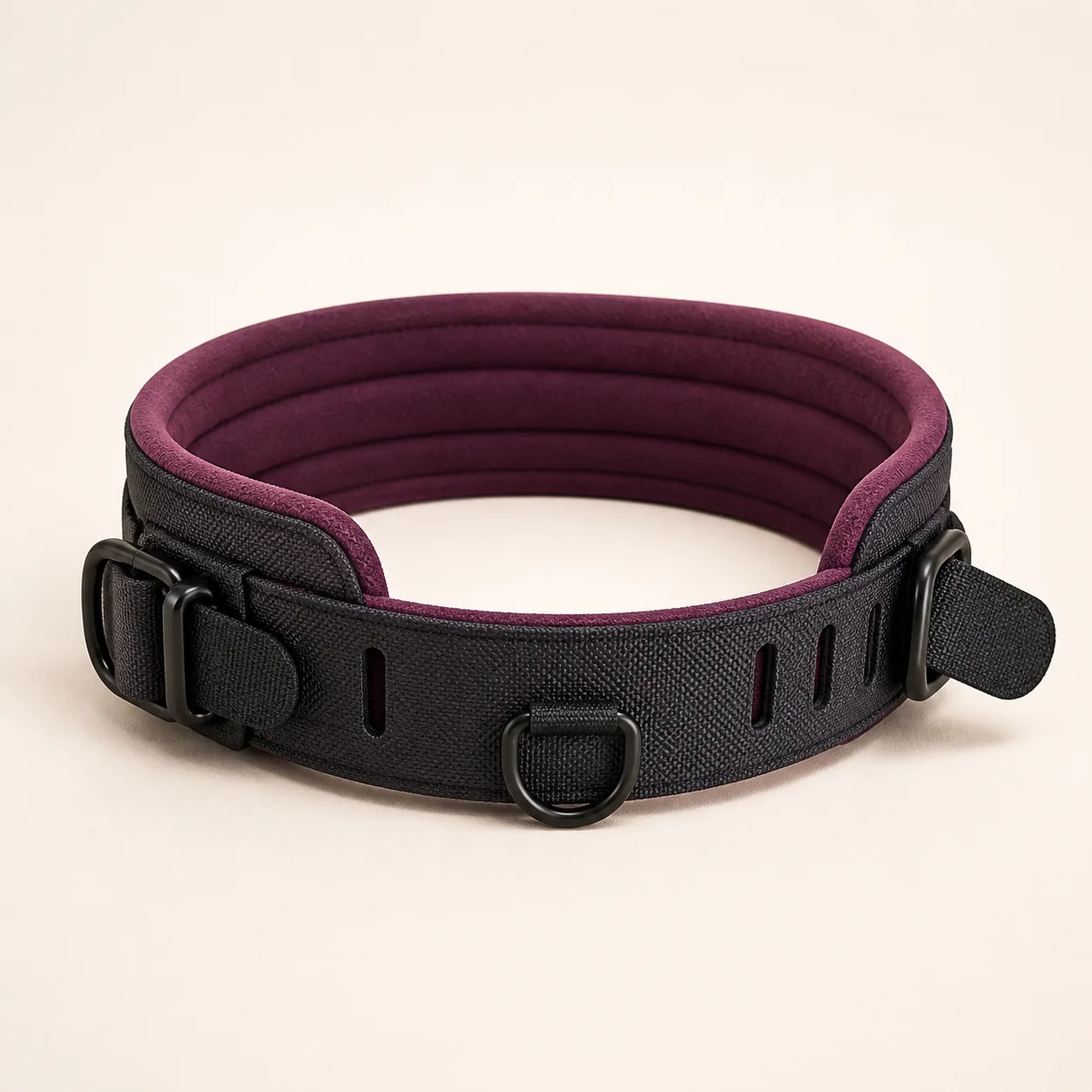
Wide Padded Bondage Collar with Dual Quick-Release Tabs
A wide padded bondage collar concept with plush lining, adjustable slots, side buckle, dual release tabs and a non-load front positioning ring.
29,99 $
200 in stock
A neck-worn restraint begins with airway-safe fit
This padded bondage collar concept uses a wide charcoal outer band, plush plum lining, adjustment slots, a side buckle, two exterior release tabs and one low-profile front D-ring. Its primary function is symbolic and positional; it must never tighten, pull, bear weight or restrict breathing, swallowing or speech.

The image does not prove quick release, load capacity, leather content or suitability for any particular neck.
Measure neck circumference and available collar height
Record the wearer’s relaxed neck circumference and the vertical space between jaw, throat and collarbones in a neutral posture. Compare those values with the collar’s internal range, height, edge radius and padding thickness.
A size label or overall strap length does not establish a safe closed circumference.
Map every adjustment slot to a real internal dimension
Close the collar on a smooth cylindrical gauge at each intended slot and measure the resulting internal circumference. Mark which positions allow comfortable breathing, speech, swallowing and head movement on a brief supervised fit.
Do not punch extra holes, double back the strap or use an unlisted tighter position.
Inspect the entire lining before it touches skin
Check the upper and lower edges, seam allowances, buckle backing, slot reinforcement and ring anchor for knots, hard ridges, exposed fasteners, adhesive, debris or collapsed padding. Rub a clean light cloth over the lining to detect color transfer.
Any hidden hard point or rough seam near the throat requires rejection or documented correction.
Padding must distribute pressure without hiding tightening
Measure padding thickness around the full circumference and compress it at several defined low loads. Log bottoming-out, recovery time and whether the collar’s internal size becomes smaller as the lining warms or absorbs moisture.
Softness does not compensate for an undersized collar or justify adding tension.
Test the buckle and both release tabs on a neck fixture
Practice closure and complete opening on a padded cylinder before a person wears it. Confirm that each tab stays visible, can be grasped quickly and releases without pulling the front ring or tightening the opposite side.
A buckle that jams, hides under the strap or requires a key is not part of this quick-release concept.
Keep backup cutting equipment appropriate to the materials
Identify where emergency cutting could occur without contacting skin or metal hardware and keep a suitable tool immediately available to the supervising partner. Practice placement on a spare or fixture, not on a worn collar.
The planned manual tabs remain the first release path; backup equipment does not permit a slower buckle.
Treat the front D-ring as non-load-bearing
Until the ring, anchor patch, thread and backing have a documented low rating, use it only as a visual positioning point with no tension. Do not attach a leash, chain, rope, weight or fixed anchor.
Never use the collar for suspension, dragging, choking, posture forcing, sudden pulling or body-weight support.
Conduct a short neutral-posture fit check first
Close the collar at the verified loose setting while the wearer is seated upright and calm. Confirm clear speech, normal breathing, comfortable swallowing, full jaw movement and no pulse, throat or collarbone pressure.
Open immediately after coughing, dizziness, voice change, panic, numbness, tingling, color change, pain or any breathing concern.
Recheck fit after head and shoulder movement
With no ring attachment, slowly turn the head, look slightly up and down, raise the shoulders and sit back. Observe whether an edge approaches the jaw, throat or collarbones and whether the buckle migrates.
A collar that fits only in one rigid posture is not accepted for movement.
Consent signals must remain clear and audible
Agree on a spoken stop word, a second audible signal and a simple hand signal before fitting. The supervising partner keeps continuous attention and confirms the signals after the collar is closed.
Do not combine the collar with a gag, hood, breath restriction, intoxication, sleep or any condition that reduces communication.
Limit wear by observation rather than appearance
Use short planned intervals and inspect the exposed upper and lower skin edges for indentation, swelling, heat, moisture or redness. Ask about swallowing and sensation even when the wearer appears comfortable.
Remove the collar before eating, drinking, bathing, driving, exercise or being left alone.
Open fully before changing position or adding other gear
Release the buckle, inspect the neck and allow normal movement before introducing any separate wrist, ankle or body restraint. Refit from the beginning only if all participants choose to continue.
Layering equipment must never reduce access to the collar tabs or backup release route.
Clean sweat from lining, slots and hardware
Use the confirmed cleaner and method for each material, wiping the lining, edges, strap faces, adjustment slots, buckle, tabs, D-ring and anchor patch. Avoid soaking padding or trapping liquid inside laminated layers.
Dry fully while open and inspect for odor, color transfer, corrosion, delamination, stretched slots, compressed padding or buckle stiffness.
Sourcing needs a collar-only quote and release test
An Alibaba bondage-neck-collars page lists a Niusida collar restraint set at USD 7.50-10.50 with MOQ 3. That price may include an anal hook and gag, so the collar-only supplier identity, quote, components, materials and every performance claim remain pending.
The procurement reference supports inquiry only. The EUR 29.99 plan allows for China-origin freight, collar-only quotation, circumference and height mapping, padding and lining inspection, slot and buckle-cycle tests, release-access trials, D-ring anchor review, material and skin-contact checks, sweat and cleaning trials, protective packing and discreet fulfillment; packed size, weight, freight, duty, tax, insurance, payment fees and destination terms remain pending.
Frequently asked questions
How tight should the collar be?
It should never be tight; breathing, speech, swallowing and head movement must remain normal at the verified loose setting.
Can a leash be attached to the D-ring?
No tension or leash use is assumed. The ring is treated only as a visual positioning point.
Is the collar suitable for posture control?
No. It must not force neck position or transmit pulling loads.
Can it be worn with a gag?
No. This plan excludes combinations that reduce speech, breathing or release communication.
Can the wearer be left alone briefly?
No. Continuous sober supervision and immediate access to both release paths are required.
When should the collar be withdrawn from service?
After torn lining, exposed hardware, stretched slots, buckle hesitation, blocked tabs, compressed padding, loose ring anchors, corrosion, odor or material transfer.
Reviews
There are no reviews yet.