


Opposed Dual-Scissor Four-Pad Automatic Stroker with Open-End Liner
August 14, 2026
MTY-26 Telescopic Rotating Male Masturbator
August 14, 2026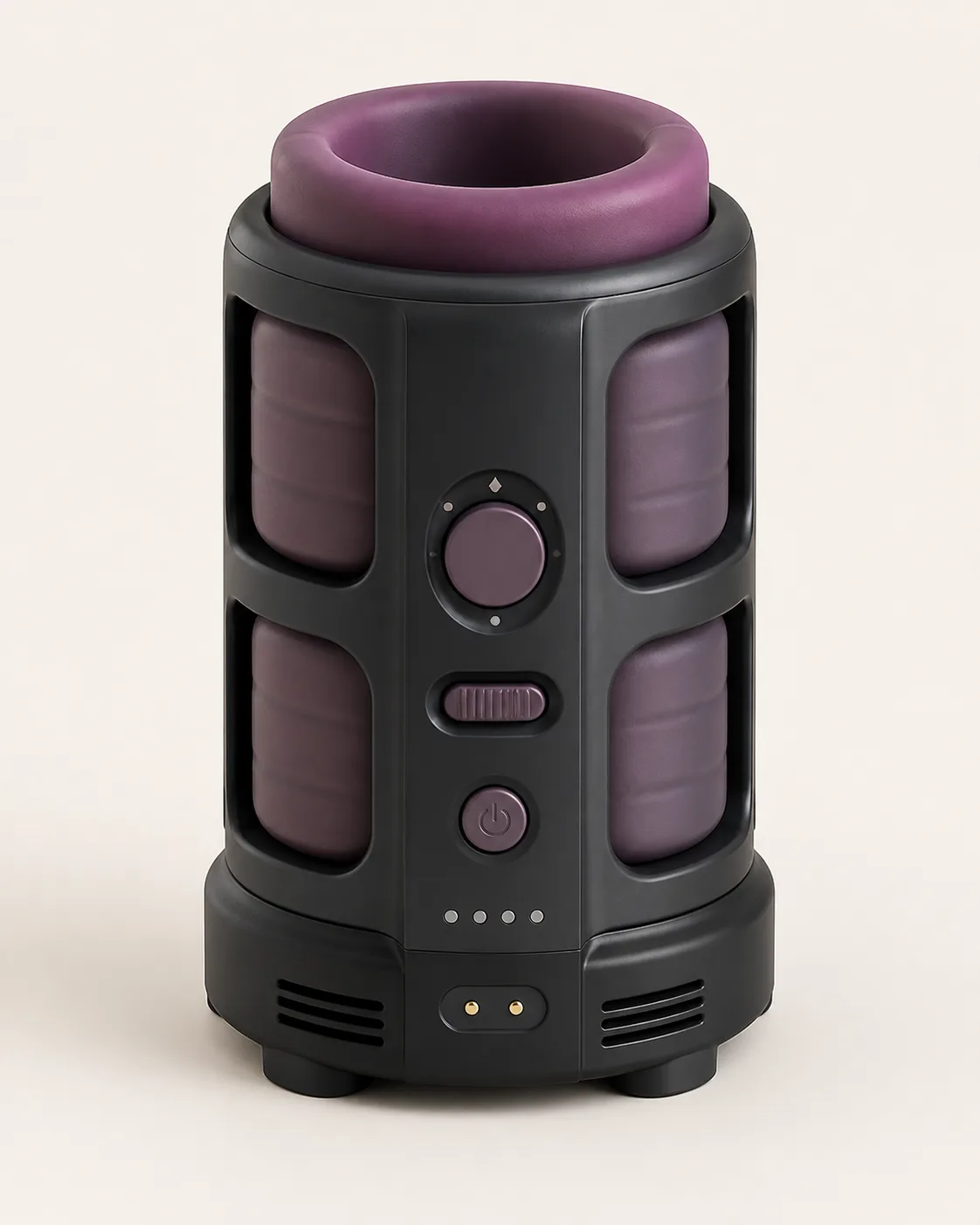
Four-Cell Differential-Pressure Automatic Stroker with Captive Through-Liner
An automatic stroker concept with one captive open-through liner surrounded by four guarded pressure-cell stations, a three-stop balance dial and immediate vent-and-stop control.
94,99 $
200 in stock
Place four pressure cells around one through-liner
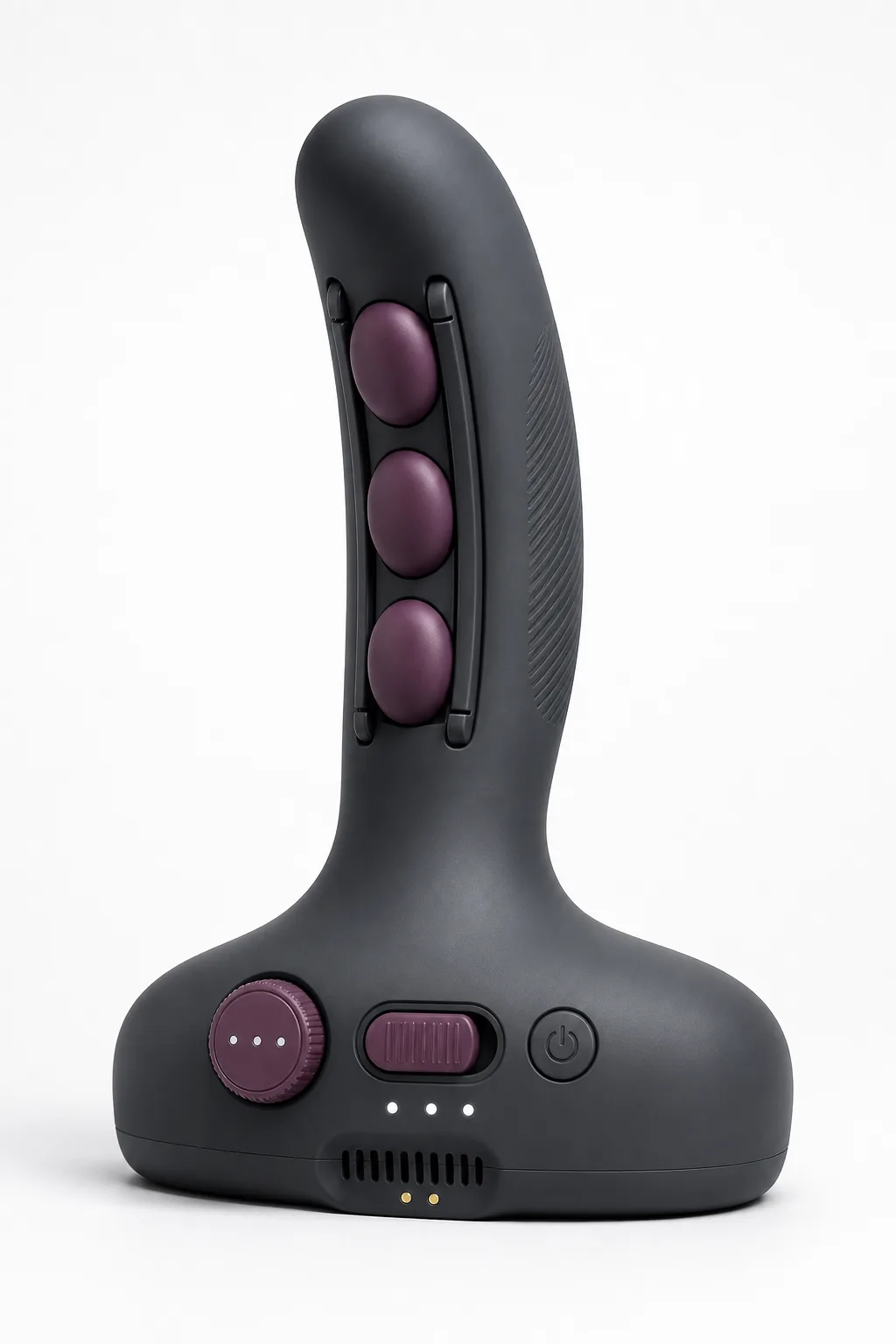
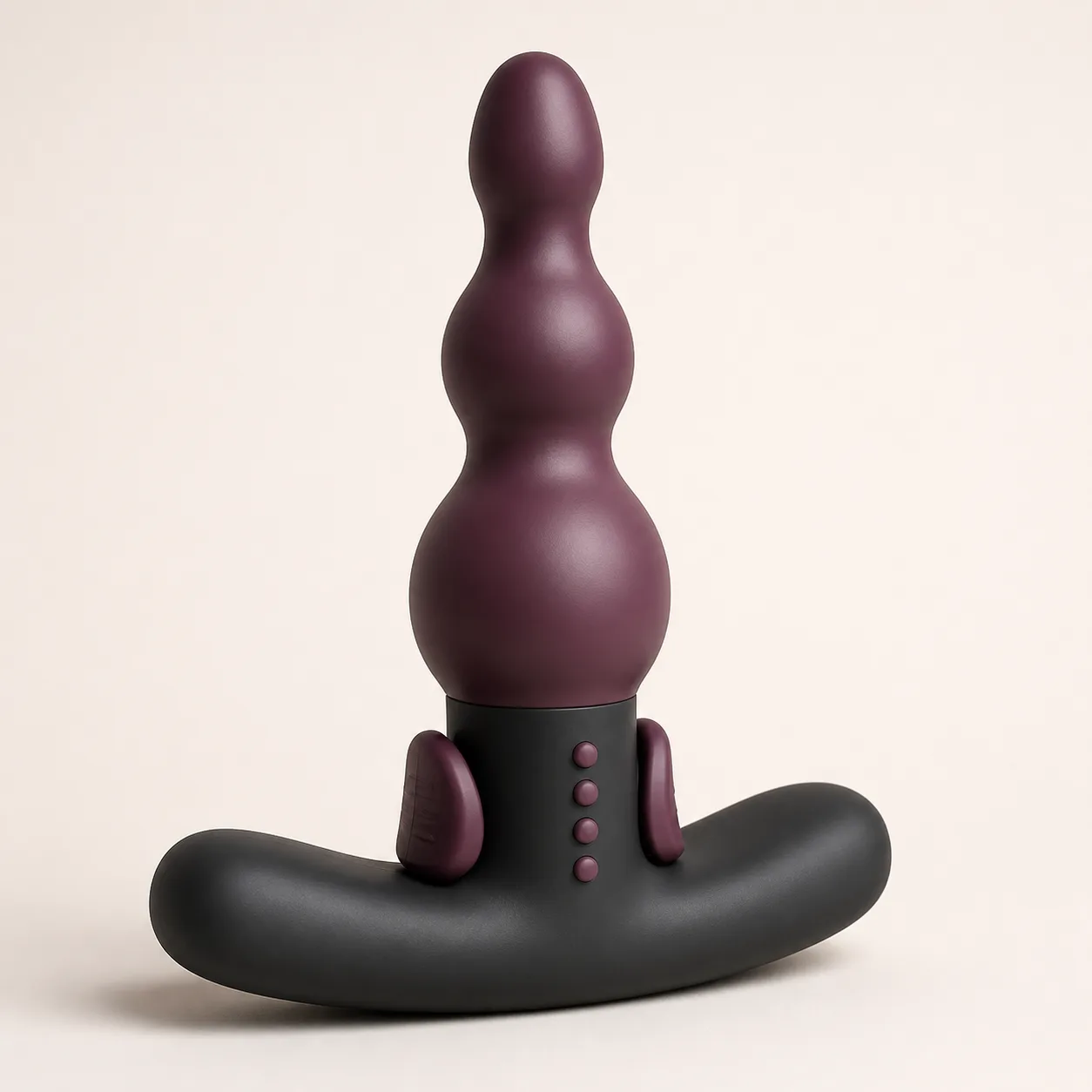
This four-cell differential-pressure automatic stroker concept surrounds one captive open-through liner with exactly four plum pressure-cell panels behind guarded windows. A three-stop balance dial and separate immediate vent-and-stop slider define the primary verification path.

The image does not prove bladder construction, pump count, pressure, stroke, suction, fit, materials, ingress or manufacturing availability.
Inventory the liner pneumatic path and housing
Require a bill of materials for liner, rim, carrier, retainers, cells C1-C4, membranes, backing plates, ducts, valves, manifold, pump or pumps, motor, filters, pressure sensors, windows, divider ribs, balance mechanism, dial, detents, vent-and-stop valve, controller, cell, controls, indicators, air inlets, contacts, shell, feet, seals, coatings, pigments, lubricants and adhesives.
Map common pneumatic volumes and electrical dependencies before assigning channel independence.
Measure housing liner and cell geometry
Record housing height and diameter, base footprint, centerline, opening axes, rim and liner dimensions, carrier depth, C1-C4 locations and exposed areas, window openings, rib widths, duct lengths, dial travel, inlet area, mass and balance.
Repeat after bounded pressure, loading, charging, cleaning and storage cycles.
Seat retain and inspect the through-liner
Measure liner insertion, rim capture, installed stretch, axial and torsional retention, tunnel length, wall thickness, opening diameter, minimum internal diameter and removal force. Confirm the approved service sequence.
Inspect for bunching, twist, creep, thin zones, hard carrier exposure, tack, pigment transfer, tearing and incomplete reseating.
Characterize cells C1 through C4
For each visible station, measure relaxed volume, displacement, compliance, hysteresis, rebound, leakage and response to commanded inflation and deflation. Preserve cell identity in every trace.
Reject membrane wrinkling, backing-plate contact, delayed deflation, asymmetric drift or a cell that remains pressurized after stop.
Identify pump valve and manifold allocation
Teardown must establish pump count, motor type, valve topology, duct routing, sensor placement and the exact path from balance dial to C1-C4. Instrument manifold and cells simultaneously.
Four windows and four indicators do not prove four pumps or independently controlled pneumatic channels.
Capture pressure waveforms and cell timing
Record static offset, peak positive and negative pressure, differential pressure, rise, dwell, decay, pulse frequency, duty cycle, leakage and phase for C1-C4 across every confirmed program. Test empty and on standardized compliant mandrels.
Quantify startup skew, cross-talk, flow starvation, drift and any pressure increase when one cell or duct is obstructed.
Calibrate the three-stop balance dial
Measure dial angle, detent force, backlash, indication and actual cell-by-cell pressure and displacement at all three states approached from both directions. Repeat under symmetric and offset liner loading.
Reject false seating, uncommanded drift or any state that pushes one station beyond the accepted pressure envelope.
Verify immediate venting and emergency stop
Measure slider force, travel, recognition, time to ambient pressure, motor shutdown, valve state, liner slack and reset from every program and dial state. Test low voltage, blocked inlet and one obstructed cell.
The fastest release path must not depend on cycling through a stronger mode or disconnecting power.
Map circumferential pressure distribution
Use instrumented graduated mandrels to record contact area, circumferential pressure, axial drag, shear and local peaks at C1-C4 and divider-rib planes. State lubricant condition, mandrel compliance and insertion depth.
Reject hard backing contact, rib-edge peaks, progressive constriction or a cell pattern that traps the fixture after venting.
Measure airflow suction and local release
Record through-liner airflow, vent conductance and any static pressure change with the liner empty, on mandrels and under manual shell loading. Identify whether cell inflation obstructs the open path.
No suction function is assumed; any negative pressure must remain measurable and locally releasable.
Screen windows gaps and cleaning separation
Probe liner-carrier edges, windows, divider ribs, dial, vent slider, shell seams, inlet grilles and base for pinch, shear, residue and moisture traps. Verify guards prevent access to moving pneumatic parts.
Validate liner removal, washing, measured drying, housing wiping, duct protection, inspection and correct reassembly without flooding unverified valves or sensors.
Verify controls battery and ingress boundaries
Document startup, programs, balance rules, pause, vent-and-stop, memory and travel lock. Confirm cell chemistry, capacity, specified input, charge time, runtime, polarity, protection circuits, indication and charging interlock.
Map liner rim, carrier, windows, controls, inlets, shell joints, vents and contacts. No ingress claim is accepted without exact-model evidence.
Log current sound heat faults and cycles
Measure current, A-weighted sound and temperatures at C1-C4, pump, valves, manifold, controller, battery, shell, inlets and contacts. Challenge blocked ducts, stuck valves, restrained cells, mis-seated liner, low voltage and power interruption in protected fixtures.
Cycle pressure programs, dial changes, venting, load, charging, liner removal, cleaning, drying and storage. Retire for torn liner, loose rim, membrane drift, leaks, stuck valves, unstable pressure, dial drift, delayed venting, cracks, abnormal heat, cell swelling or residue.
Build landed price after pressure proof
An Alibaba automatic-stroker page showed a motorized category example at USD 30.00-32.00 with MOQ one. It is a benchmark only and does not confirm this four-cell pneumatic architecture or an approved supplier.
The procurement reference supports an EUR 94.99 planning price after allowing for China-origin freight, exact-sample sourcing, liner and cell metrology, pneumatic teardown, synchronized pressure mapping, dial and vent calibration, pressure, airflow and gap work, controls, charging, current, sound, heat, faults, cleaning and cycle testing, protective packing and discreet fulfillment. Exact quotation, MOQ, materials, battery, packed size, weight, freight, duty, tax, insurance, payment fees, certifications and delivery terms remain pending.
Frequently asked questions
Are the four panels inflatable cells?
The image is conceptual; membrane, backing, ducts and cell construction require teardown confirmation.
Do the cells operate independently?
Pump count, valve topology and synchronized pressure traces remain pending.
What does the balance dial change?
Actual C1-C4 pressure, displacement and phase at each stop require calibration.
How quickly does the emergency vent work?
Time to ambient pressure and liner slack must be measured under all programs and faults.
Can the liner be removed for cleaning?
The concept shows a captive carrier; approved removal, washing, drying and reseating require exact-model evidence.
Which defects require retirement?
Torn liner, loose rim, membrane drift, leaks, stuck valves, unstable pressure, delayed venting, heat, swelling or residue.
Reviews
There are no reviews yet.