


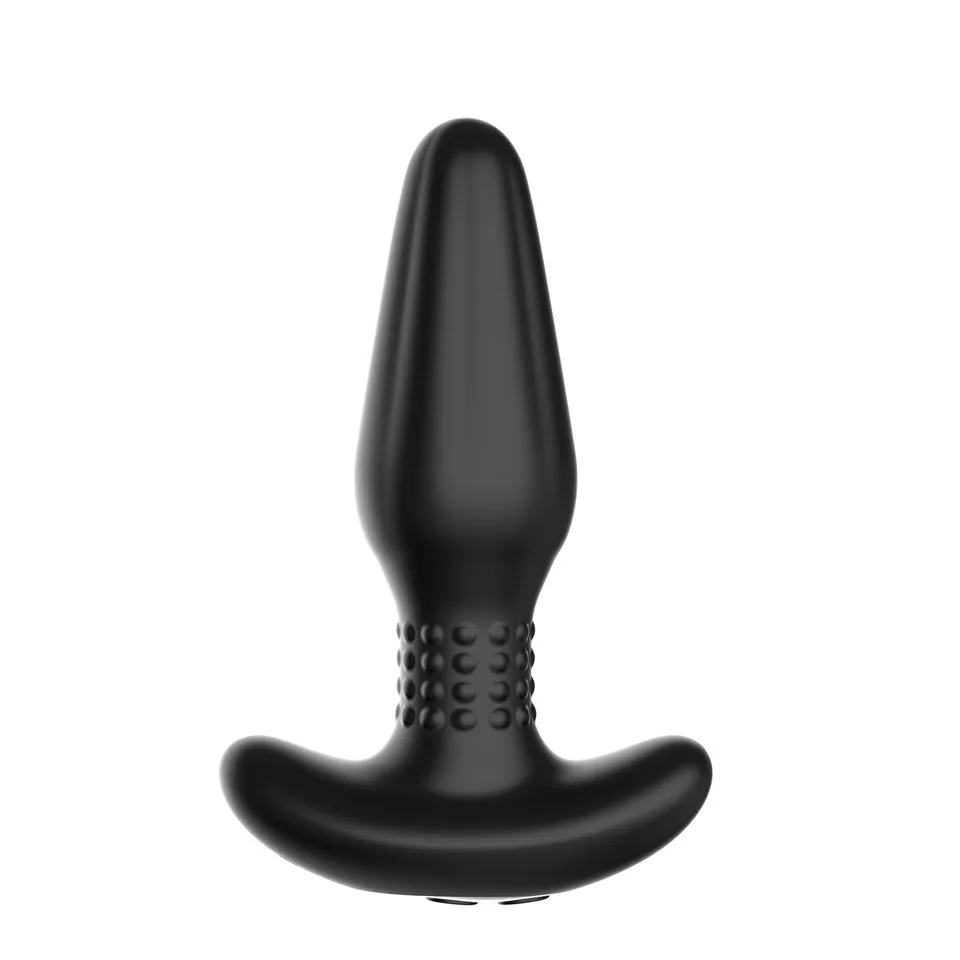
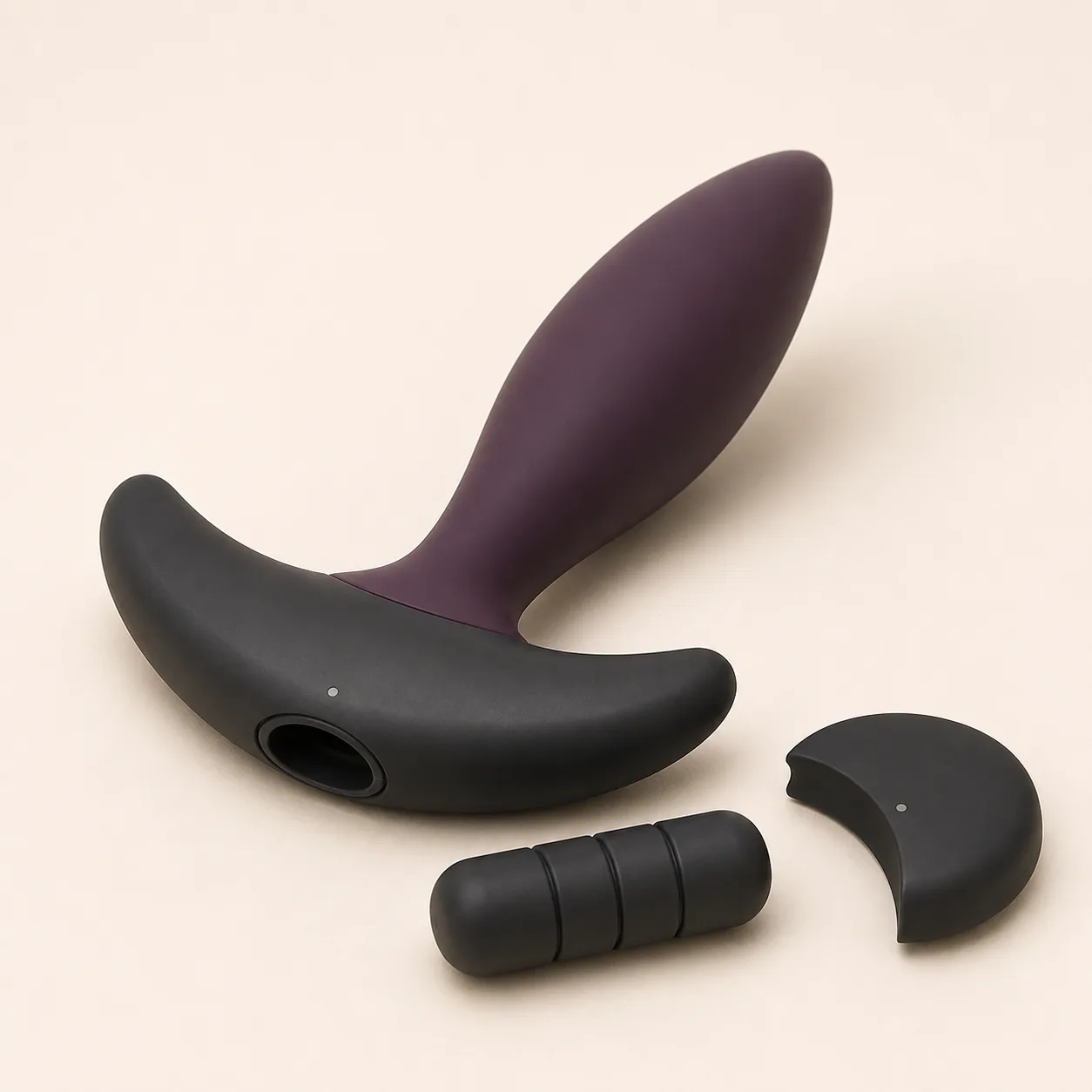
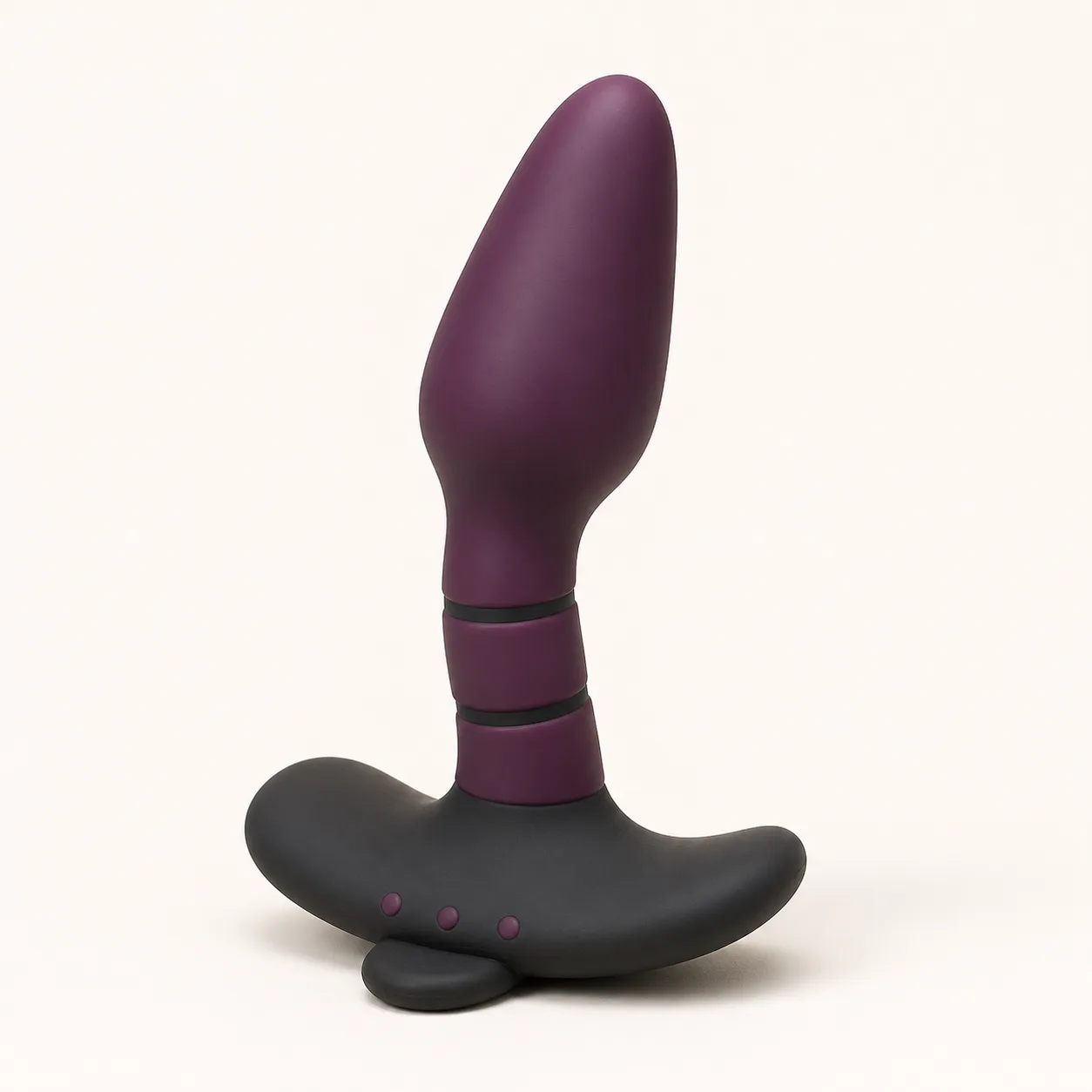
WINYI WY0626 Black Rotating Anal Plug
August 14, 2026
Three-Collar Spacing-Indexed Anal Trainer
August 14, 2026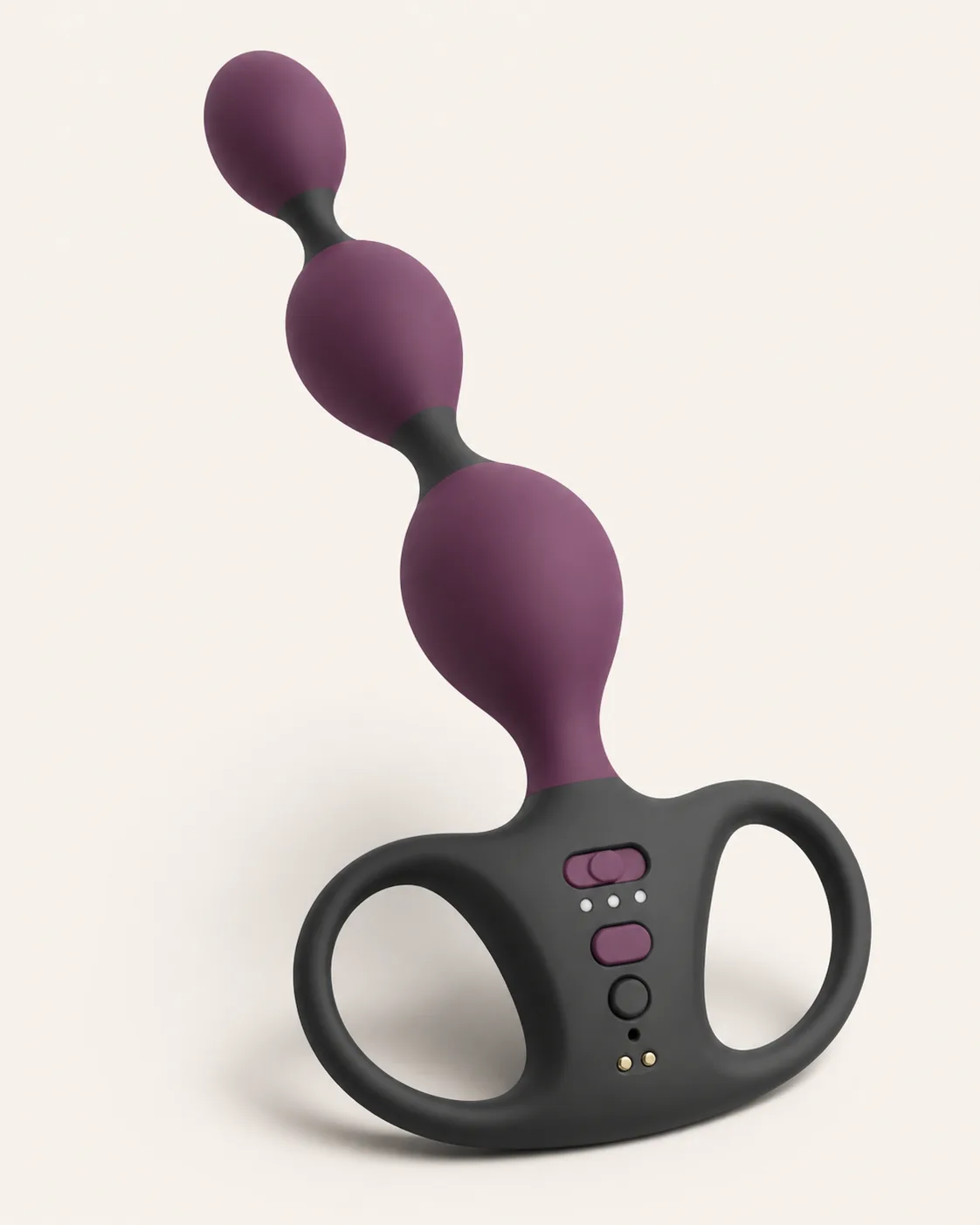
Three-Node Counter-Sway Anal Vibrator with Wide Twin-Halo Base
A rechargeable anal-wellness concept with three graduated oval nodes along an alternating offset path, two flex necks and an exceptionally wide twin-halo retrieval base.
61,99 $
200 in stock
Stage three nodes along an alternating offset path
This three-node counter-sway anal vibrator concept uses exactly three graduated smooth oval nodes joined by short narrow flex necks along a shallow side-to-side path. The body tapers into an exceptionally wide twin-halo external base with a local three-stop bias slider and immediate-stop control.

The image does not establish insertable dimensions, fit, motion, motor count, pressure, material, ingress, electrical safety or production availability.
Inventory each node neck and base component
Request a bill of materials for nodes N1-N3, skins, structural cores, two flex necks, lower taper, base neck, twin halos, internal frame, actuator, moving mass, couplers, slider, detents, controller, cell, buttons, indicators, vent, contacts, conductors, seals, coatings, pigments, lubricants and adhesives.
Trace the complete load and electrical paths through both neck junctions and the body-to-base transition.
Measure the complete insertable profile
Record tip radius, each node’s major and minor axes, center spacing, offset direction, neck length and minimum diameter, total insertable length, lower taper, base-neck dimensions and mass. Use a neutral centerline datum rather than the outside visual curve.
Publish no fit or insertion-depth range until exact samples, tolerances and professional review establish an accepted boundary.
Characterize node surfaces and compliance
For N1, N2 and N3, measure hardness, compression, recovery, friction, surface continuity and coating thickness at crown, sides and transitions. Inspect for seams, flash, voids, hard inclusions, tack, pigment transfer and local thin zones.
Compare nodes after output, bounded flex, cleaning and storage to detect swelling, permanent set or delamination.
Calibrate both flex necks and junction strain
Measure lateral, fore-aft and torsional stiffness, neutral alignment, hysteresis, residual set and minimum bend radius for the upper and lower connector necks. Apply optical strain markers around every junction.
Reject buckling, whitening, crack initiation, node collision, sharp curvature or a neck that does not recover within the accepted tolerance.
Identify drive allocation and counter-sway mechanics
Teardown must identify motor count, moving masses, transmission, couplers, frame supports and any slider-linked mechanism. Instrument all three nodes and the base before describing a counter-sway pattern.
Visible offset geometry can change passive motion even with one actuator; separate or alternating drive is not assumed.
Capture synchronized output at all three nodes
Measure three-axis acceleration, displacement, frequency, phase, rise, decay, coast-down and sound at N1-N3, both necks, base neck and each halo for every confirmed program. Repeat free and under standardized compliant loads.
Quantify phase drift, cross-coupling, beat behavior and any node-to-node approach through battery and temperature ranges.
Calibrate the three-stop bias slider
Record slider travel, detent force, backlash, indication and actual node-by-node response at each stop approached from both directions. Repeat under load and after cycle wear.
Reject false seating, setting drift or any state that increases neck strain, node collision or unstable base movement.
Map progressive pressure and shear
Use graduated compliant fixtures to measure contact area, circumferential pressure, axial drag, lateral shear and node transition loads at each accepted depth marker. State fixture stiffness, lubricant condition and preload.
Stop a supervised evaluation for pain, numbness, bleeding, loss of sensation or any withdrawn consent; safe-use limits remain pending expert review.
Verify the twin-halo retrieval base
Measure total span, halo opening dimensions, edge radii, thickness, stiffness, twist, grip access and body-to-base strain. Confirm both open wings remain external on conservative retention fixtures.
Reject halo collapse, rolling, sharp inner edges, frame exposure, control obstruction or a base narrower than the accepted retrieval geometry.
Verify controls lockout and immediate stop
Document startup, intensity levels, confirmed patterns, bias adjustment, pause, stop, memory and travel lock. Measure button force, recognition and time to zero motion from every state.
Confirm predictable behavior after low voltage, slider mismatch, power interruption and interrupted charging without automatic restart into output.
Verify battery charging and ingress boundaries
Confirm cell chemistry, capacity, specified input, charge time, runtime, polarity, protection circuits, charge indication and charging interlock. Inspect conductor routing across flexing junctions.
Map node surfaces, neck junctions, base seam, slider, buttons, vent and contacts. No water-resistance claim is accepted without exact-model ingress evidence.
Log current sound heat and protected faults
Measure current, A-weighted sound and temperatures at every node, neck, drive, controller, cell, base frame, vent and contacts under free and bounded loads. Challenge one restrained node, excessive neck bend, blocked slider, low voltage and power interruption in protected fixtures.
Verify shutdown without exposed conductors, sharp temperature rise, cell swelling, uncontrolled restart or persistent mechanical stress.
Clean cycle and define retirement criteria
Validate a material-specific cleaning method, cleaner and lubricant compatibility and measured drying around node-neck transitions, base seam, controls, vent and halo openings. Cycle output, bias changes, flex, load, charging, cleaning, drying and storage.
Retire for tears, tack, swelling, junction cracks, permanent bends, node collision, base distortion, slider drift, delayed stop, exposed contacts, abnormal heat, cell swelling or persistent residue.
Build landed price after profile validation
An Alibaba silicone prostate-massager page showed a rechargeable category example at USD 5.50-6.90 with MOQ four. It is a benchmark only and does not confirm this three-node counter-sway architecture or an approved supplier.
The procurement reference supports an EUR 61.99 planning price after allowing for China-origin freight, exact-sample sourcing, profile and flex metrology, drive teardown, synchronized node and bias mapping, pressure and base-retention work, charging, current, sound, temperature, faults, cleaning and cycle testing, protective packing and discreet fulfillment. Exact quotation, MOQ, materials, battery, dimensions, packed size, weight, freight, duty, tax, insurance, payment fees, certifications and delivery terms remain pending.
Frequently asked questions
How large are the three nodes?
All axes, offsets, center spacing and total insertable dimensions require exact-sample measurement.
Do the nodes move in opposite directions?
No motion pattern is confirmed; motor allocation and synchronized phase traces remain pending.
What does the bias slider control?
Actual node amplitude, phase, pressure and neck strain at each stop require calibration.
Is the twin-halo base wide enough?
Total span, stiffness, edge geometry and retention behavior need conservative fixture verification.
Is the product waterproof?
No ingress claim is confirmed for node surfaces, necks, seams, controls, vent or contacts.
Which defects require retirement?
Tears, swelling, cracked necks, permanent bends, node collision, base distortion, slider drift, heat, cell swelling or residue.
Reviews
There are no reviews yet.