


Three-Index Rounded Prism-Head Vibrator with Guarded Flip Yoke
August 14, 2026
Write-On Care-Storage Label Clips, 12-Pack
August 14, 2026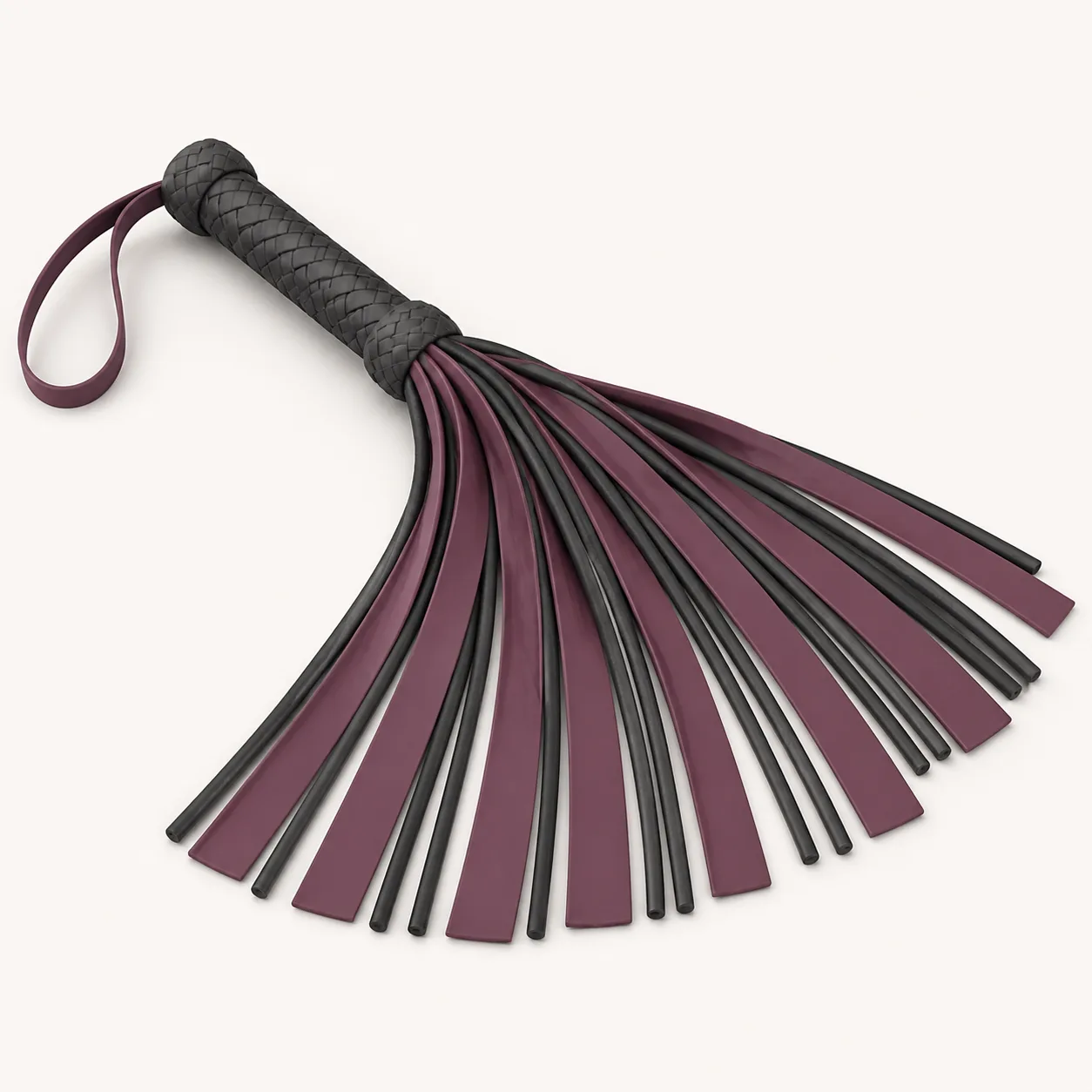
Compact Wrist-Loop Sensory Flogger with Alternating Falls
A compact sensory flogger concept with braided grip, loose wrist loop and alternating broad and narrow blunt falls for measured low-intensity evaluation.
19,99 $
200 in stock
Alternating falls need separate evaluation
This compact sensory flogger concept combines broad plum ribbons with narrower charcoal cords, a short braided grip and a separate wrist loop. The two fall groups may bend, spread and concentrate force differently, so they cannot be treated as one uniform bundle.

The image does not verify leather content, total mass, fall count, attachment strength or any safe intensity level.
Inventory every fall before the first swing
Separate the broad and narrow groups, count each strand and assign a temporary number from the crown outward. Measure length, width or diameter, thickness, end shape and mass where practical, then flag any outlier.
A single short, heavy or hardened strand can land ahead of the rest and alter the intended spread.
Inspect edges and tips with light and cloth
Run a clean lint-free cloth along both sides of every broad fall and around every narrow cord. Look for cut burrs, splits, hardened coating, sharp corners, exposed reinforcement, adhesive or rough seams at the blunt ends.
Withdraw the sample if any strand catches fibers, transfers color or feels noticeably stiffer than its peers.
Confirm the crown holds both fall groups evenly
Photograph the crown from all sides, mark each strand’s entry point and apply the same low pull to every fall. Record slippage, rotation, creaking, adhesive movement or gaps opening beneath the collar.
The crown fails qualification if a narrow cord can migrate between broad ribbons or any attachment becomes hidden from inspection.
Map grip dimensions and the real balance point
Measure handle length, diameter, pommel shape, grip texture and total product mass, then balance the flogger horizontally on a rounded support. Note whether the crown or pommel dominates and whether the wrist loop changes the balance when it hangs free.
A compact handle is not automatically easier to control if the fall bundle is forward-heavy.
Size the wrist loop without trapping the hand
Measure relaxed loop circumference, width, flexibility and attachment position. The loop should act only as a drop guard with enough slack for immediate hand release; it must not tighten, knot around the wrist or carry the force of a swing.
Practice slipping the hand out while the product is stationary and reject a loop that snags jewelry, clothing or the pommel.
Practice fall alignment against empty space
In a clear room, use slow shoulder-free wrist motions without a person or target. Observe whether the broad ribbons fan, the narrow cords cross, the loop touches the falls or the crown rotates inside the hand.
Stop if the bundle wraps the arm, strikes the operator or reaches farther than the measured clearance zone.
Calibrate only on a marked padded target
Place a large pad at a fixed height and mark a generous central zone. Begin with the smallest motion, photograph the landing pattern and increase only enough to identify how the two fall groups separate.
The purpose is repeatable placement, not maximum sound, speed or visible deformation.
Keep vulnerable anatomy outside the plan
Exclude the head, face, eyes, ears, neck, front and sides of the torso, spine, kidneys, abdomen, genitals, hands, feet, joints, bony points, broken skin and any area with reduced sensation or circulation.
Only broad muscular external areas considered appropriate by informed consenting adults belong in a cautious low-intensity plan.
Use a signal sequence that stops motion early
Agree on a spoken stop word, a second audible signal and a hand signal before the implement is picked up. The receiving partner stays able to speak and move, and the operator pauses fully before checking comfort or changing distance.
Do not combine this product with intoxication, sleep, breath restriction or equipment that blocks communication.
Watch the narrow cords during every cycle
Narrow falls may travel faster, cross over broad ribbons or wrap around a curved target. Use brief sets, count each motion and inspect landing spread rather than assuming the bundle stays aligned after the first contact.
Any wrap, sharp sting, unexpected mark, numbness, skin break or loss of placement ends the session.
Check the grip and crown between short sets
Set the implement down, fan the falls and inspect for knots, twisting, dampness, loose strands or crown movement. Check the braided handle for rotation and verify that the wrist loop remains open and unobstructed.
Continuing with tangled falls can create a heavier combined tip and an unpredictable landing point.
Clean broad ribbons and cords one by one
Use only a cleaner confirmed for each exact material. Wipe from crown toward tip, support the strand to avoid pulling its attachment and use separate cloth areas when testing for color transfer.
Do not soak the crown, saturate a hidden handle core, boil the implement or use harsh solvents without documented compatibility.
Dry the bundle fully fanned and untwisted
Hang or lay the product so air reaches every fall without stretching the wrist loop or bending the crown. Separate touching ribbons and cords, then inspect both sides for trapped moisture, tackiness, odor or new stiffness.
Store only after every strand and the braided grip are dry.
Price the verified construction, not the showroom label
An Alibaba floggers showroom lists a 2025 braided-design synthetic-leather flogger at USD 0.35-0.45 with MOQ 2. Supplier identity, exact match, material composition, fall count, dimensions, mass, construction and trade terms remain pending.
The procurement reference supports inquiry only. The EUR 19.99 plan allows for China-origin freight, complete fall inventory, edge and color-transfer inspection, crown pull testing, grip and balance checks, wrist-loop sizing, swing-spread calibration, cleaner trials, individual drying, protective packing and discreet fulfillment; packed size, weight, freight, duty, tax, insurance, payment fees and destination terms require confirmation.
Frequently asked questions
Do the wide and narrow falls feel the same?
No equivalence is assumed. Their mass, stiffness, speed and contact area must be assessed separately.
Is the wrist loop a restraint?
No. It is only a loose drop guard and must allow immediate hand release.
Can the falls be knotted together?
No. Knots create heavier, less predictable contact points and are outside this product plan.
Is loud sound evidence of controlled impact?
No. Placement, spread and low-force repeatability matter more than sound.
Can the flogger be soaked for cleaning?
Not without verified material and construction instructions; the crown and handle core may trap moisture.
When is the product removed from service?
After edge damage, hardened tips, color transfer, fall slippage, crown gaps, grip rotation, a tightening loop, persistent odor or material cracking.
Reviews
There are no reviews yet.