


Slim Ventilated Care-Cloth Hamper with Hinged Lid
August 14, 2026
Compact Wrist-Loop Sensory Flogger with Alternating Falls
August 14, 2026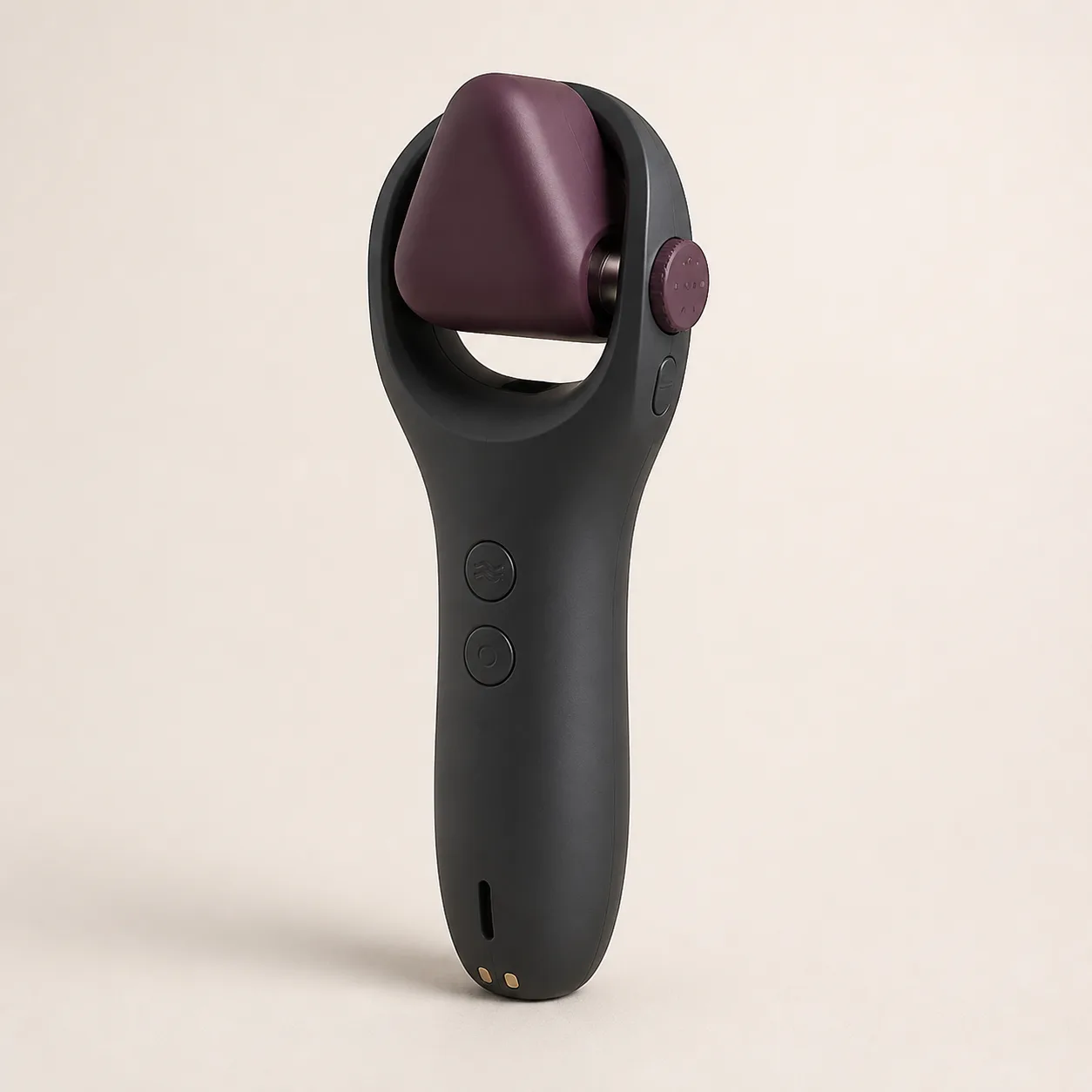
Three-Index Rounded Prism-Head Vibrator with Guarded Flip Yoke
A rechargeable handheld vibrator concept with a rounded three-face prism head that manually indexes inside a guarded flip yoke.
42,99 $
200 in stock
Choose a contact face before activating the head
This three-index prism-head vibrator concept mounts a rounded triangular-prism head inside an open guarded yoke. A side dial and separate release tab are proposed to let the head flip between three stable face positions, changing contact geometry without swapping attachments.

The visible face does not prove that production samples have three distinct surfaces, secure detents, powered motion, verified materials, water resistance, runtime or supplier approval.
Inventory the complete indexed head
Request an exploded drawing for the three-face outer head, internal carrier, transverse axle, bearings or bushings, retainers, yoke cheeks, guards, three-position detent plate, dial, release tab, latch, hard stops, vibration actuator, counterweight, frame, handle shell, buttons, vent, contacts, cell, controller, conductors, seals, pigments, lubricants and adhesives.
Identify whether vibration travels through the axle, a flexible conductor or a motor located inside the head.
Establish a neutral dimensional record
Measure handle length, width and depth, grip profile, yoke opening, cheek thickness, axle span, head width, height and depth, corner radii, each face width, dial diameter, release travel, control positions, mass and center of gravity.
Record the head centerline and face plane at all three proposed index positions.
Verify that the prism has three usable faces
Map the full perimeter and label faces A, B and C. Record surface area, crown height, texture profile, edge blending and transition symmetry for every face rather than inferring geometry from the triangular silhouette.
Confirm that no face orientation exposes an axle recess, seam, guard edge or unsupported corner.
Map the pivot axle and yoke alignment
Measure axle runout, radial and axial play, cheek parallelism, bearing drag, head tilt, end clearance and retainer capture. Repeat under standardized face-normal and off-axis fixture loads.
Compare left and right yoke deflection so a loading bias cannot silently change the active face angle.
Test the index dial and release sequence
Measure dial torque, release-tab force, detent approach, engagement depth, false seating, rebound, over-travel, locked play and unlock force at each position. Use witness marks to distinguish a fully seated face from a near detent.
The head should not rotate merely because vibration, grip movement or off-center contact loads the prism.
Characterize each contact surface
For the smooth, shallow-ridge and broad-dome proposals, measure profile height, pitch, radii, local compliance, seam visibility and cleaning access. Inspect for flash, voids, hard spots, color transfer or texture peaks.
Supplier samples must match the face-specific drawing and not substitute three cosmetically similar panels.
Map vibration face by face
Record acceleration, displacement, frequency content and phase at the center, corners and edge midpoints of A, B and C. Compare free output with calibrated compliant loading and several grip forces.
Document how much energy enters the yoke and handle instead of the selected face.
Compare alignment under loaded use
Apply compliant normal force at each face center and controlled offsets toward every corner. Track face angle, head shift, dial movement, yoke strain, axle play and local pressure while output is active.
Set working limits from the earliest loss of index stability or local pressure peak.
Inspect yoke guards and moving gaps
Probe axle ends, cheek-to-head clearances, guard lips, dial perimeter, release recess, hard stops, shell seams, buttons, vent and charging recess through every index transition and load state. Use articulated fixtures rather than fingers.
Gaps must remain inaccessible while leaving enough inspection and cleaning access for residue and wear detection.
Verify controls and startup logic
Document startup hold, output levels, patterns if present, pause, immediate stop, memory, lockout and indicator meanings. Confirm whether the device can start while the release tab is held or the head is between detents.
A non-indexed state should block activation or enter a clearly documented safe response.
Measure current sound and heat
Record current, acoustic output and temperature at each face, axle ends, yoke cheeks, dial, release tab, handle, controls, vent, contacts and cell during free operation, compliant load, off-center load and repeated face changes.
Confirm cell chemistry, capacity, protection, charge input, polarity, charge time, runtime method, charging interlock and transport evidence.
Challenge detent and pivot faults
Add controlled detent wear, pivot drag, one-sided cheek flex, retainer play and a partly seated index using protected fixtures. Measure unexpected rotation, force, current, sound, heat, detection, shutdown and manual recovery.
Quarantine a sample with index creep, cracked yoke, missing retainer, grinding, loosened head, failed release, exposed conductor or cell swelling.
Cycle indexing output and cleaning together
Run repeated A-B-C changes, latch engagement, compliant loading, output states, pauses, immediate stops, charging, cleaning, measured drying and storage. At checkpoints repeat face geometry, dial torque, release force, locked play, axle alignment, output maps, gaps, current, sound and heat.
Validate cleaning around the entire head perimeter, both axle ends, yoke guards, dial, release recess, controls, vent and charging contacts.
Build landed price after index validation
An Alibaba rechargeable mini-vibrator results page currently shows a mini bullet category example from Shenzhen Pleasure Factory Co., Limited at USD 2.24-2.43 with MOQ ten pieces. It is a category benchmark only and does not confirm this three-face prism head, guarded flip yoke, index dial or approved supplier.
The procurement reference supports an EUR 42.99 planning price after allowing for China-origin freight, exact-model sourcing, teardown, three-face metrology, pivot and yoke alignment, detent and release calibration, face-specific vibration and pressure maps, gap inspection, control interlock, electrical and thermal testing, fault simulation, combined indexing and care cycle life, material evidence, protective packing and discreet fulfillment. Exact quotation, MOQ, materials, packed size, weight, freight, duty, tax, insurance, payment fees and delivery terms remain pending.
Frequently asked questions
Are the three faces genuinely different?
Production samples need separate geometry and output maps for A, B and C; the visible silhouette alone is insufficient.
Does the head rotate while powered?
The concept is manually indexed before activation, not a continuously rotating powered head.
How is an index position confirmed?
Dial alignment, detent engagement, locked play and witness marks should all agree before activation.
Can the yoke pinch during a face change?
That risk requires full-motion articulated gap testing at axle ends, guards, cheeks and hard stops.
Will every face vibrate equally?
Not assumed; each center, corner and edge needs separate loaded and unloaded measurement.
Which faults require retirement?
Index creep, growing axle play, cracked cheeks, missing retainers, a loosened head, sharp damage, failed release, abnormal heat, exposed conductors or cell swelling.
Reviews
There are no reviews yet.