


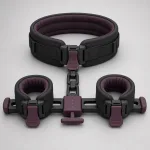
Three-Link Floating Posture Collar Restraint with Twin Sliding Wrist Cuffs
August 14, 2026
Three-Node Phase-Lock Couples Vibrator Set with Triangular Charging Dock
August 14, 2026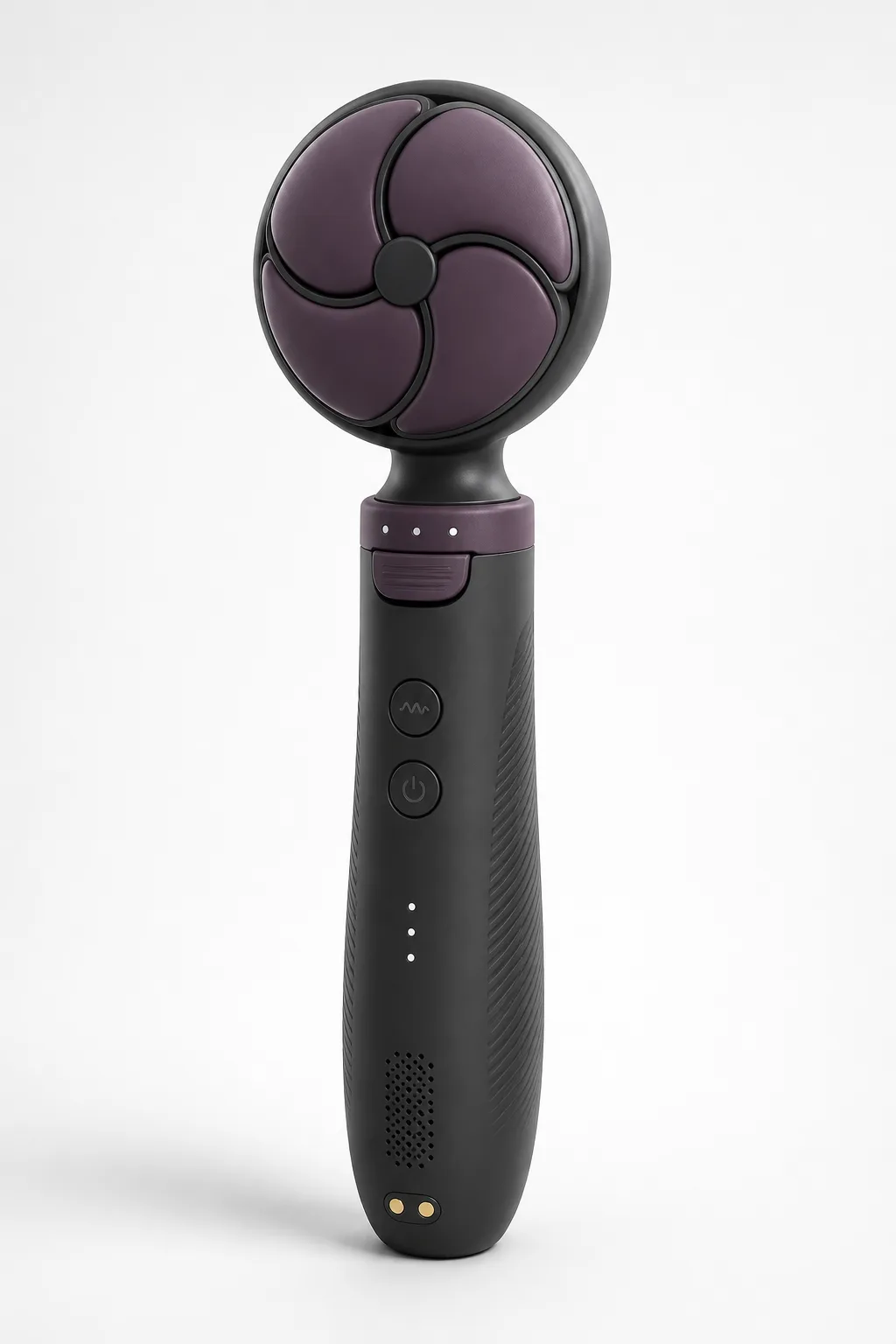
Four-Leaf Overlap-Shear Wand Massager with Three-Stop Travel Collar
A rechargeable wand concept with four captive curved contact leaves, guarded spiral overlaps, a three-stop travel collar and a wide local release tab.
78,99 $
200 in stock
Inspect four captive leaves across one round wand head
This four-leaf overlap-shear wand massager concept arranges exactly four broad smoky-plum curved contact leaves around one low charcoal hub. Guarded spiral seams separate the leaves, while a three-stop travel collar and wide release tab sit below the fixed neck.

The render does not prove leaf motion, overlap depth, stroke, output, pressure, materials, ingress or manufacturing availability.
Inventory the head drive neck and handle
Require a bill of materials for leaves L1-L4, contact skins, compliant cores, carriers, overlap lips, seam guards, center hub, backing ring, guides, flexures or sliders, actuator, transmission, travel collar, detents, release tab, stops, neck core, head shell, controller, cell, buttons, indicators, conductors, strain reliefs, vent, contacts, handle shell, grip ribs, seals, coatings, pigments, lubricants and adhesives.
Trace mechanical, vibration and electrical paths before assigning independent leaf motion.
Measure head leaf collar and handle geometry
Record head diameter and thickness, L1-L4 exposed area, curvature, center angle, overlap length, seam width and depth, hub diameter and height, guide axes, collar angle and travel, neck dimensions, handle length and circumference, control positions, mass and balance.
Repeat in every collar state and after loaded output, adjustment, charging, cleaning and storage cycles.
Profile leaves L1 through L4 separately
Map each leaf surface, edge radius, thickness, compliant-layer depth, carrier boundary, local hardness, friction, deformation, rebound and attachment. Preserve L1-L4 identity in every measurement.
Reject thin edges, hard carrier exposure, delamination, buckling, tack, pigment transfer, tearing or a leaf that sits proud at rest.
Inspect overlap lips and guarded spiral seams
Measure every overlap from center hub to outer rim, including lip thickness, engagement, hidden clearance and maximum relative motion. Probe seams unloaded, compressed and during commanded travel.
Reject accessible pinch or shear zones, lip inversion, trapped debris, exposed reinforcement, shell contact or gaps that narrow below the accepted guard limit.
Identify actuator transmission and leaf guidance
Teardown must establish actuator type, moving mass, transmission ratio, cam or guide layout, follower count, leaf constraints, phase relationships and hard stops. Instrument head position and drive current together.
A four-leaf appearance does not prove four actuators or true tangential motion.
Calibrate the three-stop travel collar
Measure collar angle, detent force, backlash, indication and actual L1-L4 displacement at all three stops approached from both directions. Repeat under centered and offset compliant loads.
Reject false seating, state drift, uneven leaf travel or a collar position that permits guide or seam contact.
Test the wide local release tab
Measure tab force, travel, drive disengagement, residual leaf offset and reset from every collar stop and confirmed program. Test low voltage, stalled motion and one obstructed leaf in protected fixtures.
The release path must reduce mechanical preload without requiring a stronger travel setting.
Track tangential motion and leaf synchronization
Use optical targets to record L1-L4 displacement vectors, velocity, stroke, timing, phase, dwell, reversal and repeatability. Compare unloaded and loaded trajectories at each collar stop.
Quantify skew, lost motion, guide friction, leaf collision, center-hub rotation and drift over repeated cycles.
Map compliant pressure and vibration output
Measure contact area, local pressure, seam bridging, leaf deflection, acceleration, dominant frequency, harmonics and output loss on standardized compliant fixtures. Test centered, edge and tilted loads.
Reject hard hub contact, overlap-line peaks, uneven pressure, bottomed guides or a leaf that carries excessive output.
Verify fixed-neck strength and loaded head stability
Measure neck bending, torsion, head tilt, handle moment, residual set and conductor strain under bounded axial, lateral and diagonal loads. Repeat with leaf motion and vibration active.
Inspect neck-to-head and neck-to-collar transitions for cracks, looseness, rubbing, heat and progressive alignment loss.
Validate gaps cleaning and drying access
Inspect leaf rims, guarded seams, center hub, outer head ring, collar, release tab, neck joints, buttons, indicators, shell seam, grip ribs, vent and contacts for residue and moisture traps.
Define wiping, washing, rinsing and measured drying for the exact sample without forcing liquid into unverified guides, electronics or vents.
Verify controls battery charging and ingress
Document startup, output programs, collar rules, release priority, pause, stop, memory, indicators and travel lock. Confirm cell chemistry, capacity, input limits, polarity, charge time, runtime, protection circuits and charging interlock.
Map head seams, hub, collar, tab, neck, controls, shell joint, vent and contacts. No ingress rating is accepted without exact-model evidence.
Log current sound heat faults and cycle wear
Measure current, A-weighted sound and temperatures at L1-L4, hub, guides, transmission, actuator, neck, collar, controller, battery, vent and contacts. Challenge obstructed leaves, stalled drive, collar drift, blocked vent, low voltage and power loss in protected fixtures.
Cycle leaf motion, output, collar states, release, head loading, charging, cleaning, drying and storage. Retire for torn leaves, lip inversion, seam lift, guide play, uneven travel, collar drift, delayed release, neck cracks, abnormal heat, exposed contacts, cell swelling or persistent residue.
Build landed price after overlap proof
An Alibaba wand-massager page showed a rechargeable category example at USD 8.35-8.65 with MOQ one. It is a benchmark only and does not confirm this four-leaf overlap mechanism or an approved supplier.
The procurement reference supports an EUR 78.99 planning price after allowing for China-origin freight, exact-sample sourcing, leaf and guide teardown, head and seam metrology, collar and release calibration, synchronized trajectory capture, pressure and output maps, neck loading, gaps, cleaning, controls, charging, current, sound, heat, faults and cycle testing, protective packing and discreet fulfillment. Exact quotation, MOQ, materials, battery, packed size, weight, freight, duty, tax, insurance, payment fees, certifications and delivery terms remain pending.
Frequently asked questions
Do the four leaves move independently?
Actuator, guide and transmission allocation require teardown and synchronized traces.
What changes at the three collar stops?
Actual L1-L4 displacement, overlap and loaded pressure at each state remain pending.
Are the spiral seams exposed gaps?
The concept shows recessed guards, but minimum clearance and pinch screening require sample tests.
What does the release tab do?
Drive disengagement, residual offset and response under faults must be measured.
Is the wand waterproof?
No ingress rating is claimed for head seams, hub, collar, controls, vent or contacts.
Which defects require retirement?
Tears, lip inversion, seam lift, guide play, uneven travel, neck cracks, heat, swelling or residue.

Reviews
There are no reviews yet.