


Lockable Wall-Mount Care-Supply Cabinet
August 14, 2026
Five-Head Modular Rechargeable Mini Wand
August 14, 2026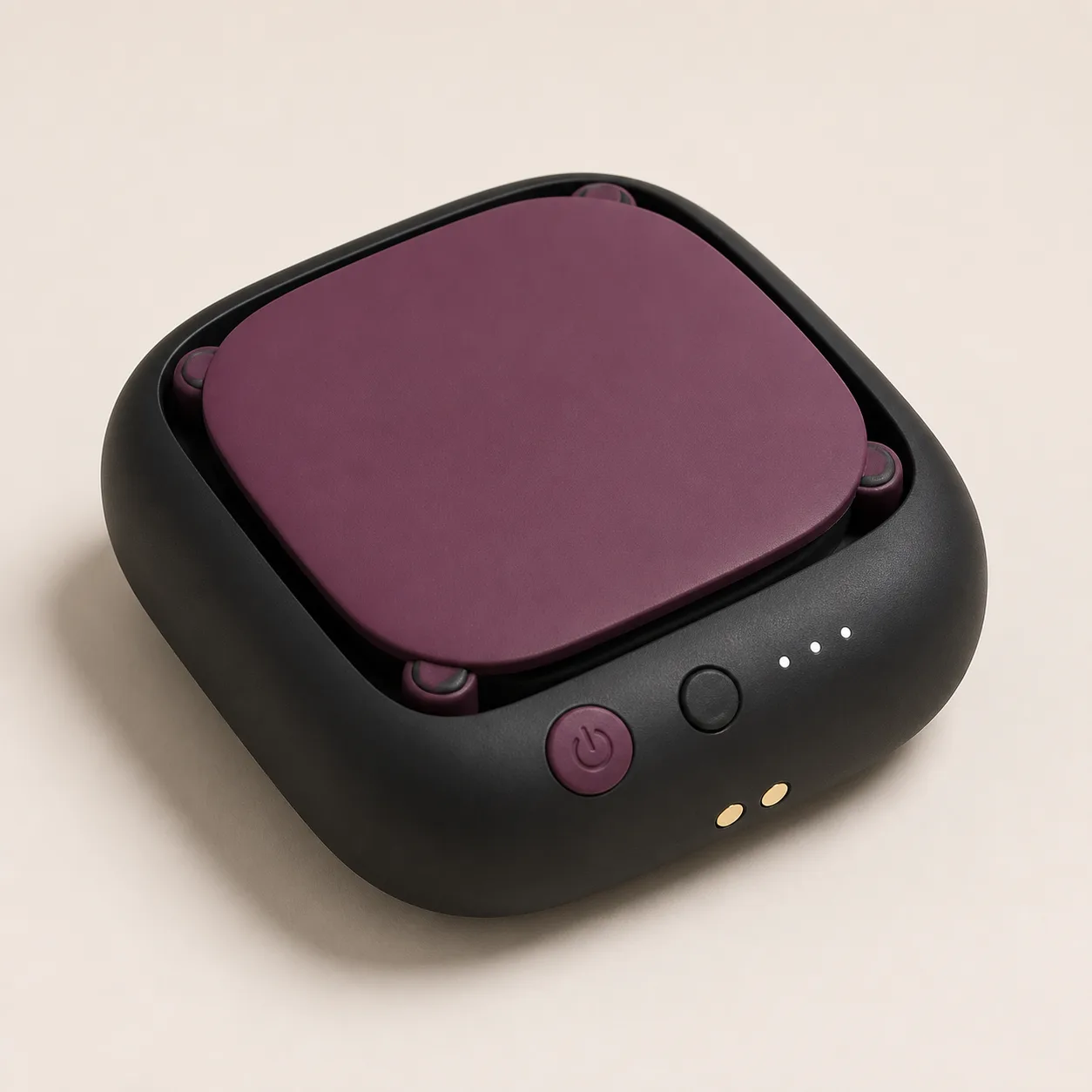
Four-Point Floating-Plate Palm Vibrator with Corner Dampers
A compact rechargeable palm vibrator concept with one broad contact plate supported by four visible corner dampers for separately testable travel and tilt.
36,99 $
200 in stock
Four corner supports define one floating contact plane
This floating plate palm vibrator concept suspends one broad rounded-square contact plate above a compact shell on four visible corner dampers. The layout makes plate tilt, corner compression and gap clearance measurable instead of hiding them inside a single molded surface.

The image does not prove floating travel, pressure sensing, damper material, motor count, output, waterproofing, runtime or safe pressure.
Inventory every load path beneath the plate
Request drawings and a bill of materials for the contact plate, underside carrier, four dampers, posts, retainers, travel stops, shell, actuator, coupling, sensors if any, controller, battery, buttons, indicators, contacts, pigments, seals, lubricants and adhesives.
Confirm whether the dampers carry vibration, limit tilt, isolate the shell or serve only as cosmetic covers.
Measure the plate, gap and neutral height
Record body length, width and depth, plate area and curvature, gap width around every edge, neutral plate height, each post diameter, corner-to-corner spacing, maximum verified travel, control reach and device mass.
Use the same four shell datum points across samples so plate lean and assembly skew are visible.
Map the first corner damper under low compression
Apply small documented loads above the first corner on a guarded fixture. Measure displacement, force, rebound, sound and motion transferred to the opposite corners.
Inspect its post and retainer for rub marks, twisting or delayed recovery.
Map the second corner without averaging
Repeat the test at the adjacent support with the plate centered and unloaded elsewhere. Compare stiffness, stop contact and recovery time with the first corner.
A visually matched post can still differ because of actuator or battery placement beneath the plate.
Map the third corner across charge levels
Measure the third support mechanically with power off, then repeat compliant-load vibration observations at full, middle and low indicated charge. Record any plate bias that appears only while running.
Keep electrical effects separate from static damper stiffness.
Map the fourth corner and close the balance check
Complete the four-point force-displacement map, then compare diagonal pairs. Specify acceptable corner-to-corner variation rather than reporting one average spring value.
Reject a support that bottoms early, sticks, knocks or leaves the plate permanently tilted.
Measure plate translation, rocking and twist
Use synchronized sensors at all four corners while applying centered, edge and diagonal loads within confirmed limits. Resolve vertical translation, pitch, roll and torsional motion.
Define mechanical stops and an approved contact envelope before describing the plate as adaptive or pressure responsive.
Inspect the perimeter gap for pinch and residue
Probe every edge and corner with standardized soft film, hair and textile fixtures while the plate is centered, tilted and vibrating. Examine stops, post wells and underside access with magnification.
Reject closing gaps, sharp plate edges, exposed hardware or cavities that cannot be seen, wiped and dried.
Compare free-air and loaded vibration maps
Measure amplitude, frequency, startup, decay, sound and surface temperature at the plate center, four corners and surrounding shell in free air and against a compliant instrumented surface at several low loads.
Record current and plate motion so output loss can be distinguished from damper compression.
Measure contact spread instead of claiming pressure control
Use pressure film or a calibrated soft array to map the plate footprint under centered and off-center loads. Note high spots, corner lift, shell contact and changes between programs.
No pressure-sensing claim is valid unless the production device measures pressure and changes behavior in a repeatable documented way.
Audit controls, indicators and magnetic charging
Document button functions, press duration, lockout, program order, intensity steps, memory, indicator meanings, low-battery behavior, contact polarity, cable specification, charger input, charge time, runtime and operation during charging.
Keep the product off and dry while charging unless exact-model instructions explicitly permit otherwise.
Track current, heat and fault response under tilt
Run the highest verified program with centered, edge and diagonal compliant loads below supplier limits. Log battery current and temperature at the plate, each damper, shell, controller, battery and charging contacts.
Verify shutdown and restart behavior if one corner is gently obstructed on a guarded fixture; stop for stall, knock, unusual heat, smell, deformation or control failure.
Cycle the plate assembly and validate cleaning access
Run repeated centered, edge and diagonal compression cycles interleaved with vibration. At scheduled checkpoints inspect plate bond, posts, dampers, retainers, stops, gaps, shell seams, buttons and contacts; track stiffness, travel, noise, output, heat, cracks and residue.
Obtain exact material and electrical evidence for every component. Clean the plate edge, full gap, post wells, shell, controls and contacts only by the verified method, then dry completely. Immersion, boiling, alcohol, bleach, abrasives and oils require explicit compatibility evidence.
Price the suspension system after four-corner tests
An Alibaba mini palm massager listing currently shows USD 3.49-3.99 with an MOQ of one piece. It is a category benchmark only and does not confirm this floating plate, four damper supports or an approved supplier.
The procurement reference supports an EUR 36.99 planning price after allowing for China-origin freight, exact-part inventory, four-corner force maps, plate-motion analysis, pinch and residue inspection, loaded vibration and pressure mapping, current and thermal review, complete-assembly cycling, materials and battery documentation, cleaning validation, protective packing and discreet fulfillment. Exact quotation, packed dimensions, weight, freight, duty, tax, insurance, payment fees and delivery terms remain pending.
Frequently asked questions
Does the plate detect pressure?
No sensor is confirmed; movement on dampers does not by itself establish electronic pressure detection.
Do all four corners move equally?
That requires separate force, travel and recovery measurements for every production support.
Can the plate touch the surrounding shell?
Only documented stop geometry and loaded tests can establish clearance across the approved contact envelope.
Is the perimeter gap safe for hair?
Pinch and entrapment testing remains pending, so keep hair, loose fabric and jewelry away from the gap.
Can the device be immersed for cleaning?
Ingress protection is unconfirmed; use only the exact verified cleaning and water-exposure method.
Which faults require retirement?
A tilted or loose plate, split damper, exposed post, closing gap, cracked shell, failed control, unusual heat, battery swelling, corrosion or residue beyond cleaning access.
Reviews
There are no reviews yet.