


Five-Diaphragm Sequential-Compression Automatic Stroker
August 14, 2026
Aolan JA-ZGB-C709 Pink Triple-Stimulation Telescopic Rabbit Vibrator
August 14, 2026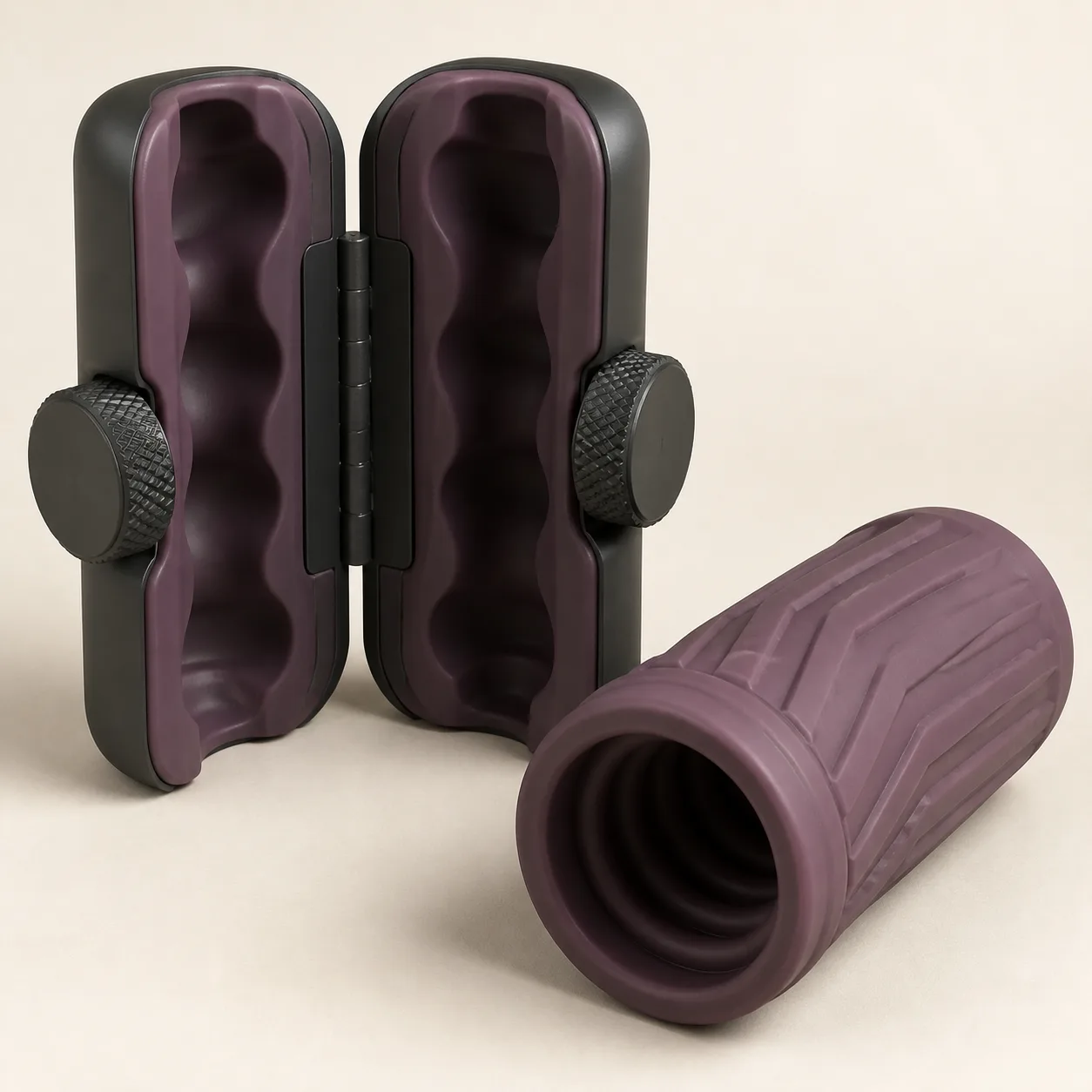
Twin-Roller Full-Hinge Manual Stroker with Removable Wave Liner
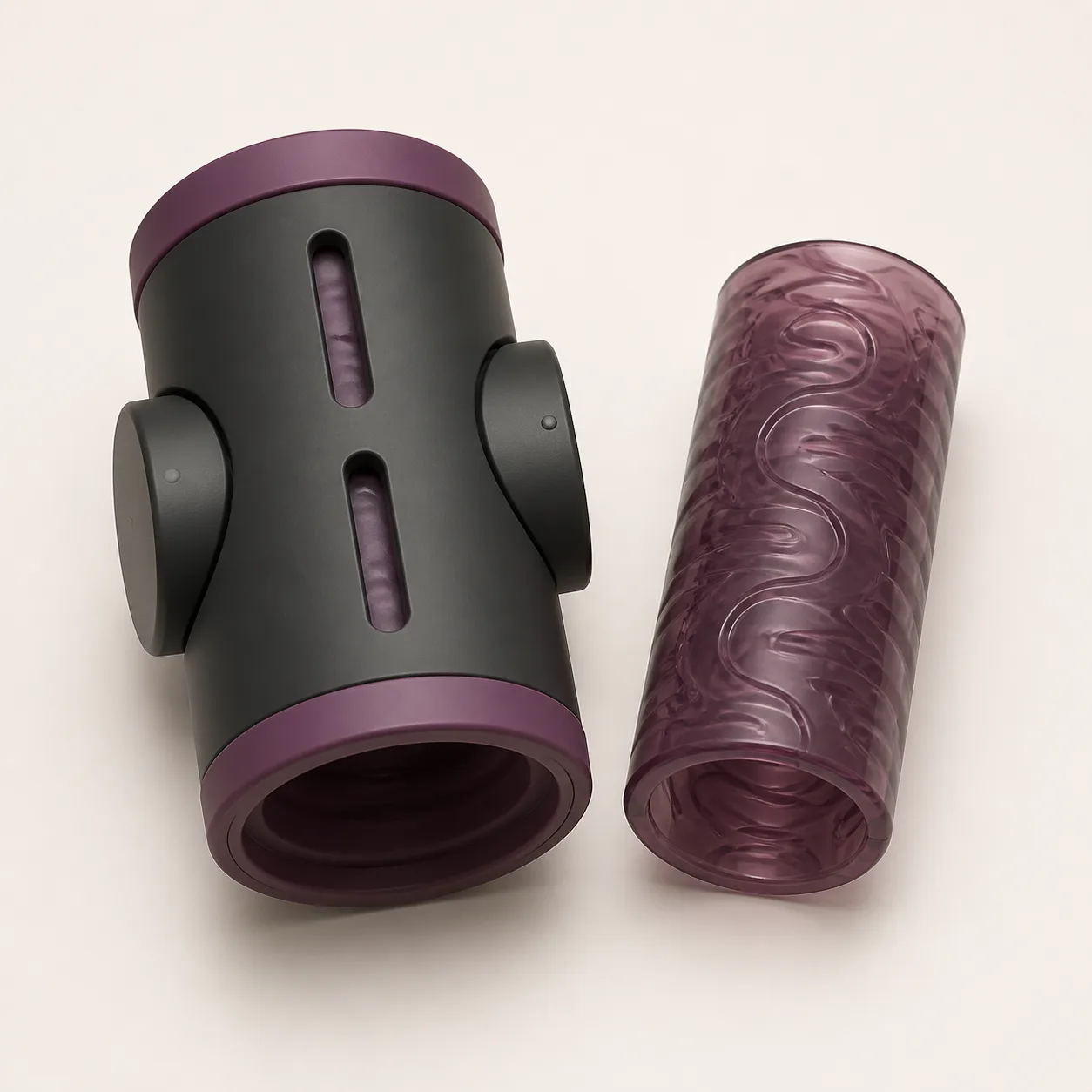
A non-powered manual stroker concept with one full-length hinged charcoal clamshell, exactly two large knurled side tension rollers and one separate removable open-ended smoky-plum liner with an abstract concentric-wave channel.
59,99 $
200 in stock
Open a twin-roller shell around one removable liner
This twin-roller full-hinge manual stroker with removable wave liner concept contains exactly one non-powered charcoal clamshell body and one separate smoky-plum open-ended liner. The shell opens along one full-length center hinge and presents exactly two large knurled side rollers, one on each half.

The image establishes visible industrial design only. It does not confirm dimensions, materials, channel texture, adjustment force, retention, cleaning or production readiness.
Audit the exact two-assembly pack
The planned inventory is one hinged shell and one removable liner. Motor, battery, remote, cable, charger, separate cap, suction base, storage case and other accessories are excluded.
Record colour match, liner and shell lot numbers, hinge protection and roller travel before packing the two assemblies together.
Measure the full-length center hinge
Record hinge length, pin diameter, knuckle count, opening angle, axial play and closure alignment. Cycle the shell from fully closed to the documented cleaning position while checking for binding and sharp pinch points.
Hinge life, maximum opening angle and serviceability remain pending the approved shell drawing and cycle test.
Calibrate exactly two side tension rollers
Label the left roller T1 and the right roller T2. Measure diameter, width, knurl profile, rotation torque, adjustment pitch, end stops and shell displacement per turn.
Compare both sides on a fixture so adjustment remains balanced. Pressure range, compression levels and tactile output remain pending calibrated samples.
Inspect both internal cradle halves
Map the smoky-plum cradle surfaces inside each shell half, including axial contour, contact zones, edge clearance and relief around the hinge. Check that the closed shell supports the liner without cutting, folding or trapping it.
Reject rough seams, mould flash, exposed fasteners, roller interference and asymmetry that shifts the liner away from the centreline.
Measure the removable open-ended liner
Record total length, outside diameter, entry flange, exit opening, wall thickness, mass and relaxed channel diameter. Inspect both ends and the full outer surface for tears, voids, contamination and uneven curing.
The liner is shown as removable for inspection and cleaning; actual removal force, fit and cycle life remain pending.
Map the abstract concentric-wave channel
Use a sectioned validation sample or non-destructive scan to record wave count, height, spacing, channel transitions and minimum wall thickness. Do not rely on the dark entrance view to infer internal dimensions.
Texture, sensation, tightness and suction language remains excluded until the approved liner is measured and bench tested.
Inspect the geometric exterior ribs
Record the number, depth, angle and spacing of exterior ribs along the liner. Check how each rib seats inside the cradle and whether adjustment causes local folding.
The outer pattern is intended for shell engagement rather than direct performance claims. Reject torn peaks, collapsed valleys and misalignment outside tolerance.
Validate liner retention when the shell closes
Measure flange capture, axial movement, rotational movement and pull-out force at minimum, midpoint and maximum approved roller settings. Confirm that the liner cannot contact the hinge or escape through a shell seam.
Retention must remain reversible for cleaning without tools unless the final instructions explicitly specify a service step.
Map compression along the full working length
Place pressure film or calibrated sensors at defined axial positions and compare T1 and T2 adjustments. Record peak, average and left-right variation with the liner empty and with an approved test mandrel.
Reject sharp pressure spikes, shell contact through the liner, roller creep and settings that permanently deform the liner.
Identify every shell and liner material
Obtain traceable declarations for liner, entry flange, internal cradle, outer shell, hinge pin, roller cores, surface coatings, colourants and any adhesive or fastener.
Silicone, TPE, ABS, stainless steel, body-safe, phthalate-free, hypoallergenic and certification claims remain pending exact composition and applicable tests.
Clean the liner outside the opened shell
Remove the liner only according to the validated sequence, open both ends and wash with the approved mild method for the final material. Work through the full channel and exterior ribs without stretching or turning it beyond its tested limit.
Rinse only if permitted and dry the channel completely before reassembly. Boiling, dishwashers, bleach, solvents, abrasives and high heat remain excluded unless the care study permits them.
Wipe and dry the hinge and rollers separately
Clean the shell cradle, hinge, seams, roller gaps and knurled surfaces using a method that does not trap liquid or damage coatings. Do not immerse the shell unless the final construction and care protocol allow it.
Dry every mechanism, back both rollers to the documented storage position and install the liner only after both assemblies are fully dry.
Set non-powered use and inspection boundaries
Inspect the liner for tears, tackiness and contamination and inspect the shell for cracks, hinge play, sharp edges and roller drift before each session. Use abundant material-compatible lubricant and begin at the lowest verified compression.
Stop for pain, numbness, skin pinching, liner folding, shell contact or inability to open the hinge promptly. The product contains no motor and makes no medical or performance outcome claim.
Build landed price from manual-stroker benchmarks
An Alibaba manual-stroker category page displayed a manual cup at USD 15.97 to 17.47 with MOQ 1, while a separate male-sleeve category displayed a portable manual cup at USD 1.61 to 1.88 with MOQ 1. These are broad procurement references, not this exact twin-roller hinged-shell design or an approved supplier.
The public procurement benchmark supports an EUR 59.99 planning price after provisional allowance for China-origin freight, two-part shell tooling, full hinge, twin roller mechanisms, removable liner, retention and compression mapping, cleaning validation, discreet fulfilment and handling loss. Exact supplier, quote, MOQ, dimensions, materials, channel design, packed weight, freight, duty, tax, certification, payment terms and lead time remain pending.
Frequently asked questions
What is included?
Exactly one hinged shell and one removable open-ended liner are planned.
How many tension rollers are present?
Exactly two large side rollers are shown, one on each shell half.
Does the stroker use a motor?
No. The planned product is entirely manual and includes no battery, electronics or remote.
Can the liner be removed for cleaning?
Yes in the concept, but the validated removal sequence and cycle life remain pending approved samples.
What is the liner made from?
The exact polymer, hardness, colourants and channel dimensions remain pending supplier declarations and testing.
How should it be stored?
Clean and dry both assemblies fully, relax both rollers to the documented position and keep the hinge protected from heavy loads.
Reviews
There are no reviews yet.