



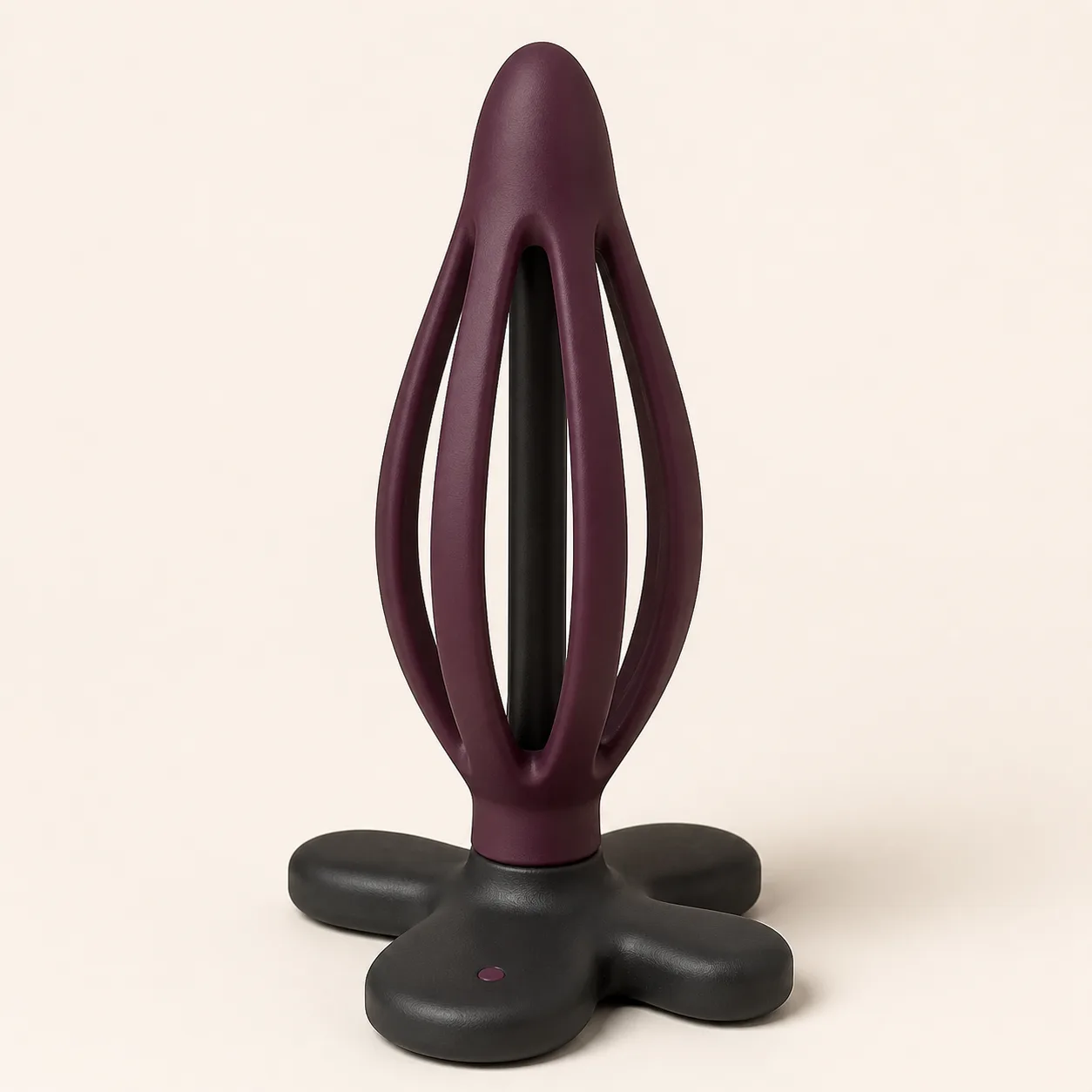
Tapered Inflatable Anal Plug with Bulb Pump and Release Valve
August 14, 2026
GM-382 Thrusting Suction Vibrating Male Masturbator: Black or White
August 14, 2026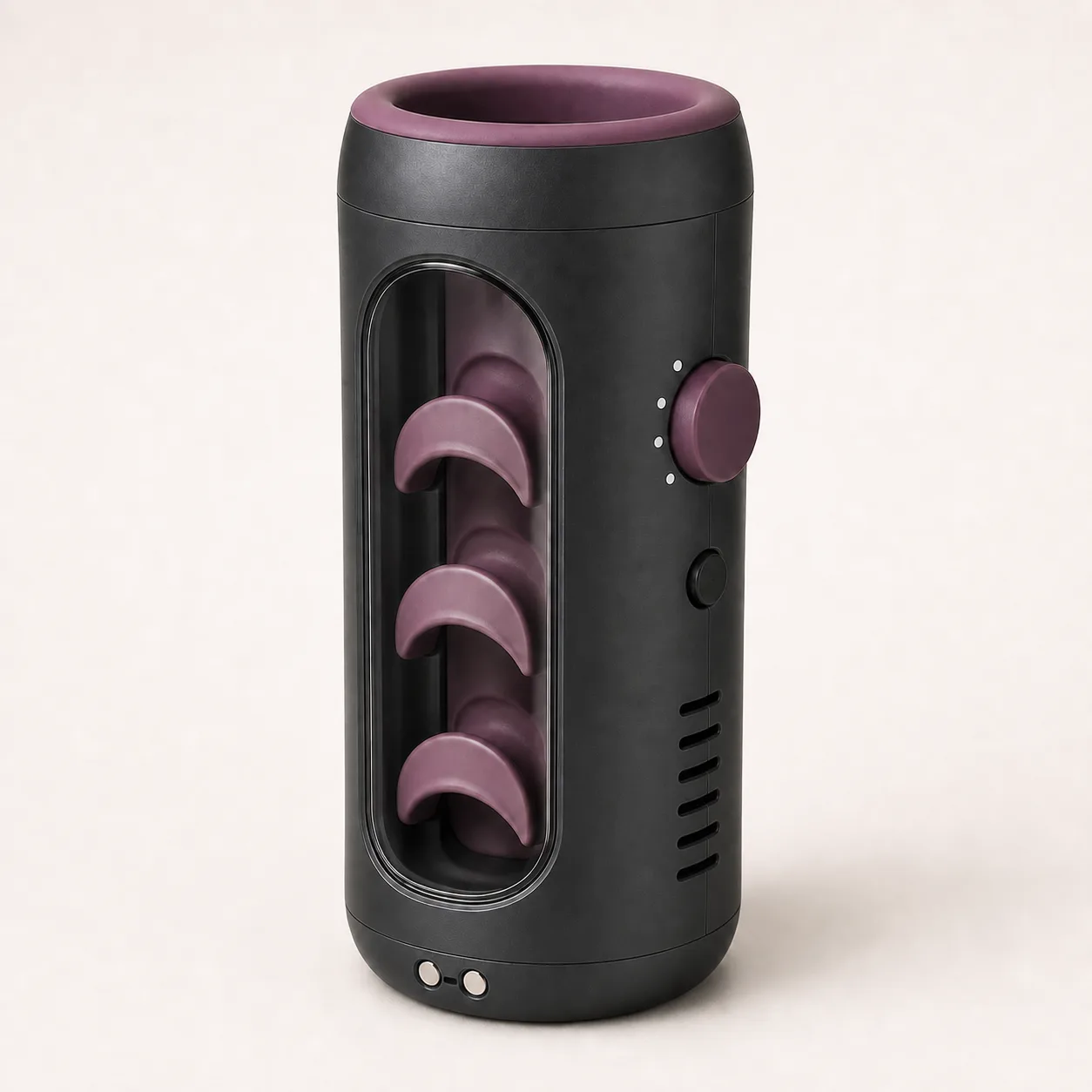
Three-Arch Phase-Indexed Automatic Stroker
An open-ended automatic stroker concept with three visible arch rockers, four proposed phase states and an immediate-stop control.
89,99 $
200 in stock
Index three rocking arches along one channel
This three-arch phase-indexed automatic stroker concept places one removable smoky-plum liner inside a charcoal open-ended shell. A transparent side window exposes exactly three separated arch-shaped rocker yokes, while an exterior dial and four white dots propose four timing relationships.

The image defines a mechanical test target and does not confirm rocker motion, compression, liner material, battery or production status.
Identify pivots drives and guarded boundaries
Label liner L0; rockers A1-A3; pivots P1-P6; drive links D1-D3; window W0; phase dial S0; marks I1-I4; stop B0; vents V1-V6; contacts J1-J2; motor, gearbox, controller, cell, seals and fasteners.
Require exact-sample drawings, firmware identity and a bill of materials before assigning function to visible parts.
Measure the removable liner first
Record relaxed bore, wall thickness, working length, flange geometry, hardness, friction, mass and dimensional variation along L0. Measure retention at both ends and support beside the window.
Reject tears, tack, exposed hard transitions, thin zones, flange lift or uncontrolled liner migration.
Calibrate arch A1 through A3 separately
Measure axial position, span, inner clearance, angular travel, pivot play, surface finish and reset accuracy for every rocker. Track both edges through full commanded motion.
Three visible arches are not three independently controlled stations until command and displacement data identify each one.
Decode four proposed phase relationships
Map S0 and I1-I4 to rocker direction, offset, dwell, overlap, amplitude and speed. Capture actuator commands beside synchronized A1-A3 angle traces.
Four dots remain reference marks until testing proves four distinct stable timing states.
Build axial compression and timing maps
Place synchronized displacement and force sensors beneath each arch and between stations. Record onset, peak, duration, overlap and release for every confirmed program and intensity.
Plot phase progression so simultaneous rocking, traveling compression and dead zones can be distinguished.
Challenge standardized fixture diameters
Use bounded compliant fixtures spanning the documented range. Log liner stretch, rocker clearance, compression, current, sound, temperature and flange movement at each diameter.
Do not translate fixture results into universal-fit statements.
Measure off-axis load and pivot balance
Apply controlled eccentric loads toward the window, rear shell and both lateral axes. Compare A1-A3 travel, pivot reaction, liner displacement and drive current.
Reject rocker skew, window contact, exposed pinch paths, abrupt stall or persistent asymmetric loading.
Inspect window clearance through every phase
Measure W0 thickness, attachment, clarity and minimum gap from rockers, liner and links. Probe the window perimeter, pivots and station gaps for snag, abrasion and trapped residue.
Reject contact marks, loose glazing, sharp edges, fogging or fastener movement.
Verify stop and jam-release behavior
Measure B0 access and time from actuation to drive stop and force decay at all three arches. Challenge power loss, low voltage, blocked vents and one-rocker restraint in guarded fixtures.
The system must enter a documented low-energy state without an unexpected restart.
Trace airflow sound and heat sources
Map air movement through V1-V6 and internal passages. Measure A-weighted sound and temperatures at A1-A3, pivots, motor, gearbox, controller, cell, window, vents and contacts.
Separate normal drive signatures from pivot knock, gear wear, shell resonance and obstructed cooling.
Validate controls charging and protection
Document startup, phase selection, speed, pause, immediate stop, travel lock and low-battery response. Confirm J1-J2 polarity, charge time, operating time, cutoff, standby drain and contact temperature.
Battery chemistry, capacity, cable, input limits and transport documents remain pending supplier evidence.
Design cleaning and drying challenges
Time liner removal and refitting without tools, then apply visible test soil to the bore, flanges, arch interfaces, pivot recesses, window edges, vents, controls and contacts. Record residue, drying time, swelling, odor and corrosion.
No waterproof, immersion or automated-washing claim is made without exact-model evidence.
Confirm materials and cyclic durability
Request declarations for the liner, arch surfaces, pivots, links, shell, window, seals, pigments, adhesives and lubricants. Cycle all verified phase states, loads, cleaning, charging and storage, then remeasure alignment, timing, sound and heat.
Retire samples for tears, pivot drift, rocker scoring, window damage, abnormal heat, fluid entry, charging faults or cell swelling.
Build landed price after phase validation
An Alibaba automatic-stroker category page showed one motorized example at USD 30.00 to 32.00 with a one-piece minimum. It is a broad benchmark only and does not identify this three-arch mechanism or an approved supplier.
The public procurement benchmark supports an EUR 89.99 planning price after provisional allowance for China-origin freight, exact samples, liner and rocker metrology, four-phase calibration, force and timing maps, stop, sound, heat, charging, cleaning, fault and fatigue work, protective packing and discreet fulfilment. Exact supplier, quote, MOQ, dimensions, materials, battery, packed weight, freight, duty, tax, certification, payment terms and lead time remain pending.
Frequently asked questions
How many rocker arches are shown?
The concept uses exactly three separated arches visible through one side window.
Are four phase modes confirmed?
No. Four distinct timing relationships require synchronized command, angle and force data.
Can the liner be removed?
The concept proposes removal, but retention force and refitting accuracy require testing.
What happens after the stop button is pressed?
Drive-stop and force-decay time must be measured at all three stations.
Is the unit waterproof?
No ingress claim is made for the window, seams, vents, controls or charging contacts.
Which faults require retirement?
Tears, pivot drift, rocker scoring, window damage, heat, fluid entry or cell swelling.
Reviews
There are no reviews yet.