



Lever-Release Parallel-Pad Sensory Clamps with Three-Stage Load Windows
August 14, 2026
Black Spacerail Automatic Stroker with Clear Blue Drive Chamber
August 14, 2026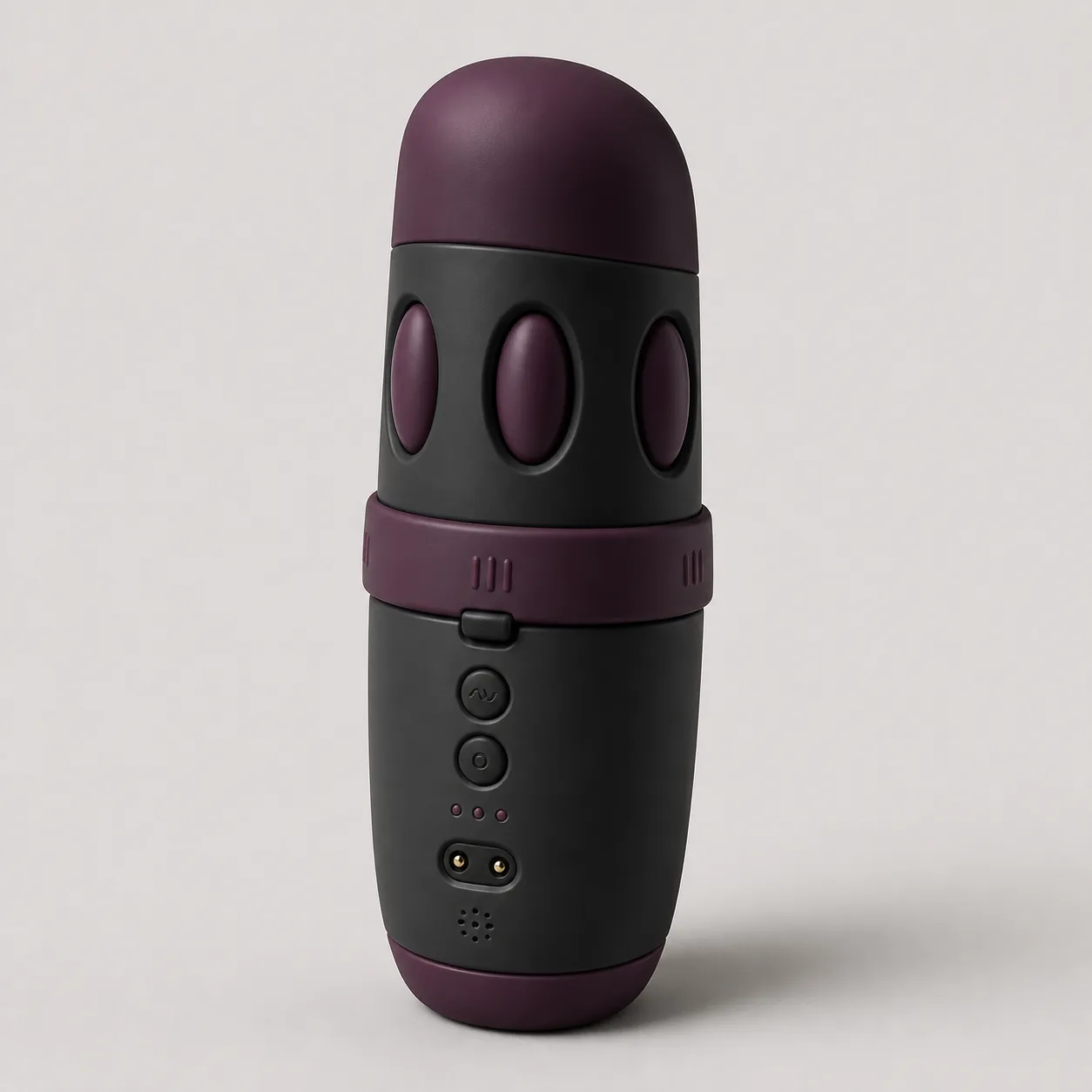
Three-Chamber Adjustable-Balance Capsule Vibrator with Index Collar
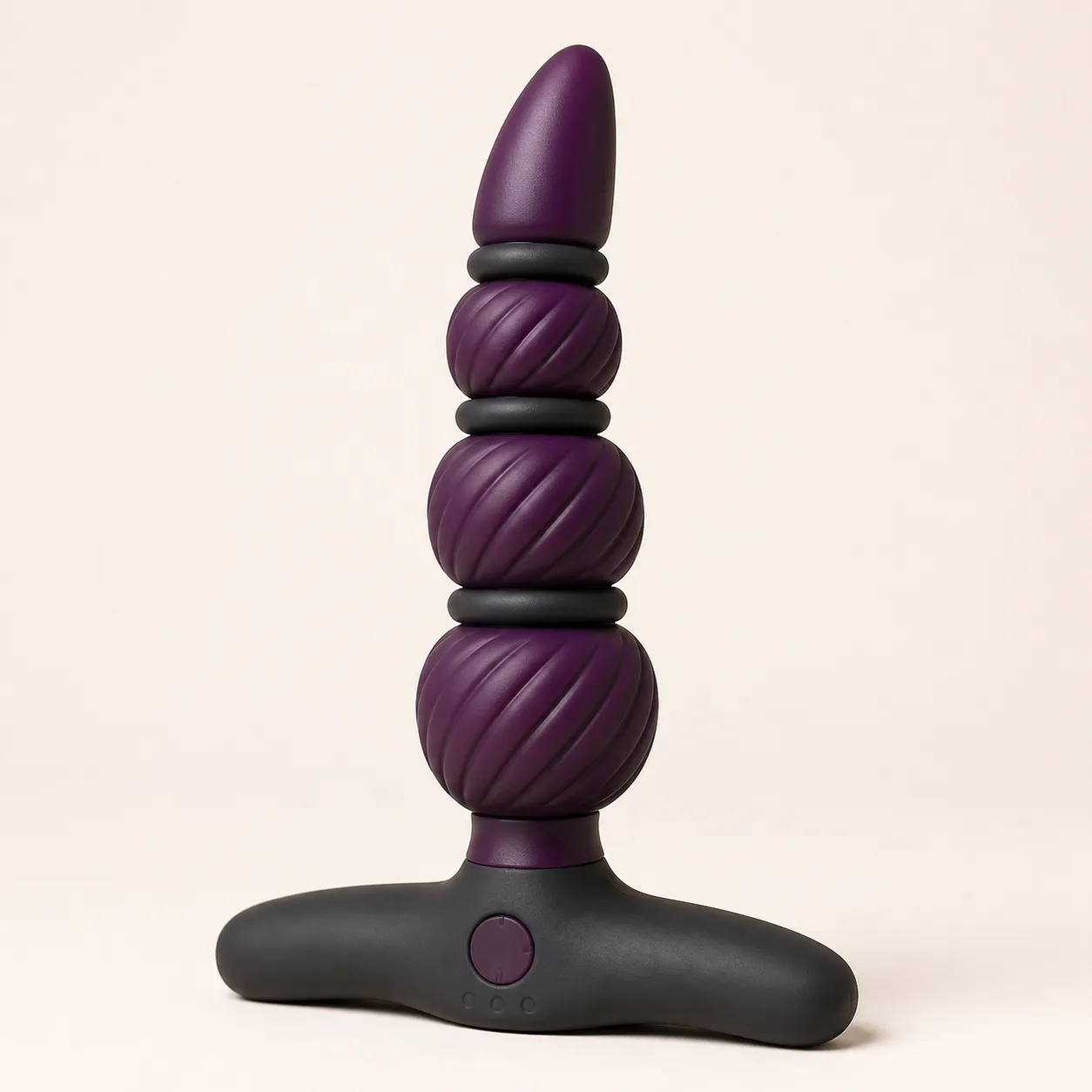
A compact capsule vibrator concept with three guarded balance chambers, a three-stop index collar, collar lock, rounded tip and upright end cap.
39,99 $
200 in stock
Redirect vibration with three guarded balance chambers
This adjustable-balance capsule vibrator concept groups three low-profile plum chambers evenly around a charcoal body. A broad indexed collar below the chamber band is intended to change their operating relationship, while the rounded plum tip, flat end cap and compact control grip keep the exterior visually simple.

The image does not prove movable masses, directional adjustment, output, dimensions, material composition, sealing, charging safety, acoustic performance or production availability.
Inventory the complete capsule assembly
Request an exploded bill of materials covering the rounded tip shell, upper frame, chambers C1 through C3, guarded recesses, internal weights or actuators, bearings or flexures, broad index collar, three detents, lock tab, lower grip shell, two buttons, three indicator lenses, board, cell, motor drivers, charging contacts, vent membrane, flat end cap, seals, fasteners, pigments, lubricants and adhesives.
Trace each item to the approved drawing and batch record; a generic mini-vibrator sheet cannot establish this three-chamber architecture.
Measure external geometry and balance
Record total length, maximum diameter, tip axes and radius, chamber-band height, recess depth, collar width, stop-mark spacing, grip dimensions, end-cap footprint, charging recess, mass and center of gravity. Repeat after conditioning and after the declared cycle test.
Measure standing stability on the flat cap and tip alignment relative to the body centerline.
Characterize chambers C1 C2 and C3
For each chamber, document position angle, shell thickness, guarded clearance, internal mass, travel if present, support stiffness, free play, resonance and attachment method. Use imaging or controlled teardown to verify that the visible oval pods correspond to a real mechanism.
One chamber must not rely on a neighboring shell to retain its moving part.
Calibrate the three-stop index collar
Measure collar rotation, detent angles, required torque, hysteresis, repeatability and end-stop margin at positions one, two and three. Approach each stop from both directions and record any backlash or partial engagement.
Tactile marks need a documented mechanical meaning and must remain legible after cleaning and wear.
Verify the collar lock tab
Measure tab travel, engagement depth, operating force and resistance to accidental contact. Apply conservative torsional disturbance to the collar while locked and confirm that it cannot settle between defined positions.
The lock must not expose a sharp edge, create a debris trap or obstruct access to the controls.
Map output direction at every index
Mount the capsule in a low-mass fixture and measure tri-axial acceleration at the tip, each chamber recess, collar, grip and end cap. Record dominant frequency, harmonics, vector direction, phase and repeatability for every mode at all three collar stops.
A claimed balance shift should produce a measured, repeatable vector change rather than only a different sound.
Measure transfer through the rounded tip
Use controlled preload on an instrumented compliant pad to map contact area, local pressure and acceleration across the rounded plum tip. Compare centered contact with small angular offsets and all collar positions.
Inspect the tip-to-frame seam for hard print-through, movement, heating or a gap that changes under load.
Separate chamber effects from motor variation
Log motor command, current and speed while changing the index collar. Use phase analysis and chamber-mounted sensors to determine whether output changes come from the chamber configuration or from unintended changes in motor load.
Document any transient spike, stalled chamber, irregular beat or loss of synchronization.
Evaluate grip vibration and control access
Measure acceleration at several grip positions and the force needed to activate each flush button without changing the collar. Check whether the chamber setting produces unwanted numbness, rattling or control ambiguity in the lower shell.
The three status indicators should map clearly to charging, lock and operating states defined by the manufacturer.
Verify charging vent and power-loss behavior
Confirm charging-contact polarity, specified lead, charger limits, cell protection, low-voltage response, vent-membrane construction and accessible contact spacing. Interrupt power in every operating state and verify a predictable off condition without unwanted restart.
Electrical sealing and moisture claims remain pending until sample inspection and documented tests are complete.
Measure sound current runtime and heat
At each mode and index stop, log input current, runtime, accessible surface temperature, chamber hot spots and A-weighted sound at a defined distance on a controlled fixture. Repeat after a conservative blocked-chamber simulation and low-cell condition.
Investigate rising current, asymmetric heating, collar chatter, changing pitch or intermittent indicator behavior.
Challenge one imbalanced or stalled chamber
Add a bounded mass offset to one test mechanism and controlled drag to another while monitoring acceleration vector, frame load, current, heat, sound, collar force and guard movement. Stop before damage and quarantine any sample with a loose internal component or shell deformation.
The failure response must not depend on continued operation of the other two chambers.
Cycle indexing operation cleaning and storage
Run repeated collar changes, locking, mode changes, controlled preload, charging, cleaning, measured drying and upright storage. At checkpoints repeat dimensions, chamber play, detent torque, lock engagement, output vector, current, heat, sound, indicator logic, charging contact condition and seam inspection.
Retire samples with chamber rattle, collar drift, failed locking, cracked guards, loose tip, exposed contacts, swollen shell, abnormal heat, persistent odor or trapped residue.
Build landed price after chamber proof
An Alibaba mini-bullet vibrator page currently shows a rechargeable category example at USD 1.91-2.19 with MOQ three. It is a price benchmark only and does not confirm this three-chamber balance system, indexed collar, lock tab or an approved supplier.
The procurement reference supports an EUR 39.99 planning price after allowing for China-origin freight, exact-model sourcing, three-chamber inspection, collar calibration, vector and phase mapping, tip-transfer testing, electrical review, current, sound and heat measurements, fault analysis, cycle life, protective packing and discreet fulfillment. Exact quotation, MOQ, dimensions, materials, battery, packed weight, freight, duty, tax, insurance, payment fees, certifications and delivery terms remain pending.
Frequently asked questions
What do the three oval chambers do?
They represent separate balance elements, but their internal mechanism and output contribution require sample evidence.
Does the collar change intensity?
Its three positions are intended to alter balance behavior; acceleration, phase and motor command must be measured separately.
Can the collar move during operation?
The lock tab must hold every detent under conservative torsional disturbance and cycle testing.
Is the device waterproof?
No sealing claim is confirmed; inspect the tip seam, collar, buttons, contacts and vent before approving care instructions.
How should output be compared?
Use tri-axial tip and chamber measurements under the same preload, mode, collar stop and battery condition.
Which faults require retirement?
Internal rattle, collar drift, failed locking, cracked guards, loose tip, exposed contacts, swelling, abnormal heat, persistent odor or trapped residue.
Reviews
There are no reviews yet.