


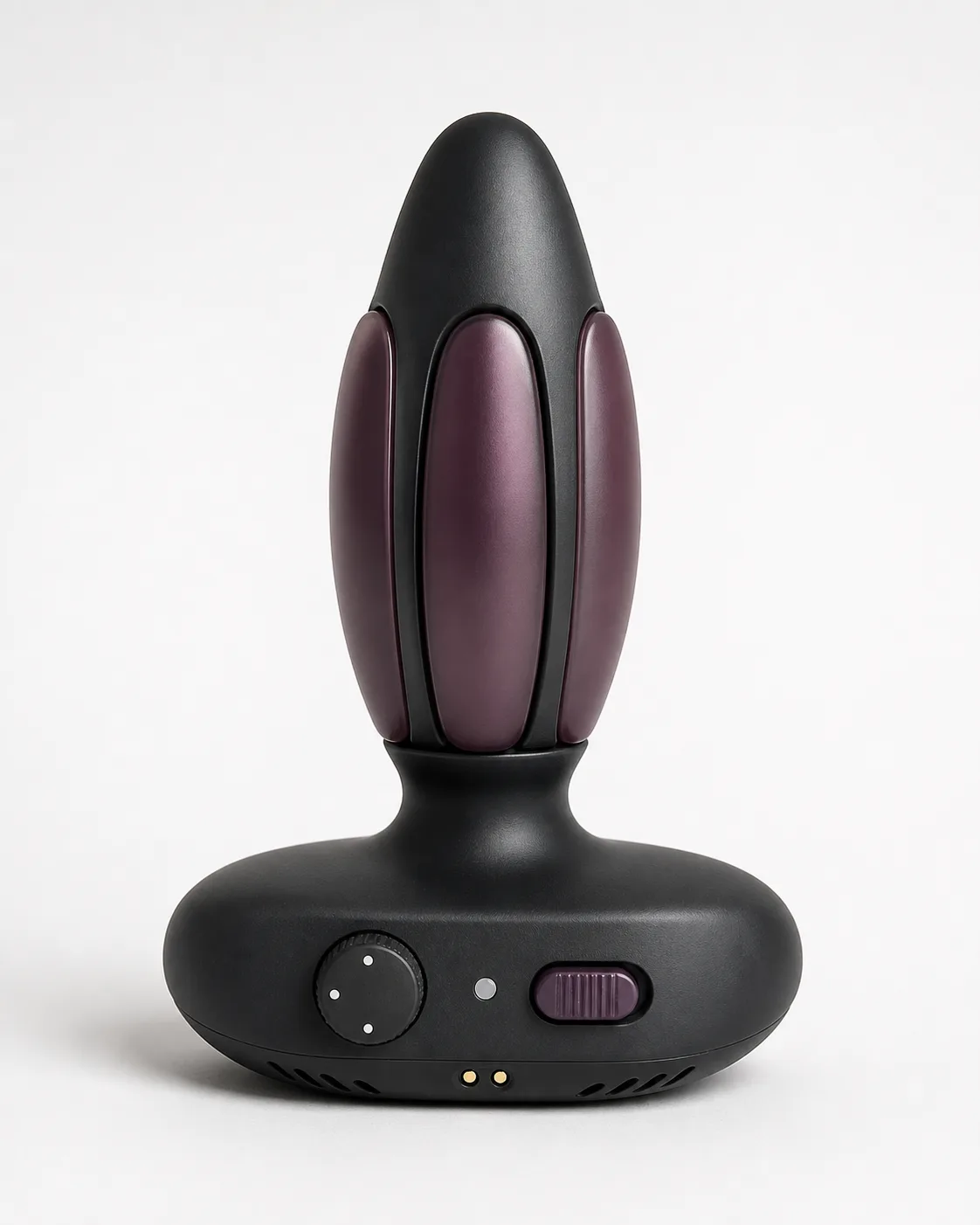
Purple Precision-Ball G-Spot Stimulator Pen
August 14, 2026
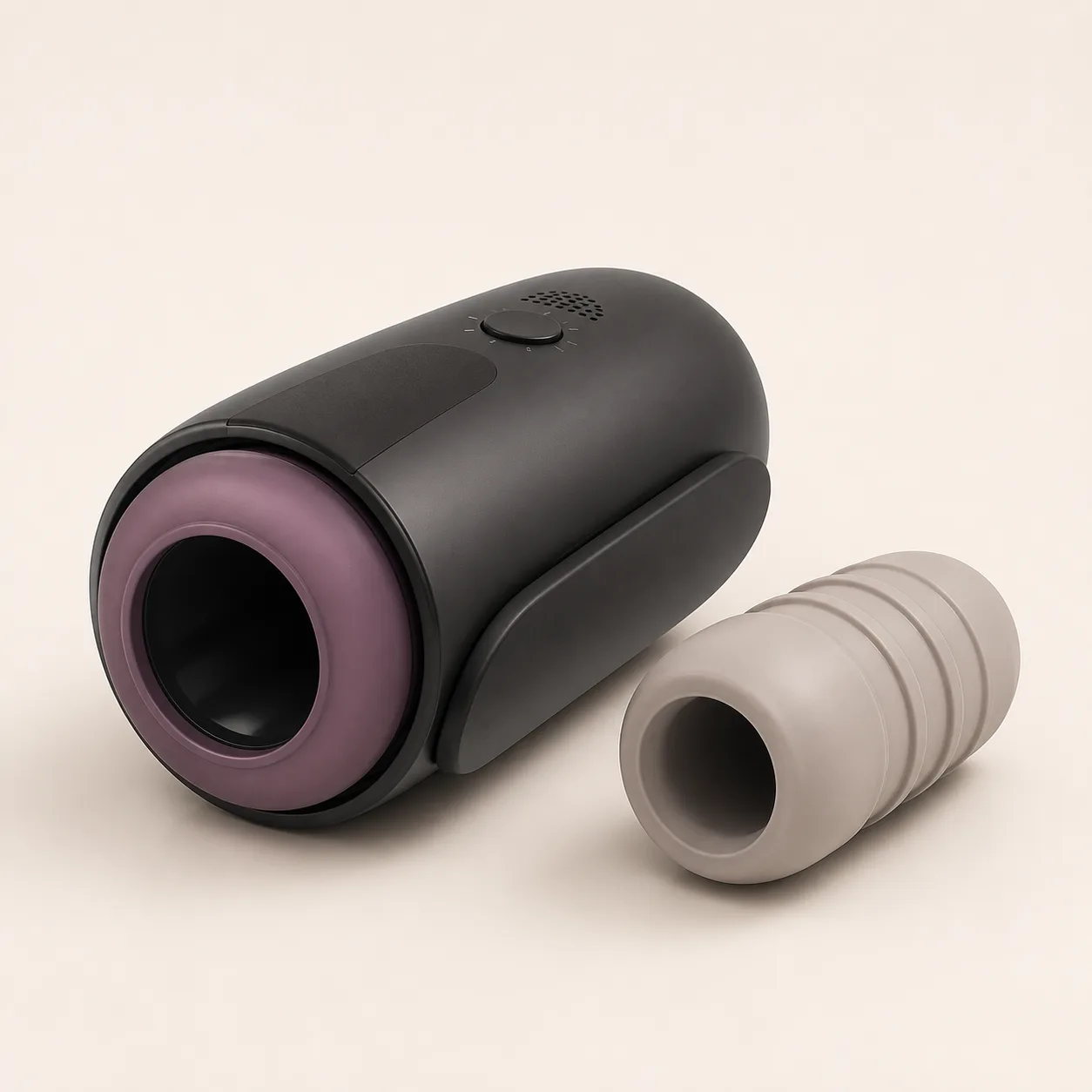
Four-Tappet Radial-Pulse Automatic Stroker with Liner-Lock Collar
August 14, 2026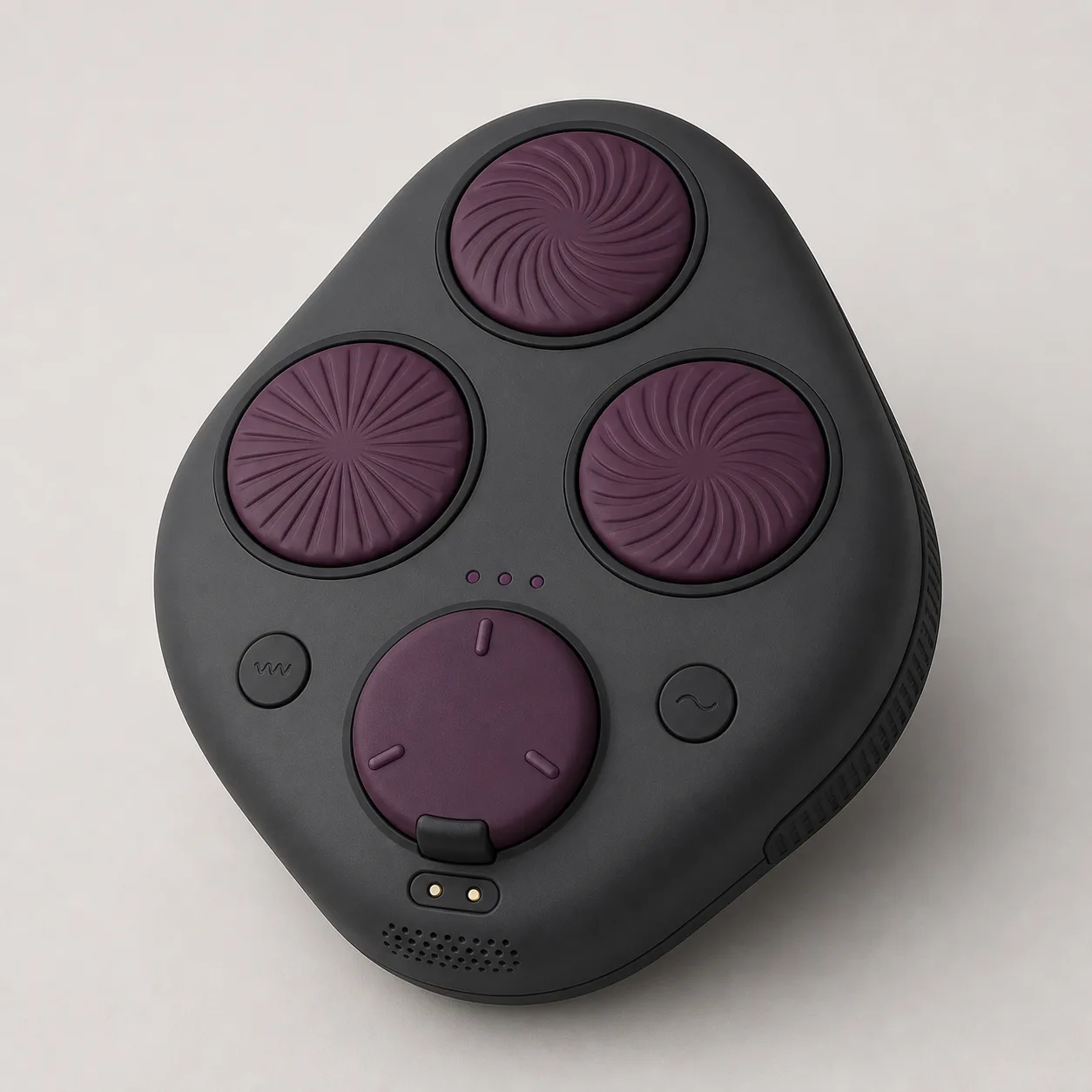
Three-Disc Counter-Rotating Pocket Vibrator with Phase Dial
A palm-sized vibrator concept with three independently guarded rotating contact discs, distinct groove patterns and a lockable three-position phase dial.
45,99 $
200 in stock
Coordinate three rotating contact discs in one palm shell
This three-disc counter-rotating pocket vibrator concept arranges three guarded plum discs across a rounded triangular charcoal body. Each disc carries a distinct radial groove pattern, while a broad three-position phase dial and lock tab are intended to change their timing relationship.

The image does not prove rotation, phase control, vibration output, dimensions, materials, sealing, charging safety, sound level or production availability.
Inventory all three disc drive paths
Request an exploded bill of materials for shell halves, discs D1 through D3, soft faces, shafts, bearings, guard rings, seals, motors, gears or couplings, phase dial, three detents, lock tab, two buttons, indicators, control board, cell, charging contacts, vent membrane, rear grip rail, fasteners, pigments, lubricants and adhesives.
Trace each component to drawings, tolerances, batch records and the approved sample.
Establish shell and disc geometry
Measure body axes, thickness, corner radii, disc centers, face diameters, crown, projection, guard-ring clearance, dial position, control reach, charging recess, grip-rail dimensions, mass and center of gravity.
Record face coplanarity and shell flatness before and after conditioning.
Characterize the three groove patterns
For D1, D2 and D3, measure groove count, depth, pitch, curvature, edge blend, face hardness, compression recovery and surface friction. Inspect seams, flash, voids, thin regions, hard inclusions and pigment transfer.
Pattern differences should be documented by metrology rather than decorative names.
Inspect guard rings and moving gaps
Measure full-circumference disc-to-guard clearance at rest, under centered preload, edge preload and operation. Use articulated gauges and inspect shaft recesses, dial, lock and control margins after cleaning.
No moving gap should admit an approved gauge, expose a hard retainer or trap residue beyond the validated cleaning method.
Measure individual disc rotation
Use optical tracking to record direction, speed, runout, startup delay, coast-down, torque and stall response for D1 through D3. Repeat with controlled face preload and low-cell conditions.
Confirm whether every disc rotates continuously, oscillates or only vibrates; shell appearance is not evidence of motion.
Calibrate the three-position phase dial
Measure dial angle, detent torque, hysteresis, repeatability and command mapping at all three marks. Approach each stop from both directions while tracking disc speed and relative angular phase.
An intermediate position must not produce unstable commands or unexpected direction reversal.
Verify the dial lock tab
Record tab travel, engagement depth, force and resistance to accidental contact. Apply bounded vibration and torsional disturbance while locked and confirm that the dial cannot drift between indexed stops.
The lock must remain distinguishable by touch without obstructing either control button.
Map pressure across the three-disc triangle
Use an instrumented compliant pad to measure contact area, pressure contribution and edge loading for each disc under centered, offset and tilted preload. Compare static faces with every operating and phase setting.
Reject hard guard contact, one-disc overload or a shell corner that contacts before the intended faces.
Measure phase patterns and surface motion
Synchronize optical markers and tri-axial accelerometers to record relative phase, slip direction, beat frequency and resultant surface path. Map the center and perimeter of all three faces.
A counter-rotation or phase-shift claim requires measured, repeatable motion under the same preload and battery condition.
Evaluate rear grip-rail isolation
Measure grip-rail texture, finger clearance, shell acceleration and control reach at several hand-fixture positions. Compare transmitted vibration across modes and phase stops without covering the vent or contacts.
The rail must remain securely bonded and free of sharp texture or narrow debris traps.
Verify controls charging and power loss
Identify every button action, indicator pattern, lock sequence, charging polarity, specified lead, charger limit, cell protection and low-voltage response. Interrupt power in every mode and dial position and confirm a predictable off condition.
Sealing and moisture claims remain pending until disc shafts, guards, dial, controls, contacts and vent are tested.
Measure current runtime sound and heat
Log operating current, runtime, accessible temperature, motor and bearing hot spots and A-weighted sound at defined distance for every mode and representative phase stop. Repeat with one protected disc stalled and with low cell voltage.
Investigate rising current, bearing chatter, face wobble, dial drift, asymmetric heat or intermittent indicators.
Challenge one stalled disc and cycle the assembly
Immobilize one disc in a protected fault specimen while monitoring the other two, drive torque, shell load, phase behavior, current, temperature, sound and shutdown. Stop before damage and quarantine samples with shaft migration, guard contact or torn faces.
Cycle operation, phase selection, locking, controlled preload, charging, cleaning, measured drying and storage. Recheck geometry, rotation, gaps, pressure, phase, controls, contacts, grip rail and surface condition.
Build landed price after three-disc proof
An Alibaba mini-bullet vibrator page currently shows a rechargeable category example at USD 1.91-2.19 with MOQ three. It is a benchmark only and does not confirm this three-disc drive, phase dial, guarded palm shell or an approved supplier.
The procurement reference supports an EUR 45.99 planning price after allowing for China-origin freight, exact-model sourcing, three-disc and groove metrology, rotation and phase mapping, gap and pressure tests, grip isolation, electrical review, current, sound and heat measurement, fault and cycle testing, protective packing and discreet fulfillment. Exact quotation, MOQ, materials, battery, packed size, weight, freight, duty, tax, insurance, payment fees, certifications and delivery terms remain pending.
Frequently asked questions
Do all three faces rotate?
Rotation type, direction and speed require optical measurements for D1, D2 and D3 under controlled preload.
What does the phase dial change?
It is intended to select three timing relationships, subject to measured phase, drift and stability.
Can the moving discs pinch?
All guard clearances need articulated-gauge tests under preload, tilt, operation and wear.
Are the three textures identical?
No; each face has a distinct groove layout that requires separate depth, pitch and friction data.
Is the device waterproof?
No sealing claim is confirmed; disc shafts, guards, dial, buttons, contacts and vent need evidence.
Which faults require retirement?
Stalled or wobbling discs, shaft migration, guard contact, torn faces, dial drift, failed locking, exposed contacts, abnormal heat or persistent residue.
Reviews
There are no reviews yet.