


Bayonet-Lock Reversible-Liner Manual Stroker with Thumb Vent
August 14, 2026
Alternating-Profile Anal Bead Strand with Twin-Loop Base
August 14, 2026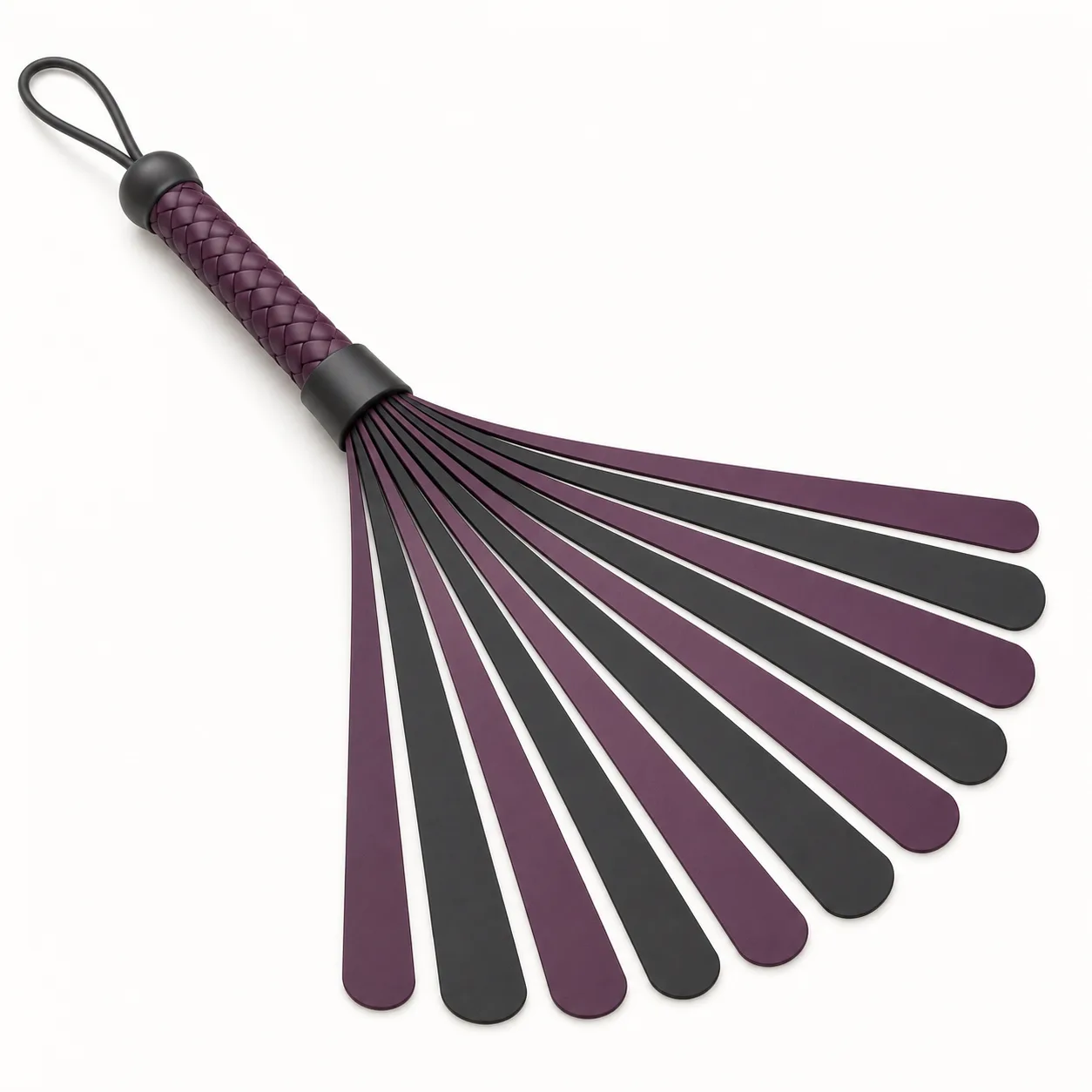
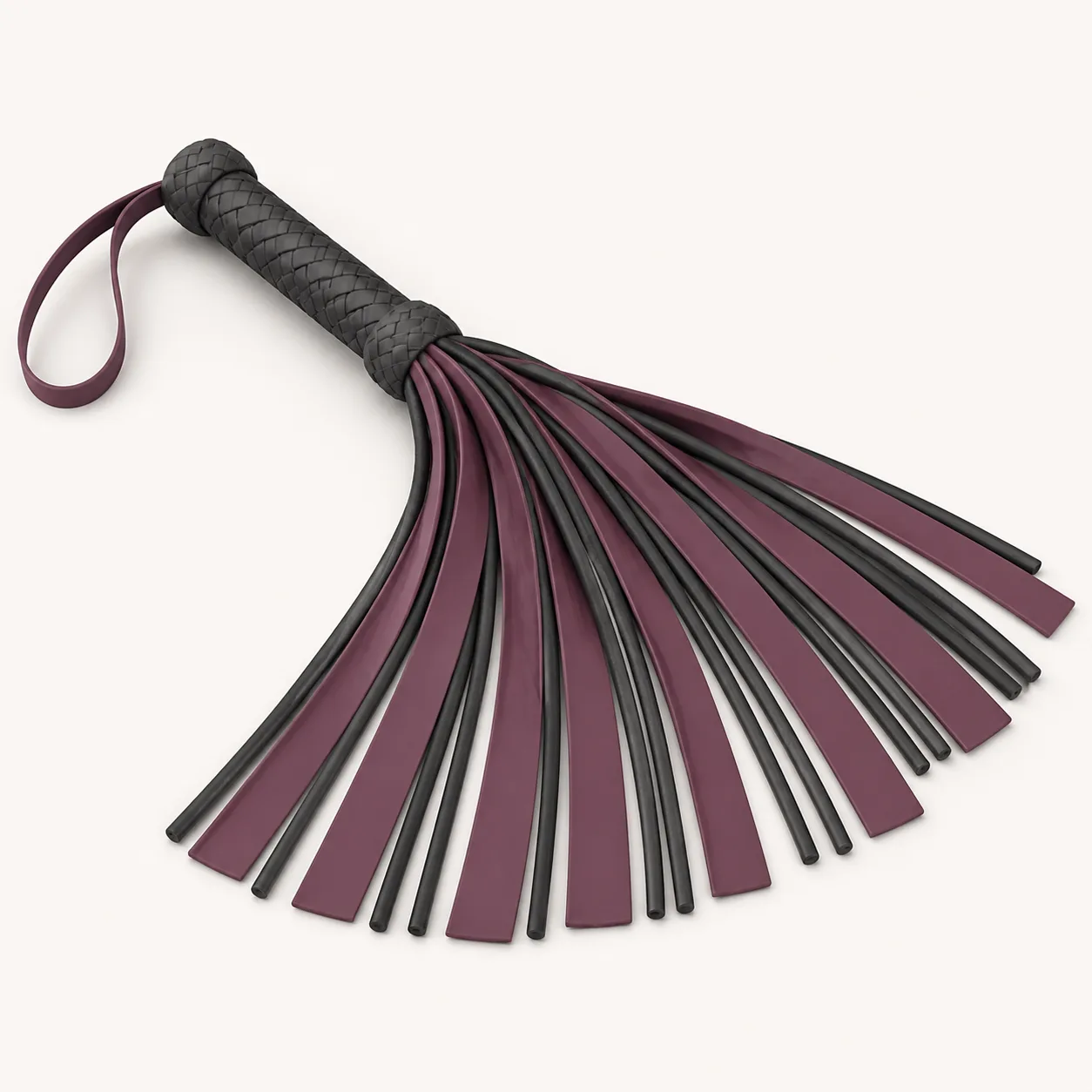
Twelve-Fall Alternating-Width Sensory Flogger with Braided Grip and Rounded End Knob
A single plum-and-charcoal sensory flogger concept with exactly twelve rounded flat falls, alternating widths, one braided grip, one reinforced collar and one wrist loop.
34,99 $
200 in stock
Read the twelve-fall alternating-width sensory flogger as one measured fan
This twelve-fall alternating-width sensory flogger is proposed as one deep smoky-plum braided grip, one charcoal wrist loop, one broad root collar, one rounded end knob and exactly twelve flat falls. The fan alternates six smoky-plum and six charcoal pieces while mixing six narrow and six broad profiles.

The rendering fixes the visual count and arrangement only. Dimensions, materials, mass, flexibility, attachment method, cleanability, impact behaviour and production readiness remain pending.
Keep the sales unit to a single complete tool
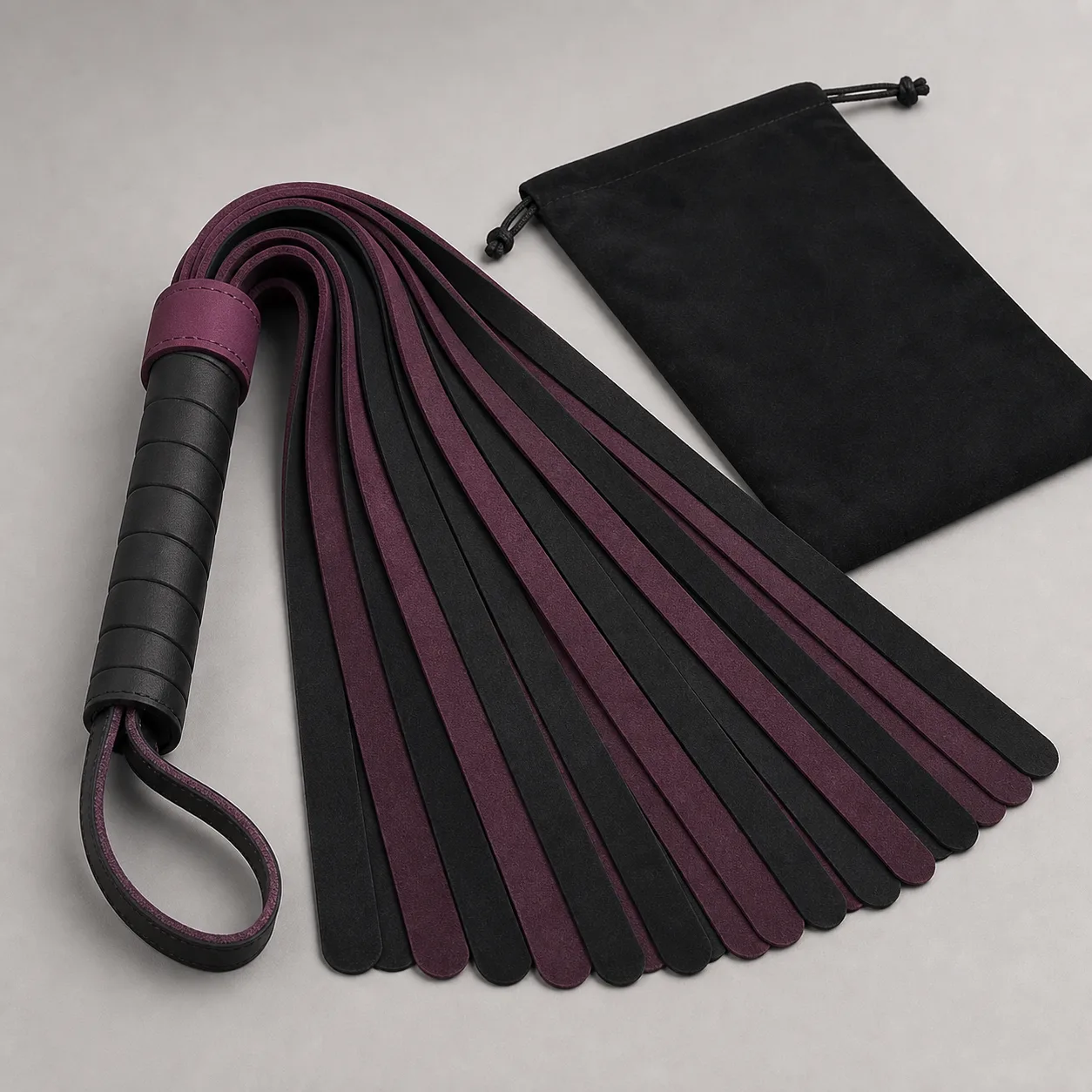
The planned inventory line contains one assembled flogger. A cuff, paddle, blindfold, storage pouch, spare fall, cleaner or presentation box is not included unless an approved packing list later names it.
Incoming inspection should identify the complete unit and separately trace the loop, top cap, braid, grip core, lower collar, end knob and all twelve falls.
Number twelve falls without hiding an overlap
Mark the root positions F01 through F12 clockwise around the collar. For every position, record free length, width, thickness, tip radius, edge radius, mass, root spacing and resting angle.
Spread the fan on a measurement board and photograph both faces so a doubled, missing or twisted fall cannot disappear behind a neighbour.
Separate the six broad profiles from the six narrow profiles
Compare width at the root, midpoint and rounded end, then calculate taper and lateral stiffness for each group. Broad and narrow pieces should be analysed separately before their behaviour is summarized together.
The proposed alternating widths may change drag, arrival timing and contact area; they do not establish a universal sensation level.
Audit the six-plum and six-charcoal colour sequence
Confirm the visual order at the collar and at the free ends, checking dye penetration, coating uniformity, rub transfer and shade drift after light, moisture and cleaning exposure. Photograph the same labelled pieces under controlled illumination.
Colour does not prove composition. The plum and charcoal pieces may share one substrate or use different constructions, and that distinction remains pending supplier evidence.
Inspect rounded ends and long edges under flex
Use magnification and a tactile edge gauge to find burrs, square corners, loose fibres, cracks, delamination or exposed reinforcement. Repeat the inspection after bending each fall toward both faces and after the validated cleaning cycle.
Any piece that develops a sharp edge, split tip or shedding surface should fail the lot check.
Expose the collar and root anchor to twelve-direction loading
Request a section drawing that shows how the fall bundle enters the charcoal collar. Pull F01 through F12 individually, then load opposing pairs, adjacent trios and the full bundle while measuring slip and collar rotation.
Adhesive, stitching, crimping, fasteners and anchor depth must be described by the actual factory construction rather than inferred from the exterior.
Measure braid pitch and grip-core control
Record grip length, diameter, braid pitch, compression, seam termination, dry friction, damp friction and core stiffness. Rotate the tool through defined hand positions to locate ridges, loose crossings or a cap that moves independently of the core.
A braided appearance does not verify hand assembly, leather, slip resistance or load capacity.
Distinguish the wrist loop from the rounded end knob
Measure loop opening, cord diameter, attachment path and extension under light hand-retention loads. Separately weigh and inspect the rounded knob to determine whether it contributes meaningful counterbalance or is only a protective finish.
The loop is not a restraint, suspension point or body anchor. It must remain easy to release from the hand and must not tighten into a locking configuration.
Map balance before describing handling
Record total mass, centre of gravity, grip-only mass, fall-bundle mass and rotational inertia. A controlled pendulum fixture can compare fan opening, alignment and rebound at several low-energy release angles.
Handling words such as balanced, light or heavy remain withheld until the approved sample shows repeatable values within a defined tolerance.
Characterize impact with energy and contact area together
Use an instrumented compliant target to measure peak force, impulse, contact area, pressure distribution and fall arrival spread. Begin at the smallest repeatable motion and increase only within an engineering protocol.
Sound is not a force measurement. The twelve-piece fan can produce a different acoustic result even when measured energy is unchanged.
Set consent, observation and stop conditions first
Use only between informed consenting adults with an agreed stop signal, continuous communication and an immediate way to stop. Keep practice away from the head, face, front and sides of the neck, spine, kidneys, joints, broken skin, areas with reduced sensation and any medically vulnerable region.
Stop after unexpected pain, numbness, dizziness, breathing difficulty, skin damage, loss of circulation or loss of communication, and obtain appropriate medical help when indicated.
Demand component-level material evidence
Request composition, coatings, pigments, adhesives, restricted-substance reports, colourfastness and lot traceability for both fall colours, the braid, core, caps, collar, knob and loop. Cross-check documents against the exact sample and factory bill of materials.
Leather, suede, vegan, PU, PVC, latex-free, phthalate-free, hypoallergenic, non-toxic and washable claims remain unavailable without exact-model evidence.
Clean twelve faces, twenty-four edges and the hidden root zone
Validate a cleaner, water temperature, contact time and drying method for the confirmed construction. Wipe both faces and all long edges individually, then inspect the collar gap, braid, caps, knob and loop without saturating a hidden absorbent core or adhesive.
Immersion, boiling, bleach, solvents, machine washing and high heat remain excluded until compatibility tests support a precise instruction. Store dry with the falls straight and ventilated away from flames and sharp objects.
Build a cautious landed-price plan from public multi-fall references
An Alibaba public leather-flogger category page displayed a red-and-black 30-inch multi-fall reference at USD 3.85 to 4.37 with MOQ 1, an eight-strand braided reference at USD 3.30 to 4.29 with MOQ 5 and another flogger reference at USD 6.25 to 7.25 with MOQ 2. These are broad market examples, not quotations for this twelve-fall alternating-width construction or approved suppliers.
The public procurement benchmark supports an EUR 34.99 planning price after provisional allowance for China-origin freight, twelve-piece count control, width and colour sequencing, edge, root, handle, loop, balance, instrumented impact, materials, colourfastness, cleaning and fatigue validation, discreet fulfilment and expected handling loss. Exact supplier, quote, MOQ, dimensions, materials, packed weight, freight, duty, tax, certification, payment terms, lead time and production availability remain pending.
Frequently asked questions about this twelve-fall design
How many falls are visible?
Exactly twelve separate flat falls are shown: six smoky-plum and six charcoal.
Are there two fall widths?
Yes, the concept alternates six narrow and six broad profiles, but exact millimetre dimensions require production drawings and samples.
Is the braided grip genuine leather?
No material claim has been approved. The braid, falls, collar, core and loop all require component-level composition evidence.
Can the wrist loop secure a person?
No. It is only a hand-retention aid and must not be used for restraint, suspension or anchoring.
Does twelve falls mean stronger impact?
Not necessarily. Energy, speed, width, flexibility, timing and contact area must be measured together.
Can it be soaked during cleaning?
Not unless the exact construction passes immersion and drying tests without root, adhesive, braid or surface damage.
Reviews
There are no reviews yet.