


Dual-Rail Interleaved-Vane Manual Stroker with Split Tension Sliders
August 14, 2026
Dual-Rim Oval Air-Pulse Stimulator with Deep and Shallow Bayonet Seals
August 14, 2026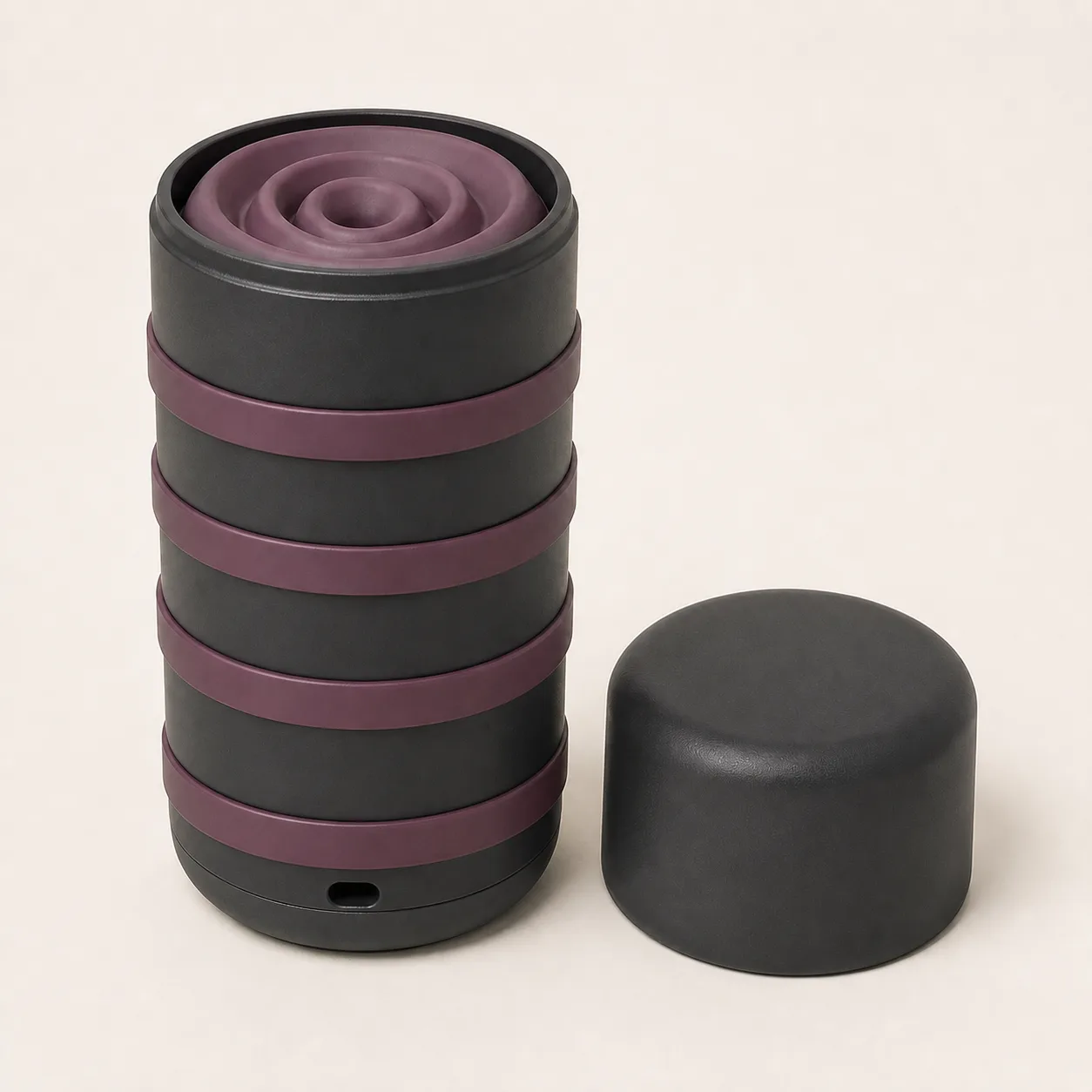
Four-Band Compression-Grip Manual Stroker
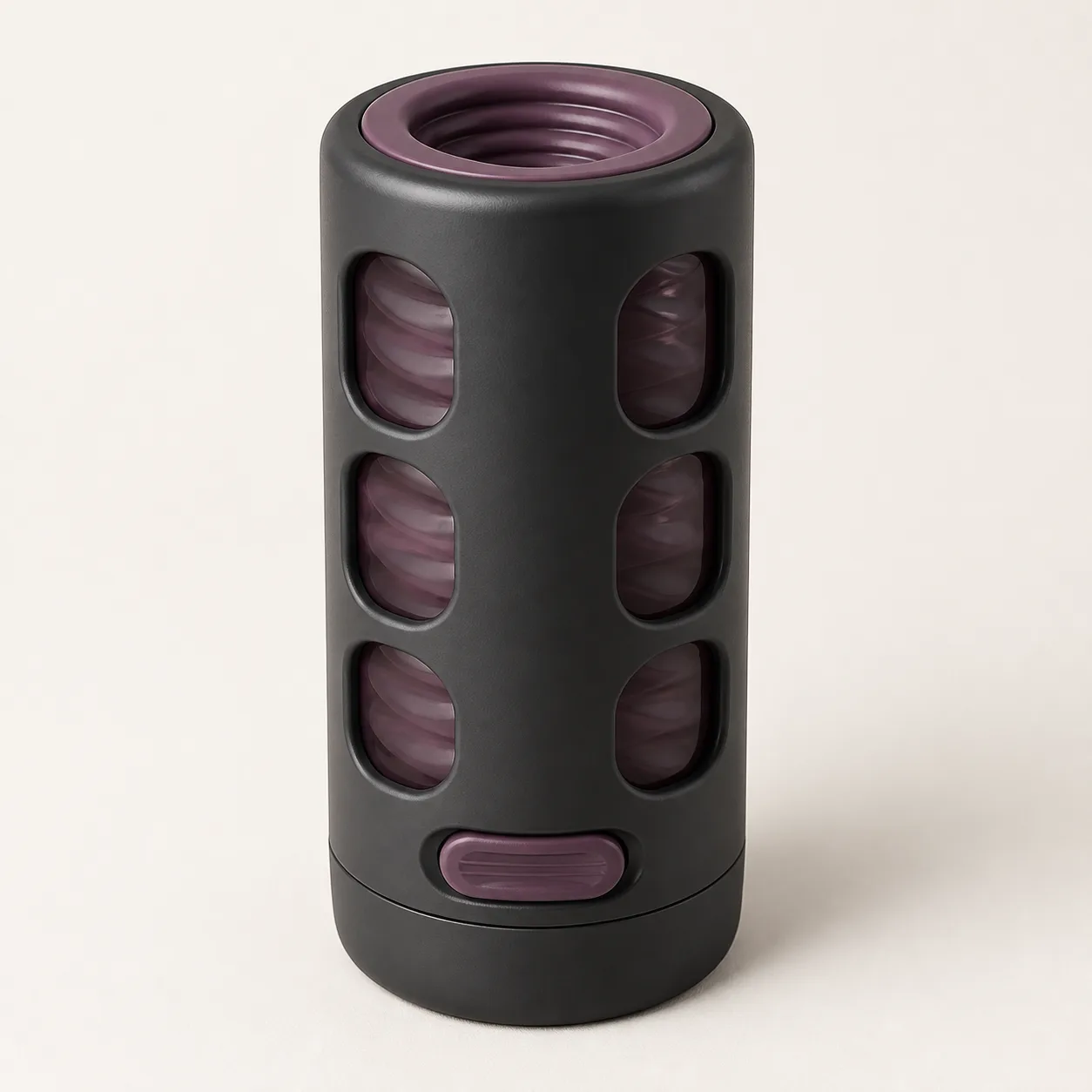
A manual stroker concept with a cylindrical shell, four compression-grip bands, removable abstract-wave liner, lower vent and separate protective end cap.
49,99 $
200 in stock
Make the four grip bands the central comparison point
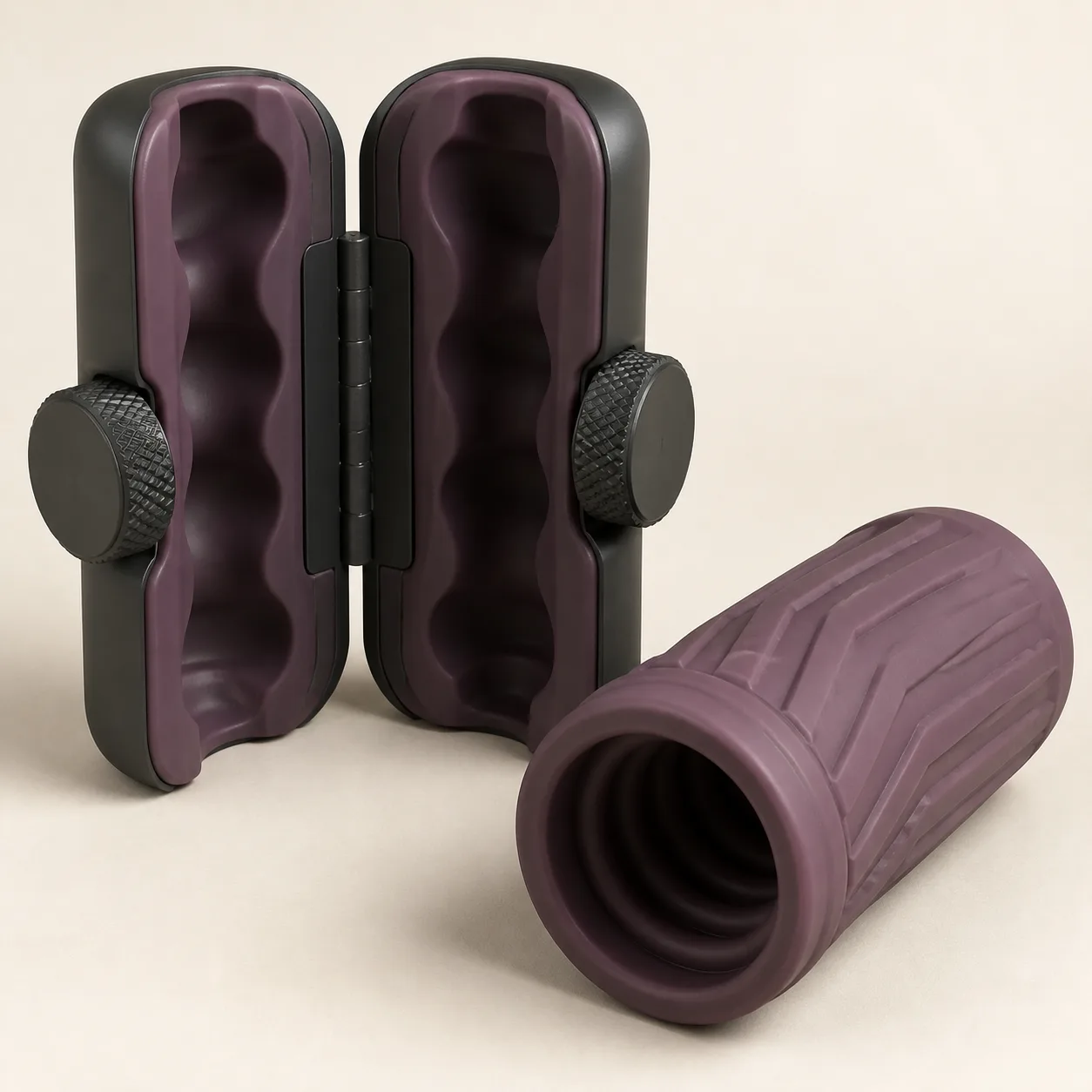
This four-band compression-grip manual stroker is a non-powered concept built from one charcoal cylindrical shell, exactly four separate smoky-plum compression bands, one removable liner with an abstract concentric-wave entry, one lower oval vent and one separate closed end cap.

The image defines visible architecture only. It does not confirm usable dimensions, materials, liner texture, pressure adjustment, vent behavior, cleaning limits or production readiness.
Confirm every removable and fixed component
The proposed assembly includes shell, liner and cap. Sample approval must determine whether the four bands are fixed, replaceable or integral to the shell and whether the lower vent has an internal valve, open passage or decorative purpose.
Request an exploded drawing and component-level bill of materials rather than inferring construction from appearance.
Measure shell and channel from independent datums
Record shell height, outside diameter, wall thickness, entry lip, cap overlap and vent position. Measure the liner’s relaxed channel length, entry diameter, minimum internal width and external dimensions using a defined low-force method.
Any future size guidance must use production measurements and tolerances, not the rendered proportions.
Calibrate four band zones one by one
Label bands B1-B4 from top to bottom. Record width, thickness, hardness, position and compression travel for each zone, then check whether hand pressure reaches the liner evenly or creates a local hard edge.
Band count does not prove four independent pressure settings. Functional claims remain pending sectioned samples and measured tests.
Map pressure without making performance promises
Use a compliant test mandrel and repeatable hand-force fixture to record channel deformation at several grip loads and positions. Note recovery time, hysteresis and whether the shell or liner shifts after repeated compression.
Reject collapse that traps the liner, exposes a seam, blocks removal or requires excessive release force.
Inspect the abstract concentric-wave entry
Measure each visible wave radius, height and transition into the internal channel. Look for flash, pits, tears, tack, thin spots and undercuts that retain residue or resist drying.
The non-anatomical entry design avoids realistic imagery but still requires the same surface, seam and cleanability inspection as the entire liner.
Verify liner retention and controlled removal
Document how the liner seats against the upper rim and lower shell. Apply bounded axial and rotational loads, then confirm removal can occur without overstretching the entry or pulling against the vent.
Retention must be strong enough for intended handling while remaining simple enough for complete disassembly and cleaning.
Determine what the oval vent actually controls
Trace the opening through the shell and liner interface, record its cross-section and test airflow with the cap both installed and removed. If a valve exists, map open, restricted and closed states under repeatable pressure.
No suction, vacuum or pressure-release claim is accepted until the production sample demonstrates the mechanism safely and consistently.
Test the end cap as protection, not decoration
Measure cap engagement, pull-off force, edge radius and tolerance after repeated fitting cycles. Confirm it protects the entry from dust without compressing, sealing dampness into or chemically interacting with the liner.
The cap is shown as a separate component and must not be confused with a powered base or pressure controller.
Confirm shell and liner materials separately
Request traceable declarations for the rigid shell, four bands, liner, pigments and any valve or bonding agent. Check hardness, odor, tack, migration, restricted-substance evidence and batch consistency for each component.
TPE, silicone, ABS, body-safe and hypoallergenic labels remain pending documentation and independent review.
Use conservative manual handling
Inspect the liner, entry, bands, vent and cap before use. Begin with minimal grip pressure, generous verified-compatible lubricant and slow movement while keeping a direct withdrawal path.
Stop at pain, numbness, bleeding, unexpected resistance, loss of control or visible product change. Persistent symptoms require appropriate medical advice.
Prevent excessive compression and trapped pressure
Keep fingertips spread across broad band areas and avoid crushing one narrow zone. The vent should remain accessible, and grip force should be reduced immediately if resistance or internal pressure rises unexpectedly.
Do not close an unverified vent, use clamps around the shell or rely on the cap to regulate pressure.
Disassemble and clean the entire liner path
Remove the liner only through the approved method and follow validated cleaner, water, temperature and contact-time limits. Clean every entry wave, channel surface, lower end, shell interior, band edge, vent passage and cap recess.
Boiling, bleach, machine washing, prolonged soaking and abrasive tools are excluded unless exact material evidence supports them.
Dry before reassembly and sealed storage
Dry liner inside and out, then inspect it separately from the shell. Confirm the vent path, band gaps and cap are moisture-free before loose reassembly or storage in a clean protective pouch.
Any persistent odor, tack, swelling, crack, seam opening or internal residue removes the sample from service.
Build landed price from a manual category reference
An Alibaba male-masturbator category page displayed one manual textured product at USD 4.09 to 4.39 with MOQ 1. It is a broad category benchmark only and does not identify this four-band shell, liner or vent mechanism.
The public procurement benchmark supports an EUR 49.99 planning price after provisional allowance for China-origin freight, exact-sample measurement, material review, band compression mapping, liner retention, vent, cap, cleanability, lubricant compatibility and packaging tests, discreet fulfilment and expected intimate-product handling loss. Exact supplier, quote, MOQ, specifications, packed weight, freight, duty, tax, certification, payment terms and lead time remain pending.
Frequently asked questions
How many compression bands are shown?
The concept has exactly four separate smoky-plum bands around the charcoal shell.
Does the product contain a motor?
No. It is a manual non-powered concept with no battery, cable or electronic controls.
Is the liner removable?
The design proposes a removable liner, but its final retention and release method require sample verification.
What does the lower vent do?
Its airflow and pressure function remain unconfirmed until the exact internal mechanism is inspected and tested.
Which lubricant is compatible?
Use only a lubricant validated against the documented production liner through supplier guidance and patch testing.
Can the cap be fitted while the liner is damp?
No. Every liner surface, shell recess, vent and cap must be completely dry before closed storage.
Reviews
There are no reviews yet.